What is Agentic AI
Agentic AI is a type of artificial intelligence designed to act with autonomy — meaning it can plan, make decisions, and carry out multi-step tasks with limited human supervision rather than just responding to single prompts.
Think of it as the shift from:
- Traditional AI: “Tell me what to do.”
- Generative AI: “Create something based on my request.”
- Agentic AI: “Here’s the goal — figure out the steps and execute them.”
🧠 Simple definition
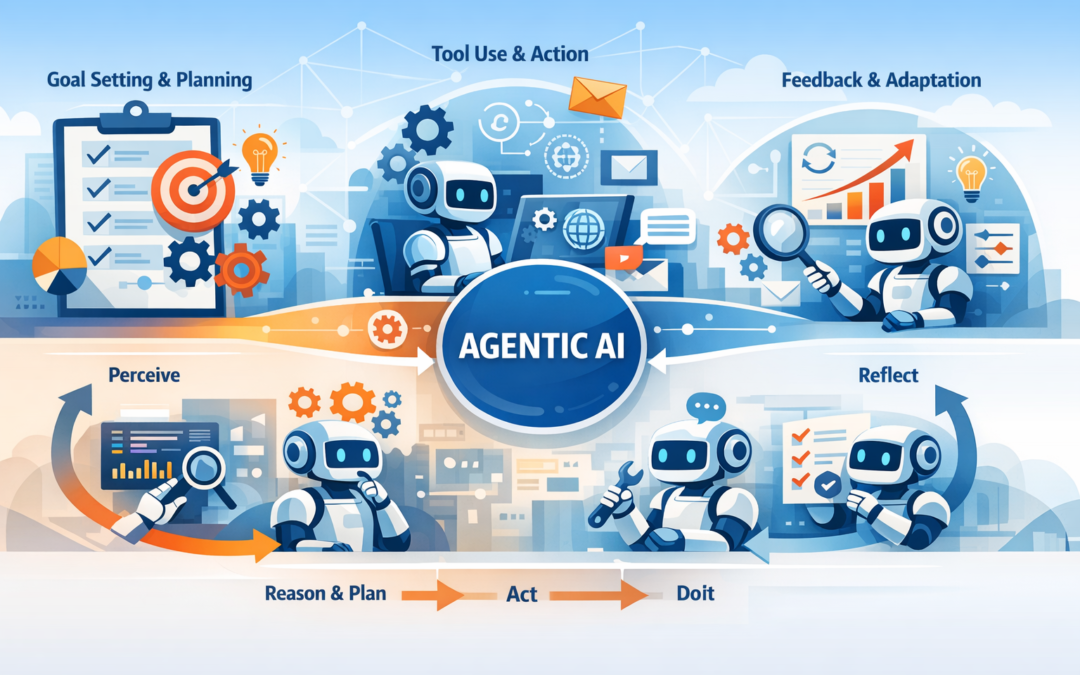
Agentic AI refers to AI systems made up of AI agents that can:
- reason about goals
- plan workflows
- use tools or external systems
- take actions automatically
- adapt based on feedback or changing conditions
This moves AI from just generating answers to performing tasks.
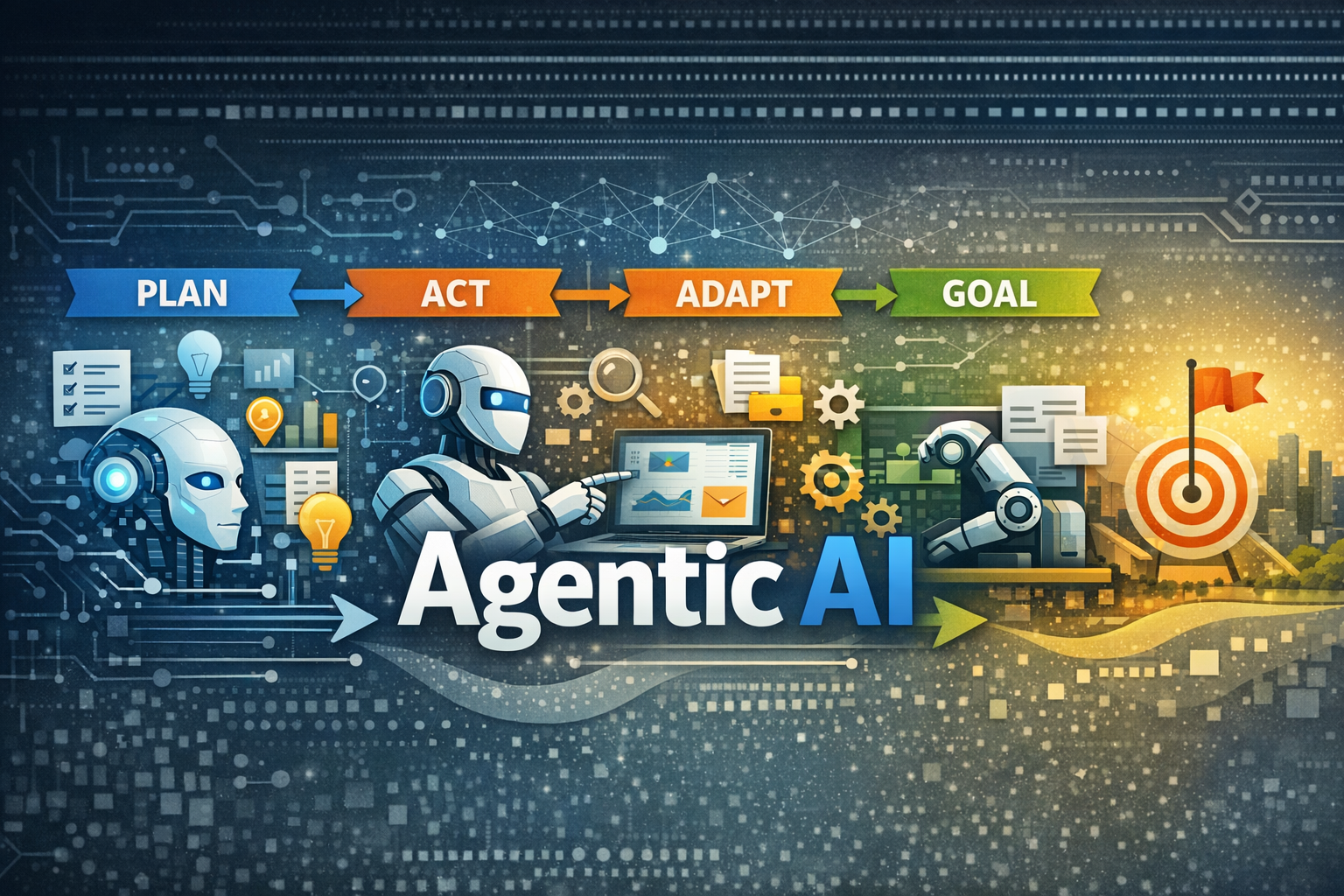
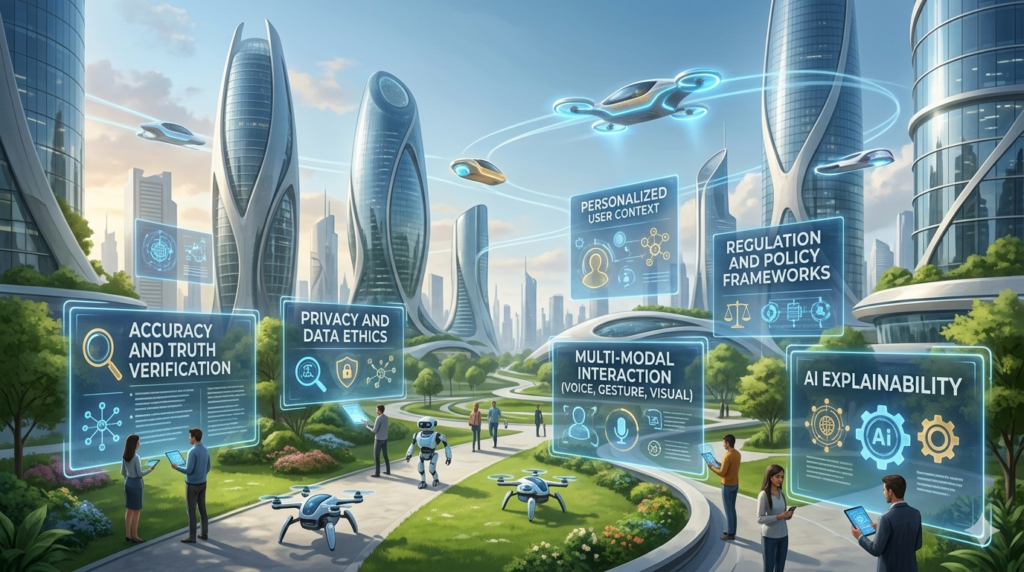
Visual layout presenting key concepts related to Agentic AI.
⚙️ Core characteristics of agentic AI
Most definitions highlight these features:
1️⃣ Autonomy
The system can operate without constant human input, handling tasks end-to-end once given a goal.
2️⃣ Planning & reasoning
Instead of a single response, it breaks problems into steps and decides how to proceed.
3️⃣ Tool use
Agentic systems can interact with APIs, databases, software, or other tools to gather information or take actions.
4️⃣ Adaptability
Agents can learn from feedback and adjust strategies over time.
5️⃣ Goal-driven behavior
The AI focuses on achieving outcomes rather than only generating text.
🆚 Agentic AI vs. regular AI
| Type | How it works | Example |
|---|---|---|
| Traditional automation | Fixed rules | Auto-reply email |
| Generative AI | ||
| Agentic AI | Plans + acts | Books meetings, gathers data, updates records automatically |
🧩 Real-world examples
- A customer support agent that checks account data, follows workflows, and completes actions instead of only answering questions.
- Systems coordinating multiple specialized agents to complete larger tasks together.
- Enterprise tools that monitor systems and take predefined actions with oversight.
🏗️ How agentic AI usually works
- Perceive → gather data
- Reason → analyze and plan
- Act → use tools or perform actions
- Reflect → evaluate results and adjust
This repeated cycle allows longer workflows than simple prompt-response systems.
⚠️ Why people are talking about it now
Experts see agentic AI as the next step after generative AI because it moves AI:
- from knowledge → to action
- from answering → to executing workflows
At the same time, it introduces new challenges around safety, governance, and oversight because autonomous systems can make decisions independently.
🧠 One-sentence explanation
Agentic AI = AI that can set plans and take actions toward goals, not just generate responses.
Agentic AI FAQ
Q1: What is Agentic AI?
A: Agentic AI is a type of artificial intelligence designed to act autonomously. It can plan, make decisions, and complete multi-step tasks with minimal human supervision, going beyond traditional or generative AI that only responds to prompts.
Q2: How is Agentic AI different from regular AI?
A: Unlike traditional AI, which follows fixed rules, or generative AI, which creates content based on instructions, Agentic AI plans workflows, uses tools, and executes actions automatically to achieve goals.
Q3: What are the main features of Agentic AI?
A: Core features include:
- Autonomy – Operates without constant human input.
- Planning & reasoning – Breaks tasks into steps and decides the next actions.
- Tool use – Interacts with software, APIs, and databases.
- Adaptability – Learns from feedback and adjusts strategies.
- Goal-driven behavior – Focuses on completing outcomes, not just generating text.
Q4: Can you give examples of Agentic AI in the real world?
A: Examples include:
- Customer support agents that gather account data and complete workflows automatically.
- Systems coordinating multiple AI agents for complex tasks.
- Enterprise monitoring tools that detect issues and act on them autonomously.
Q5: How does Agentic AI work?
A: Agentic AI works in cycles:
- Perceive – Gather relevant data.
- Reason – Analyze information and plan next steps.
- Act – Execute tasks using tools or systems.
- Reflect – Evaluate outcomes and improve future actions.
Q6: Why is Agentic AI gaining attention now?
A: Experts view it as the next evolution after generative AI, shifting AI from knowledge and responses to independent action. It promises higher efficiency but also raises questions about safety, oversight, and governance.
Q7: Do I need technical skills to use Agentic AI?
A: While understanding workflows and AI concepts helps, many Agentic AI tools are designed to be user-friendly, enabling businesses to automate tasks without deep technical knowledge.
Q8: What are the benefits of using Agentic AI?
A: Benefits include:
- Automating repetitive or complex tasks.
- Improving efficiency and decision-making.
- Reducing reliance on human supervision for multi-step workflows.
- Enabling AI-driven goal completion rather than just information retrieval.
Q9: Is Agentic AI safe to use?
A: Safety depends on proper oversight, governance, and ethical implementation. Autonomous AI can make independent decisions, so monitoring and clear policies are essential.
Q10: Can Agentic AI replace human jobs?
A: Agentic AI is designed to assist and automate tasks rather than fully replace humans. It works best when augmenting human roles, improving efficiency, and handling repetitive or structured workflows.