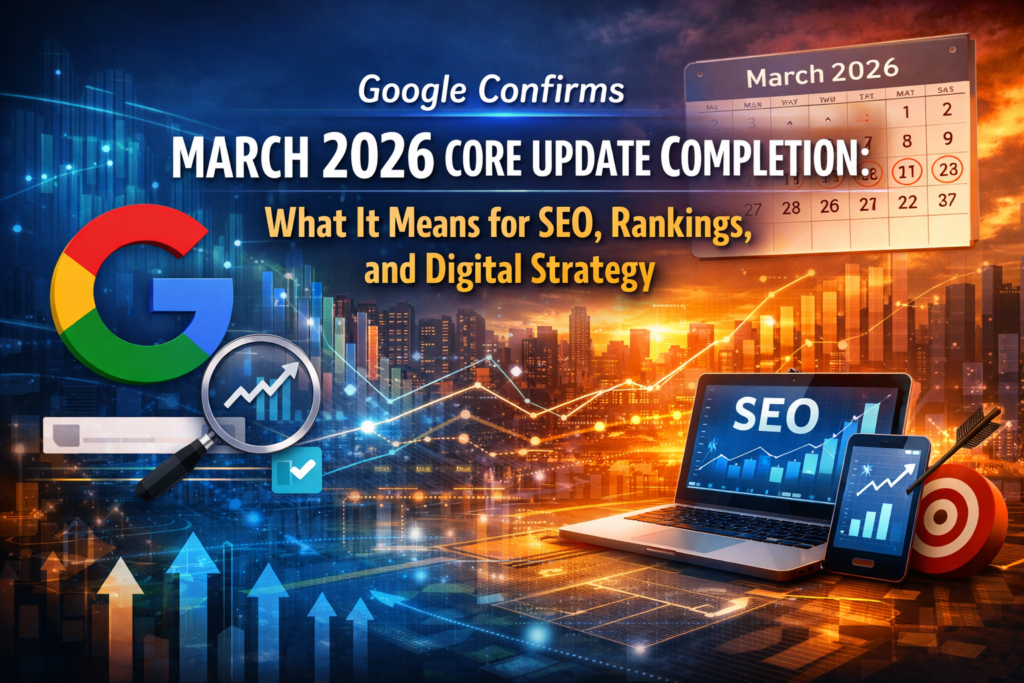
Google Confirms March 2026 Core Update Completion: What It Means for SEO, Rankings, and Digital Strategy
Google has officially confirmed that its March 2026 Core Update has completed its rollout—marking another significant recalibration of search rankings across the global digital ecosystem.
Launched on March 27, 2026, and finalized on April 8, 2026, this update took approximately 12 days to fully deploy, aligning with Google’s expected rollout window and signaling a faster iteration compared to previous updates.
But beyond the timeline, the real question for businesses, marketers, and SEO leaders is this:
What actually changed—and what should you do next?
A “Regular” Core Update—But With Strategic Implications
Google described the March 2026 update as a “regular core update”, designed to improve how content is evaluated and surfaced in search results.
No major announcement. No detailed blog. No explicit ranking factors revealed.
However, this silence is strategic.
Core updates are never about a single ranking signal—they represent system-wide recalibration. Google is refining how it interprets:
- Content relevance
- User satisfaction signals
- Authority and trustworthiness
- Content depth and originality
In short, this isn’t just an update—it’s a quality reset across the web.
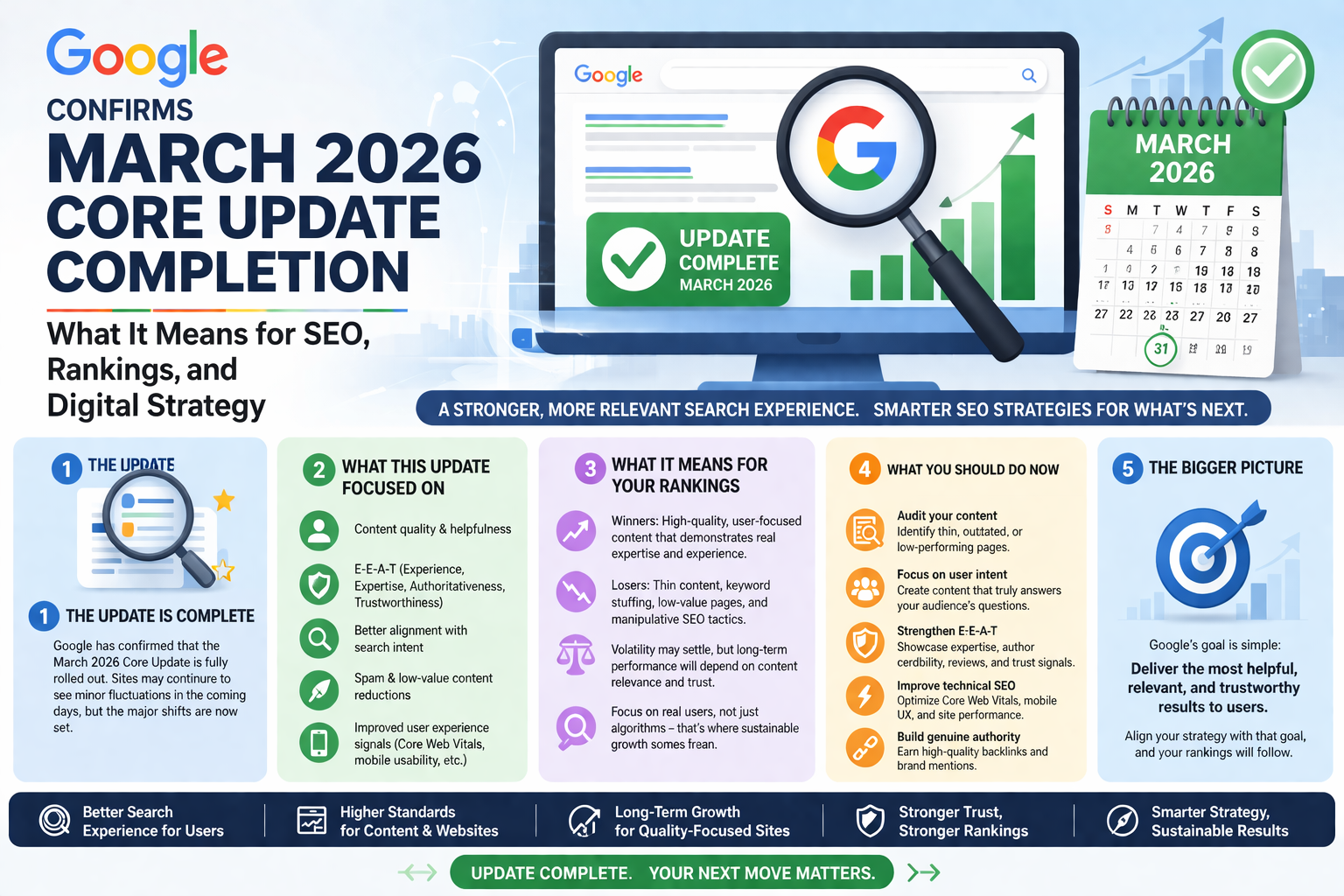
Visual outline of search system updates and ranking context.
March 2026: A High-Intensity Algorithm Month
March wasn’t just active—it was strategically aggressive in terms of Google’s ranking evolution.
Within just five weeks, three major updates occurred:
1. February 2026 Discover Core Update
- Completed: February 27
- Duration: 22 days
- Focus: Google Discover content ecosystem
2. March 2026 Spam Update
- Completed: March 25
- Duration: Less than 20 hours
- Fastest spam update recorded
3. March 2026 Core Update
- Started: March 27
- Completed: April 8
- Duration: 12 days
This sequence is not random.
Think of it as Google cleaning the foundation before rebuilding the structure.
The spam update likely removed low-quality or manipulative signals, allowing the core update to re-evaluate ranking quality with a cleaner dataset.
How This Core Update Compares
Here’s how the March 2026 rollout stacks up against recent updates:
- March 2026: 12 days
- December 2025: 18 days
- June 2025: 17 days
- March 2025: 14 days
- December 2024: 6 days
This makes it the second-fastest core update in recent cycles, suggesting increased efficiency in Google’s deployment systems.
What This Means for Your Website Performance
Now that the rollout is complete, data analysis becomes critical.
When to Check Your Data
Google recommends waiting at least one full week post-rollout before making conclusions. This allows rankings and user behavior to stabilize.
What to Compare
- Pre-update baseline: Before March 27
- Post-update performance: After April 8
Be cautious:
Ranking fluctuations between March 24–27 may be influenced by the spam update, not just the core update.
Ranking Drops Don’t Mean Penalties
One of the biggest misconceptions in SEO is assuming that ranking drops equal penalties.
That’s not how core updates work.
Instead, Google is:
- Re-evaluating content quality at scale
- Comparing your content against competitors
- Re-ranking based on evolving relevance signals
So if your rankings dropped, it doesn’t mean you did something wrong—it means others may now be doing it better.
Strategic SEO Takeaways
Here’s the real value—how to respond like a high-level operator:
1. Shift From “Optimization” to “Experience Engineering”
SEO is no longer just keywords and backlinks.
It’s about end-to-end user satisfaction.
Ask:
- Does your content fully answer the user’s intent?
- Is it better than the top 3 results?
2. Double Down on EEAT (Experience, Expertise, Authority, Trust)
Google continues to reward:
- Real expertise
- Transparent authorship
- Brand credibility
If your site lacks trust signals, expect volatility.
3. Content Depth > Content Volume
Thin content is being filtered out faster than ever.
Focus on:
- Comprehensive guides
- Structured, scannable formats
- Data-backed insights
4. Audit Pages That Lost Traffic
Don’t panic—diagnose.
Look for:
- Declining CTR
- Lower engagement
- Outdated information
Then rebuild—not just tweak.
5. Align With Search Intent Evolution
Search intent is dynamic.
What ranked last year may no longer satisfy users today.
Reassess:
- Informational vs transactional intent
- Content freshness
- SERP feature alignment
Looking Ahead: Continuous Core Updates Are the New Normal
Google has already indicated that smaller core updates are happening continuously, even between major announcements.
This means:
- There is no “safe zone” in SEO
- Rankings are always in motion
- Adaptability is now your biggest advantage
Final Insight from Roland Diaz
“SEO is no longer about chasing the algorithm—it’s about becoming the result Google wants to rank.”
The March 2026 Core Update reinforces a clear direction:
Build real value. Build trust. Build authority.
Because in today’s search landscape,
the best content doesn’t just rank—it wins.