Search Result
by iamrolanddiaz | Apr 10, 2026 | Principeng Hari

Find the best match of your interest
Google has officially confirmed that its March 2026 Core Update has completed its rollout—marking another significant recalibration of search rankings across the global digital ecosystem.
Launched on March 27, 2026, and finalized on April 8, 2026, this update took approximately 12 days to fully deploy, aligning with Google’s expected rollout window and signaling a faster iteration compared to previous updates.
But beyond the timeline, the real question for businesses, marketers, and SEO leaders is this:
What actually changed—and what should you do next?
Google described the March 2026 update as a “regular core update”, designed to improve how content is evaluated and surfaced in search results.
No major announcement. No detailed blog. No explicit ranking factors revealed.
However, this silence is strategic.
Core updates are never about a single ranking signal—they represent system-wide recalibration. Google is refining how it interprets:
In short, this isn’t just an update—it’s a quality reset across the web.
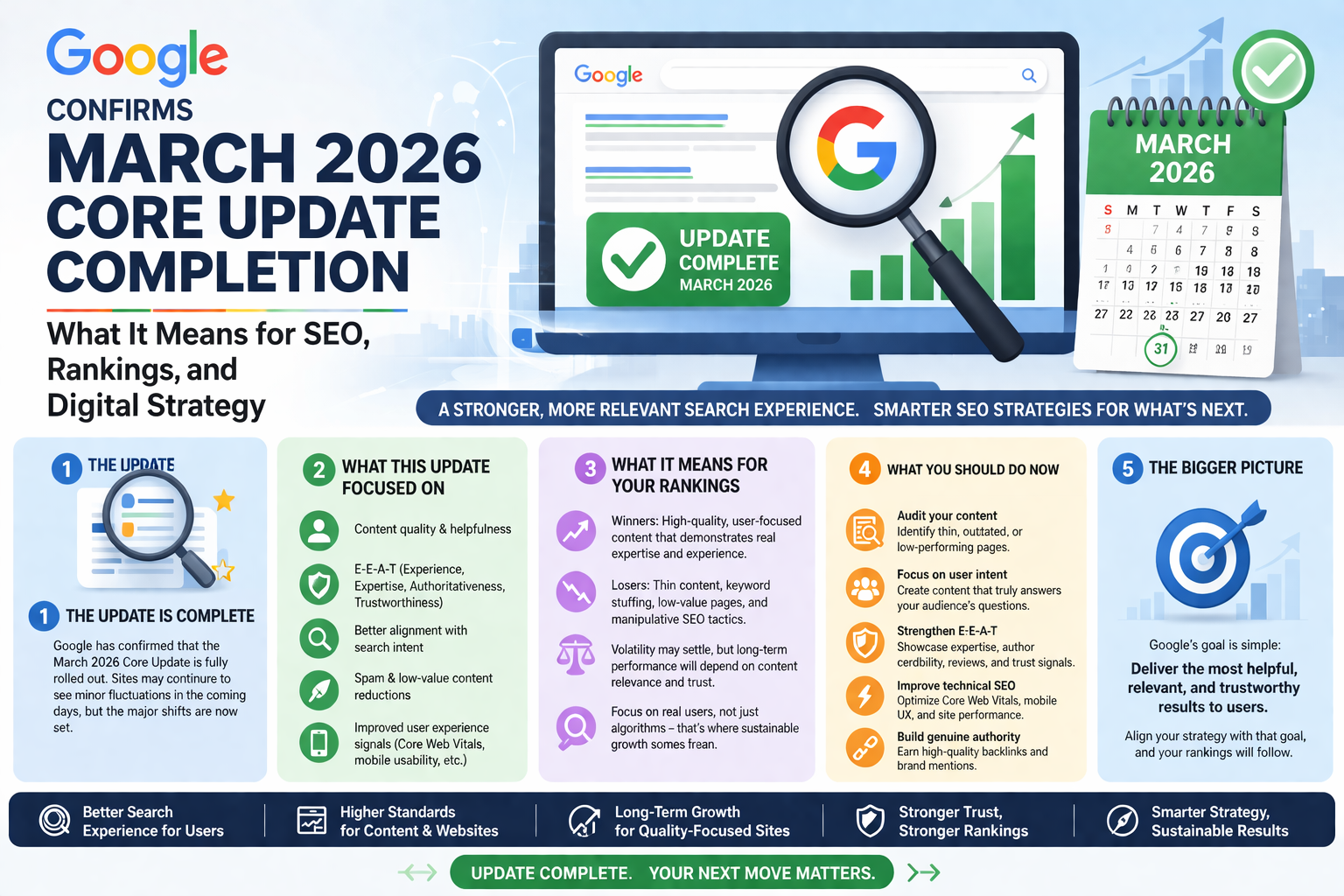
Visual outline of search system updates and ranking context.
March wasn’t just active—it was strategically aggressive in terms of Google’s ranking evolution.
Within just five weeks, three major updates occurred:
This sequence is not random.
Think of it as Google cleaning the foundation before rebuilding the structure.
The spam update likely removed low-quality or manipulative signals, allowing the core update to re-evaluate ranking quality with a cleaner dataset.
Here’s how the March 2026 rollout stacks up against recent updates:
This makes it the second-fastest core update in recent cycles, suggesting increased efficiency in Google’s deployment systems.
Now that the rollout is complete, data analysis becomes critical.
Google recommends waiting at least one full week post-rollout before making conclusions. This allows rankings and user behavior to stabilize.
Be cautious:
Ranking fluctuations between March 24–27 may be influenced by the spam update, not just the core update.
One of the biggest misconceptions in SEO is assuming that ranking drops equal penalties.
That’s not how core updates work.
Instead, Google is:
So if your rankings dropped, it doesn’t mean you did something wrong—it means others may now be doing it better.
Here’s the real value—how to respond like a high-level operator:
SEO is no longer just keywords and backlinks.
It’s about end-to-end user satisfaction.
Ask:
Google continues to reward:
If your site lacks trust signals, expect volatility.
Thin content is being filtered out faster than ever.
Focus on:
Don’t panic—diagnose.
Look for:
Then rebuild—not just tweak.
Search intent is dynamic.
What ranked last year may no longer satisfy users today.
Reassess:
Google has already indicated that smaller core updates are happening continuously, even between major announcements.
This means:
“SEO is no longer about chasing the algorithm—it’s about becoming the result Google wants to rank.”
The March 2026 Core Update reinforces a clear direction:
Build real value. Build trust. Build authority.
Because in today’s search landscape,
the best content doesn’t just rank—it wins.
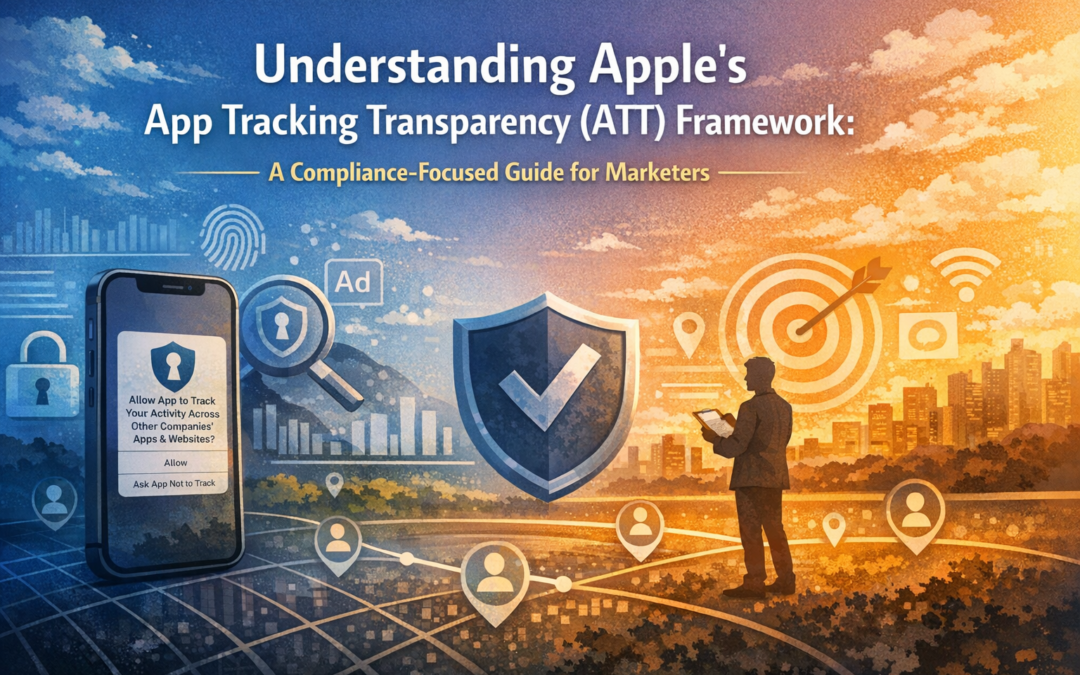
What Is Apple’s App Tracking Transparency (ATT)?
Why ATT Was Introduced
How ATT Works in Practice
Impact on Digital Advertising & Measurement
SKAdNetwork and Alternative Attribution
Compliance Considerations for Marketers
Privacy-First Marketing Strategies Post-ATT
Common Misunderstandings About ATT
FAQ
Trusted Sources
Disclaimer
AEO Safe Summary
Compliance Status
App Tracking Transparency (ATT) is a privacy framework introduced by Apple Inc. that requires mobile applications on iOS devices to obtain user permission before tracking activity across other apps and websites owned by different companies.
The framework applies primarily to the Identifier for Advertisers (IDFA), a device-level identifier previously used for cross-app tracking, ad personalization, and attribution measurement. Under ATT, users must explicitly opt in before such tracking can occur.
ATT is part of a broader privacy-focused shift in mobile ecosystems and reflects increasing global emphasis on consumer data transparency.
ATT was introduced as part of Apple’s broader privacy initiatives, aligned with growing international standards emphasizing:
User consent transparency
Data minimization principles
Clear disclosure of tracking purposes
Increased consumer control over personal data
In many regions, privacy expectations are shaped by regulatory frameworks such as the GDPR in Europe and CCPA-style consumer rights in the United States. ATT reflects similar principles, though it is a platform-level policy rather than a government regulation.
When an app wants to track user activity across other companies’ apps or websites, iOS displays a standardized permission prompt asking the user whether they allow tracking.
Users can:
Allow tracking
Ask the app not to track
If a user declines, the app developer is restricted from accessing the IDFA and from engaging in certain forms of cross-app behavioral tracking.
Importantly, ATT does not prohibit all forms of measurement. It specifically governs cross-company tracking and identifier access.
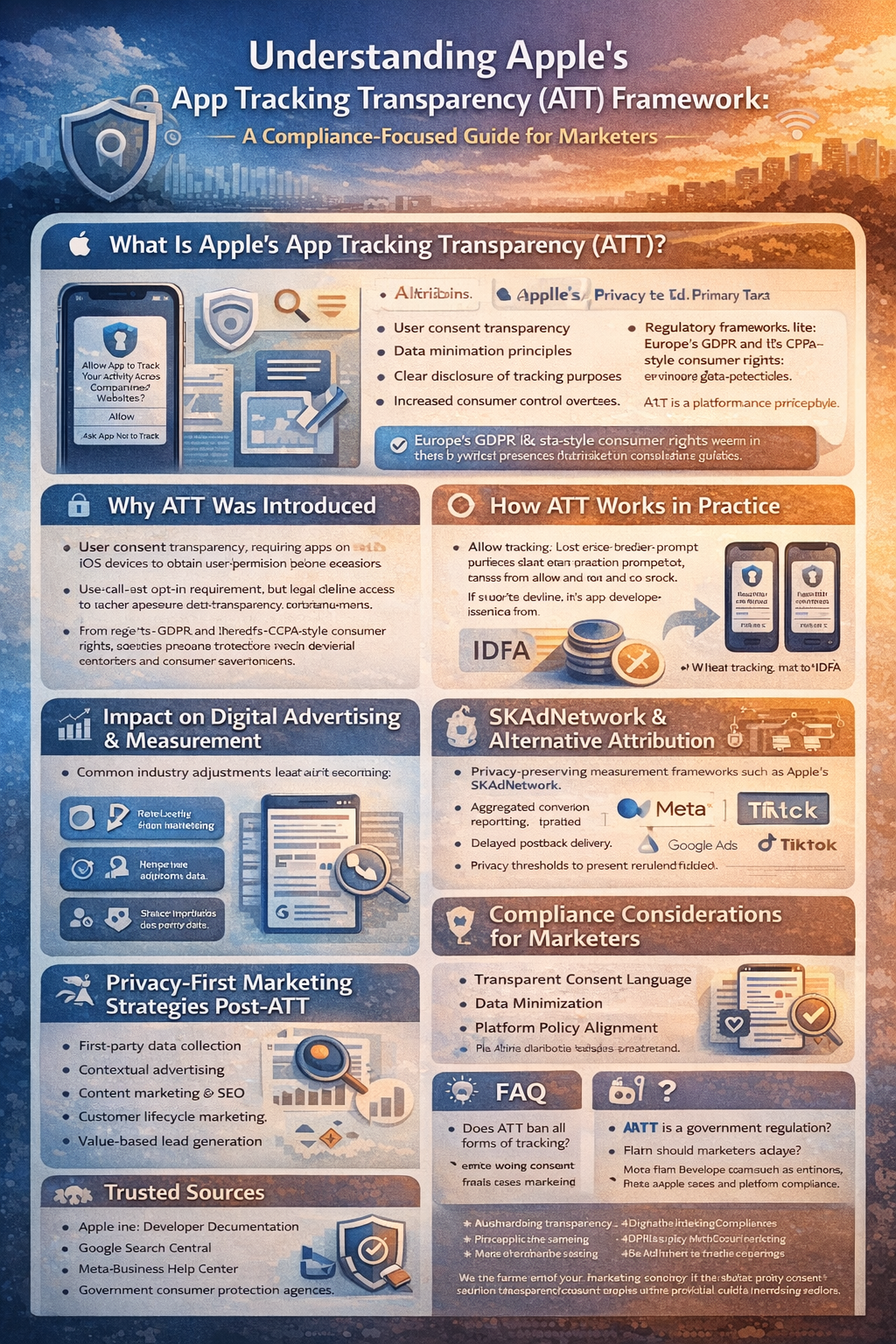
Structured infographic presenting sections related to mobile privacy permissions and aggregated attribution environments.
ATT significantly changed how mobile advertising campaigns are measured and optimized.
Common industry adjustments include:
Reduced availability of device-level attribution data
Increased reliance on aggregated reporting
Shortened attribution windows in many cases
Greater emphasis on first-party data strategies
Results vary depending on region, industry, audience behavior, and campaign structure. Performance outcomes depend heavily on implementation quality and platform compliance.
To support privacy-preserving measurement, Apple introduced SKAdNetwork, an attribution framework designed to provide aggregated campaign performance data without revealing user-level information.
Key characteristics of SKAdNetwork:
Aggregated conversion reporting
Limited granularity
Delayed postback delivery
Privacy thresholds to prevent re-identification
Marketers often combine SKAdNetwork reporting with:
First-party analytics
Contextual targeting strategies
Modeled attribution approaches
Platform-native analytics tools
Measurement methodologies continue evolving as privacy standards and platform rules change.
When operating in environments affected by ATT, businesses should consider:
Permission prompts and pre-prompts should clearly explain data usage in plain language. Avoid manipulative framing or misleading incentives.
Collect only data necessary for stated purposes. Over-collection may increase compliance risks in many jurisdictions.
ATT compliance works alongside advertising platform policies, including:
Google Ads
Meta Platforms (Meta Ads ecosystem)
TikTok
Requirements may vary depending on app category, region, and data practices.
Maintain updated privacy policies and disclosures reflecting:
Tracking practices
Data sharing practices
Third-party SDK usage
User opt-out rights
In many jurisdictions, transparency documentation is a legal expectation, not merely a best practice.
Rather than relying heavily on cross-app tracking, many organizations have shifted toward:
Stronger first-party data collection (with clear consent)
Contextual advertising
Content marketing and SEO
Customer lifecycle marketing
Value-based lead generation
These approaches often emphasize trust-building and long-term audience engagement instead of short-term data exploitation.
“ATT completely eliminates advertising.”
Not accurate. Advertising continues, but measurement and personalization methods have changed.
“ATT applies globally in the same way.”
ATT applies to iOS devices worldwide, but legal requirements surrounding data usage vary by jurisdiction.
“ATT makes attribution impossible.”
Attribution remains possible through aggregated and modeled frameworks, though granularity may differ from pre-ATT environments.
No. ATT specifically governs cross-company tracking and IDFA access. First-party data collection within an app may still occur, subject to applicable privacy laws and consent requirements.
No. ATT is a platform-level framework implemented by Apple. However, it aligns with broader global privacy trends.
Marketers often adopt privacy-first strategies, enhance first-party data practices, and use aggregated measurement tools such as SKAdNetwork.
Apple Inc. Developer Documentation
Google Search Central
Meta Business Help Center
Federal Trade Commission consumer guidance
Government consumer protection agencies in relevant jurisdictions
This content is provided for general educational purposes only. Digital marketing results vary depending on market conditions, platform rules, audience behavior, and execution.
This content does not constitute legal advice. Compliance requirements vary by jurisdiction, industry, and regulatory framework.
Apple’s App Tracking Transparency (ATT) framework requires apps on iOS devices to obtain user consent before tracking activity across other companies’ apps or websites. It limits access to the IDFA and shifts measurement toward aggregated attribution models such as SKAdNetwork. Marketers typically adapt by prioritizing privacy transparency, first-party data strategies, and platform-compliant measurement approaches.
#AppTrackingTransparency, #DigitalMarketingCompliance, #PrivacyFirstMarketing, #iOSPrivacy, #MobileAdvertising, #DataTransparency, #EthicalMarketing, #SKAdNetwork, #MarketingStrategy, #ConsumerDataProtection
Want to future-proof your marketing strategy in a privacy-first world? Explore more compliance-focused insights and practical digital marketing frameworks designed for evolving platform rules and global data standards. Stay informed, stay ethical, and build strategies that prioritize transparency and long-term trust.
This content is educational and does not provide financial, legal, or business guarantees. All guidance is general and based on commonly available platform information.
Bing Ads (Microsoft Advertising) is a pay-per-click (PPC) platform that lets businesses show ads on Bing search and partner networks. It supports a range of ad types (search, shopping, audience), offers keyword and demographic targeting, and integrates tools to help measure performance. This beginner’s guide teaches you how to start, structure campaigns, and avoid common PPC pitfalls. (50–70 words)
“Bing Ads” refers to Microsoft Advertising, Microsoft’s PPC advertising platform for search results and partner sites. It allows advertisers to bid on keywords and show ads to users searching on Bing, Yahoo, and Microsoft partner properties. The platform also incorporates audience placements on the Microsoft Audience Network and supports product and multimedia ads.
This system works like other search ads platforms — advertisers pay when users click their ads — and it focuses on reaching users with specific intent.
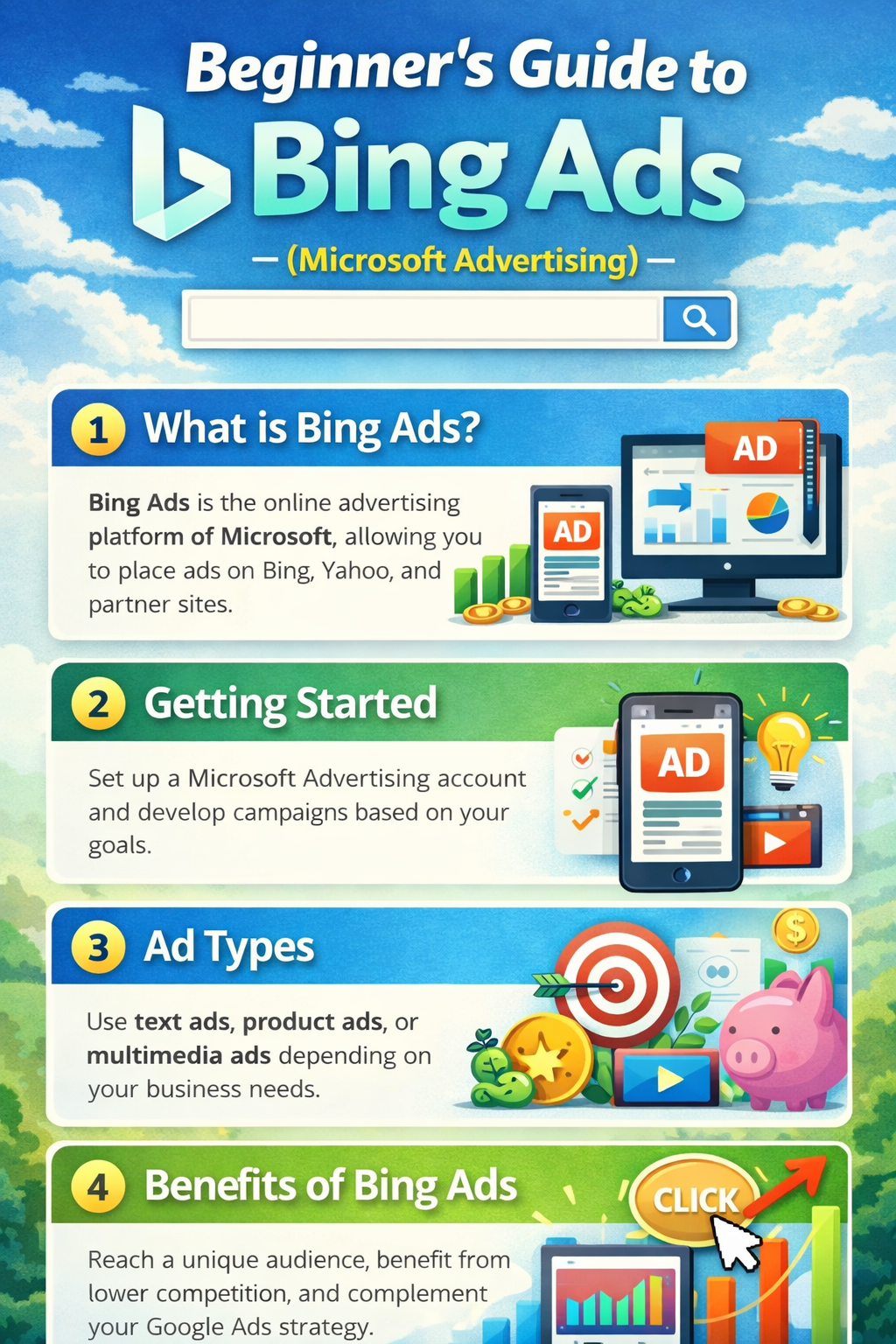
Structured visualization of Microsoft Advertising components and terminology.
Lower competition: Bing often has fewer advertisers than Google, which may mean lower cost-per-click environments.
Rich audience data: The platform supports targeting using LinkedIn profile data and in-market segments.
Easy Google import: You can bring Google Ads campaigns into Microsoft Advertising to expand reach.
Diverse ad formats: Search text ads, Shopping/Product ads, audience ads, and responsive search creatives.
💡 Tip: Start small and incrementally expand your budget as you understand what performs best.
Search Ads: Text ads that show on Bing search results.
Product/Shopping Ads: Show product images, pricing, and details for ecommerce inventory.
Audience Ads: Placements across Microsoft Audience Network (e.g., MSN, Outlook).
Each type serves different parts of the funnel — from discovery to purchase — so choose based on your objectives.
Keyword research: Use Microsoft’s Keyword Planner to find relevant terms.
Match types: Choose broad, phrase, or exact match carefully.
Negative keywords: Prevent wasted spend by excluding irrelevant terms.
Organized ad groups with tightly related keywords help improve relevance and quality measures.
Conversion tracking: Use UET (Universal Event Tracking) to monitor actions like form fills or purchases.
Regular review: Weekly or biweekly, check search terms, bids, and audience performance.
Ad refresh: Rotate headlines or descriptions to maintain relevance.
Data-driven adjustments often support better efficiency than one-off changes.
Microsoft Advertising has content and targeting policies to keep ads safe and compliant. Ensure:
Accurate business info and billing details
No deceptive or prohibited content
Measurement tags implemented with user consent and privacy disclosures
Always check region-specific ad policies inside the Microsoft Advertising portal.
“Lower CPC guaranteed”: Click costs vary widely by industry and keyword.
Import = optimization: Imported Google campaigns often need refinements.
Easy traffic = conversions: Cheap clicks are not always high quality — test and measure carefully.
Beginner’s guide to Bing Ads (Microsoft Advertising) in 2026: setup, ad types, keyword strategy, tracking basics, and compliance-safe best practices for search marketing.
Q1: Is Bing Ads still relevant in 2026?
A: Yes. Microsoft Advertising continues to support search and audience campaigns across Bing and partner properties.
Q2: Can I reuse Google Ads campaigns?
A: You can import them, but it’s often beneficial to tailor them to Microsoft’s audience profiles.
Q3: What’s UET tracking?
A: UET (Universal Event Tracking) helps measure conversions and user actions from your ads.
Microsoft Advertising official support and documentation (general platform guidelines)
PPC industry best practices for search advertising
SEO & digital marketing educational resources
This content is provided for general educational purposes only. Advertising results vary by platform rules, audience behavior, business context, and execution. This content does not constitute legal, financial, or business advice.

Meta Pixel is a browser-based tracking tool provided through Meta Platforms advertising ecosystem. It allows website owners to measure user actions after interacting with ads on platforms such as Facebook and Instagram.
In practical terms, it helps advertisers understand whether users completed actions like purchases, sign-ups, or page views after seeing or clicking an ad. Results vary depending on implementation, audience behavior, and platform attribution models.
In 2026, Meta Pixel operates within a more privacy-focused digital advertising environment. Many regions require transparent data disclosure, user consent mechanisms, and clear opt-out options.
Meta Pixel typically works by:
Due to browser restrictions and privacy updates, many advertisers also explore server-side tracking options such as Conversions API to support more stable measurement. Implementation approaches may vary depending on regional regulations and platform requirements.
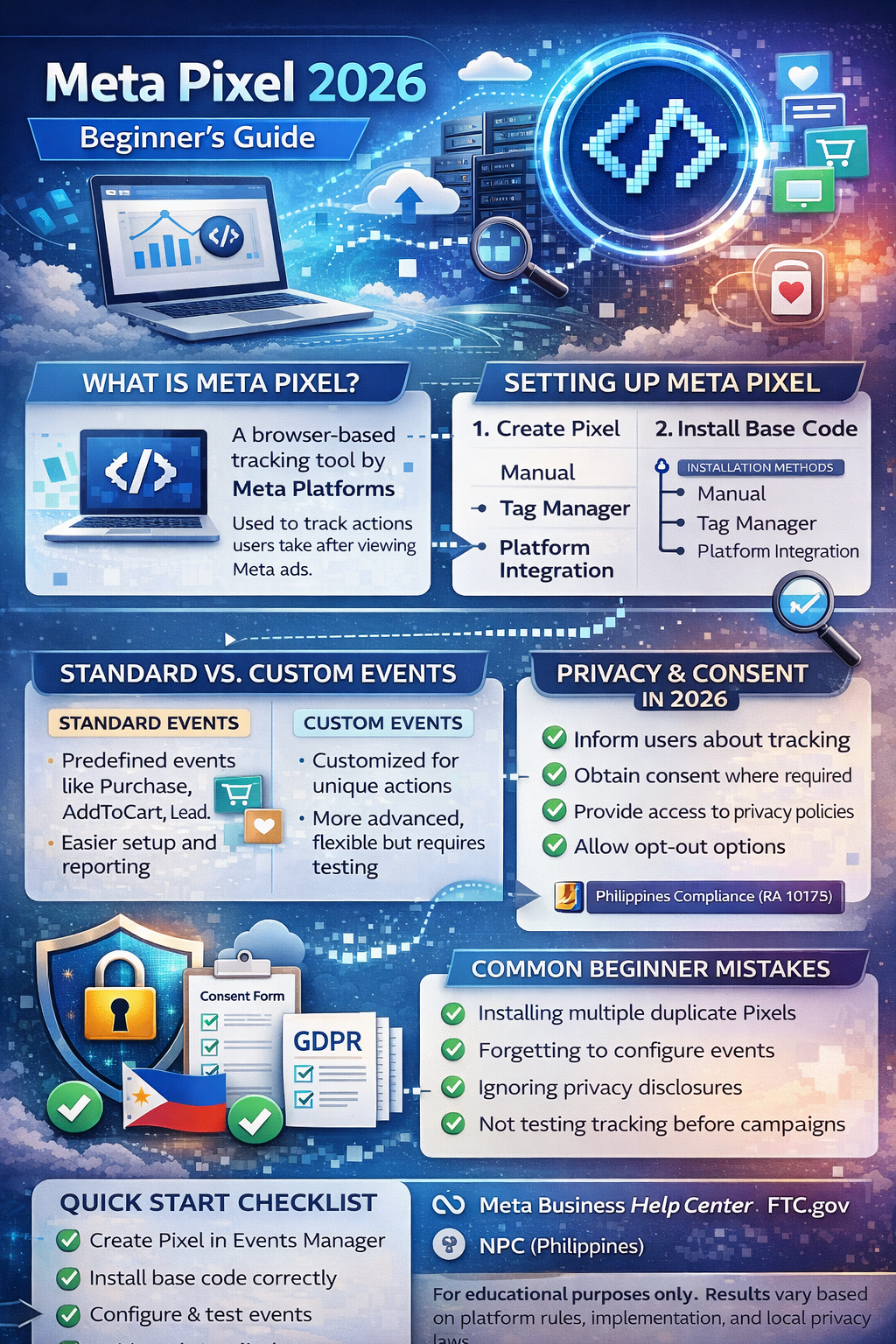
Structured overview of Meta Pixel components and digital measurement framework.
The general setup process often includes:
Some website builders offer built-in integration options. Always review platform documentation before deployment.
Standard events are predefined actions recognized by Meta’s system. Examples commonly include:
PageView
ViewContent
AddToCart
InitiateCheckout
Purchase
Lead
CompleteRegistration
Using standardized naming improves reporting consistency and campaign optimization. However, outcomes depend on accurate implementation and audience relevance.
Standard Events
Recognized automatically in reporting
Easier for beginners
Recommended for common e-commerce or lead actions
Custom Events
Used for unique website interactions
Require manual configuration
Offer flexibility but may require more testing
Choosing between them depends on business goals and technical capability.
Data transparency is increasingly important across many jurisdictions. In many regions, websites using tracking tools must:
Inform users about tracking technologies
Obtain consent where required
Provide access to privacy policies
Allow opt-out or preference management
Frameworks such as GDPR-style and CCPA-style regulations emphasize user rights and data minimization. Businesses operating in the Philippines should also consider the Data Privacy Act (RA 10173).
It is generally recommended to integrate Meta Pixel with a consent management system to align with platform and regional expectations.
Careful setup and regular audits can help improve reporting accuracy.
✔ Create Pixel in Events Manager
✔ Install base code correctly
✔ Configure standard events
✔ Test using Meta diagnostics tools
✔ Connect to ad account
✔ Review privacy policy disclosures
✔ Implement consent management (if required)
✔ Monitor event matching quality
Meta Pixel remains commonly used for ad performance measurement, although many advertisers supplement it with server-side solutions to adapt to evolving privacy environments.
Consent requirements depend on local regulations. In many regions, websites are expected to disclose tracking technologies and obtain user permission where legally required.
Many website platforms provide integration tools that reduce the need for manual coding, though technical validation is still recommended.
Meta Business Help Center
Meta Events Manager
Google Search Central
Federal Trade Commission (FTC) consumer advertising guidance
National Privacy Commission (Philippines)
This content is provided for general educational purposes only. Digital marketing results vary depending on market conditions, platform rules, audience behavior, technical implementation, and execution.
Meta Pixel is a website tracking tool used to measure ad-related actions such as purchases and sign-ups. In 2026, proper installation, event configuration, and privacy compliance are essential. Businesses should implement transparent consent practices and follow platform documentation to ensure accurate measurement and responsible data handling.