AEO Best Practices in 2026
Table of Contents
- Introduction & Scope
- Key Facts Summary
- What Is AEO?
- Who This Information Applies To
- How AEO Works in 2026
- Core Components / Types
- Benefits, Limitations & Risks
- Safety, Compliance & Standards
- Common Misunderstandings
- Evidence, Standards & Sources
- Future Developments in 2026
- Frequently Asked Questions
- Final Considerations & Next Steps
- Final CTA
Section Content Guidelines
1. Introduction & Scope
AEO (Automated Experience Optimization) is transforming digital marketing in 2026 by personalizing user experiences through AI, analytics, and automation. Modern AEO combines UX, CRO, and SEO signals to improve engagement, conversions, and search visibility.
In an era where search engines reward user satisfaction, speed, and interactivity, AEO is essential for businesses seeking to outperform competitors. By leveraging AI-driven personalization, web performance monitoring, and behavioral insights, companies can deliver highly optimized, frictionless experiences.
Link to AEO Hub
Next Funnel Link: Awareness → Consideration
2. Key Facts Summary
-
2026 AEO trends highlight AI-driven personalization, multi-device experience optimization, and data-driven testing.
-
Sites optimized for Core Web Vitals, interactive content, and accessibility outperform competitors in search rankings.
-
Businesses implementing structured AEO frameworks report up to 30% higher engagement and conversion rates.
Download Quick Stats Sheet
Next Funnel Link: Awareness
3. What Is AEO?
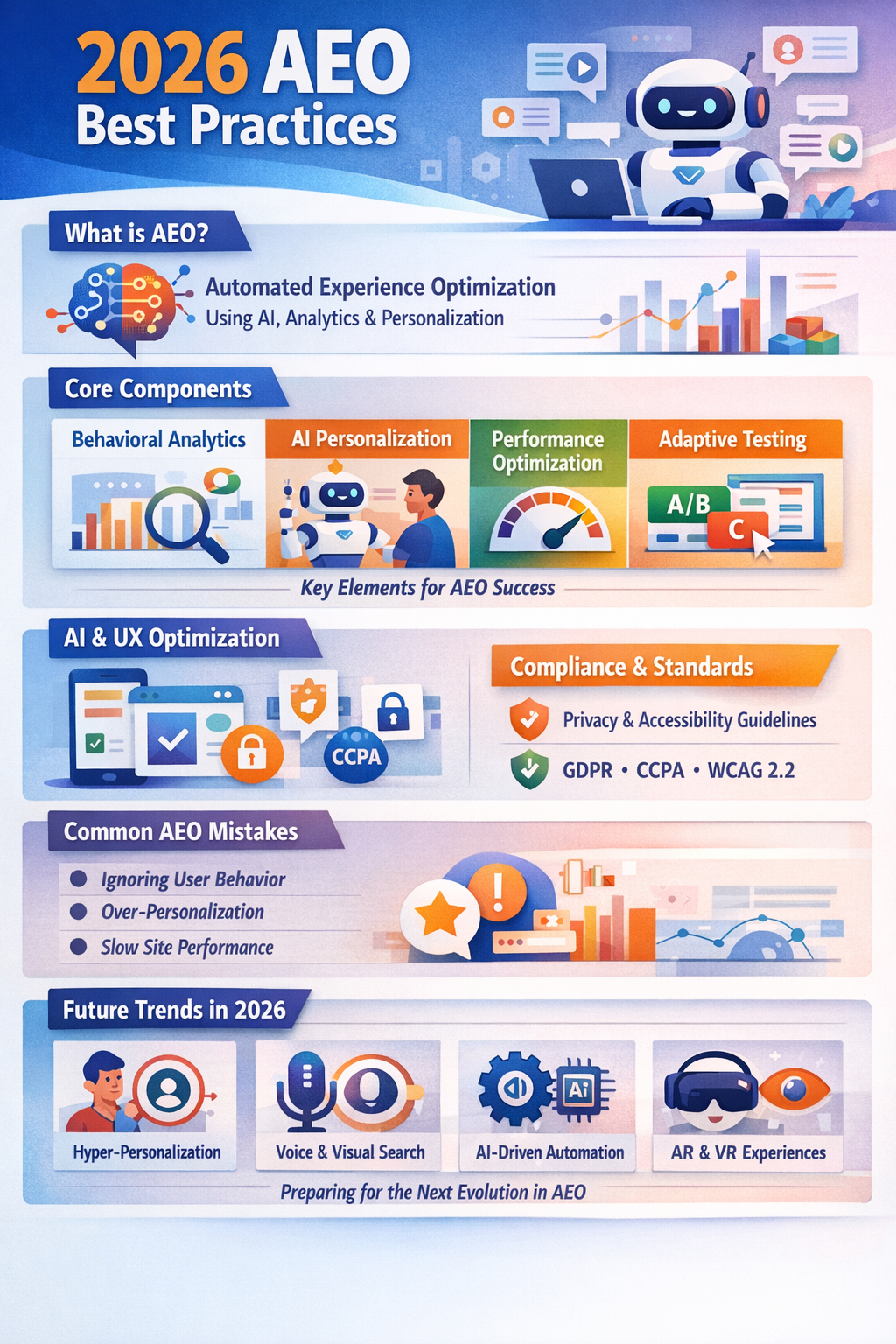
AEO (Automated Experience Optimization) is the practice of using AI, machine learning, and analytics to continuously improve website and app experiences. Unlike standard CRO, AEO focuses on real-time behavioral adaptation, testing multiple variations, and integrating SEO and UX data for optimal performance.
Introductory Guide to AEO
Next Funnel Link: Awareness
Key steps to implement effective AEO in 2026
4. Who This Information Applies To
AEO is relevant for:
-
Digital marketers
-
UX/UI designers
-
SEO and analytics teams
-
eCommerce and SaaS businesses
Join Newsletter for Updates
Next Funnel Link: Awareness
5. How AEO Works in 2026
Key mechanisms:
-
Behavioral Analytics: Track user interactions to predict optimal pathways
-
AI Personalization: Dynamically adjust content, layout, and recommendations
-
Performance Monitoring: Optimize speed, Core Web Vitals, and responsiveness
-
Automated Testing: Run A/B or multivariate experiments automatically
Link to Technical Checklist
Next Funnel Link: Awareness
6. Core Components / Types
-
On-page Experience Optimization: Adaptive content, headings, microcopy
-
Technical AEO: Fast loading, accessibility, responsive design
-
AI & Predictive Analytics: Personalization, segmentation, and recommendations
-
Integration with SEO: Structured data, semantic optimization, and search visibility
Link to Core AEO Toolkit
Next Funnel Link: Awareness
7. Benefits, Limitations & Risks
Benefits:
-
Increased engagement and conversions
-
Improved user satisfaction and retention
-
Enhanced search engine visibility
Limitations:
-
High initial setup cost
-
Requires skilled teams and AI infrastructure
Risks:
-
Poor data quality can reduce effectiveness
-
Misaligned personalization can hurt UX and brand perception
Link to Risk Mitigation Guide
Next Funnel Link: Awareness
8. Safety, Compliance & Standards
While AEO is generally low-risk for YMYL, organizations must:
-
Follow data privacy regulations (GDPR, CCPA)
-
Ensure accessibility standards (WCAG 2.2)
-
Avoid manipulative personalization that can mislead users
Link to Compliance Resource
Next Funnel Link: Awareness
9. Common Misunderstandings
-
“AEO is only for eCommerce” → FALSE, applies to all digital experiences
-
“AI replaces human optimization” → FALSE, requires monitoring and review
-
“Faster always equals better” → FALSE, UX quality and personalization matter
Link to Common Mistakes Guide
Next Funnel Link: Awareness
10. Evidence, Standards & Sources
-
Google Web Vitals & Search Central Guidelines
-
Nielsen Norman Group UX Studies
-
W3C Accessibility Standards
-
Case studies from top AI-driven marketing platforms
Access Curated Source Library
Next Funnel Link: Awareness
11. Future Developments in 2026
-
Hyper-personalization across devices and channels
-
Integration of AI, ML, and analytics for real-time optimization
-
Voice search and AR/VR experiences
-
Automated A/B and multivariate testing across segments
Sign Up for Future Trends Webinar
Next Funnel Link: Awareness
12. Frequently Asked Questions
Q1: How do I start implementing AEO?
A: Begin with behavioral analytics, set KPIs, and adopt AI-powered testing tools.
Q2: Does AEO replace CRO?
A: No, it enhances CRO with automation and real-time data adaptation.
Q3: Is AEO compliant with privacy regulations?
A: Yes, if data collection is transparent and consented.
Visit FAQ Hub
Next Funnel Link: Awareness
13. Final Considerations & Next Steps
AEO is critical for digital competitiveness in 2026. Companies must:
-
Adopt AI-driven personalization
-
Optimize Core Web Vitals and responsiveness
-
Follow privacy and accessibility standards
-
Integrate SEO with experience optimization
Link to Consideration Stage Guide
Next Funnel Link: Consideration