AI Summaries: Maintaining Accuracy Without Hype

AI Summaries: Maintaining Accuracy Without Hype


AI Summaries: Maintaining Accuracy Without Hype


An educational overview of how AI-generated summaries present information and the importance of factual consistency

AI-generated summaries are increasingly used in search engines, voice assistants, and content aggregation systems to present concise information from multiple sources. This article explains how AI summaries work, the risks of distortion, and the importance of maintaining accuracy in line with consumer protection standards and platform guidelines.


Understanding AI Summaries

AI summaries are automated outputs generated by machine learning systems that extract and condense information from available data sources. These systems may appear in search result previews, chatbot responses, and voice-based queries.

According to publicly available documentation from platforms such as Google Search Central, summaries are influenced by factors such as:

  • Source reliability and content quality
  • Clarity and structure of information
  • Relevance to user queries
  • Contextual understanding by the model

These systems are designed to provide quick answers but may omit nuance or detailed context.


Common Accuracy Risks

AI summaries can introduce unintended issues when processing complex or incomplete information:


Context Loss

Important qualifiers or limitations may be excluded, leading to oversimplified interpretations.


Overgeneralization

Specific cases may be presented as broadly applicable without sufficient evidence.


Outdated Information

If training data or indexed content is not current, summaries may reflect older standards or practices.


Misinterpretation of Tone

Neutral or hypothetical statements may be rephrased in ways that appear definitive.

These risks are relevant under consumer protection frameworks such as the Philippine Consumer Act (RA 7394), which emphasizes accurate and non-misleading information.


Principles for Maintaining Accuracy

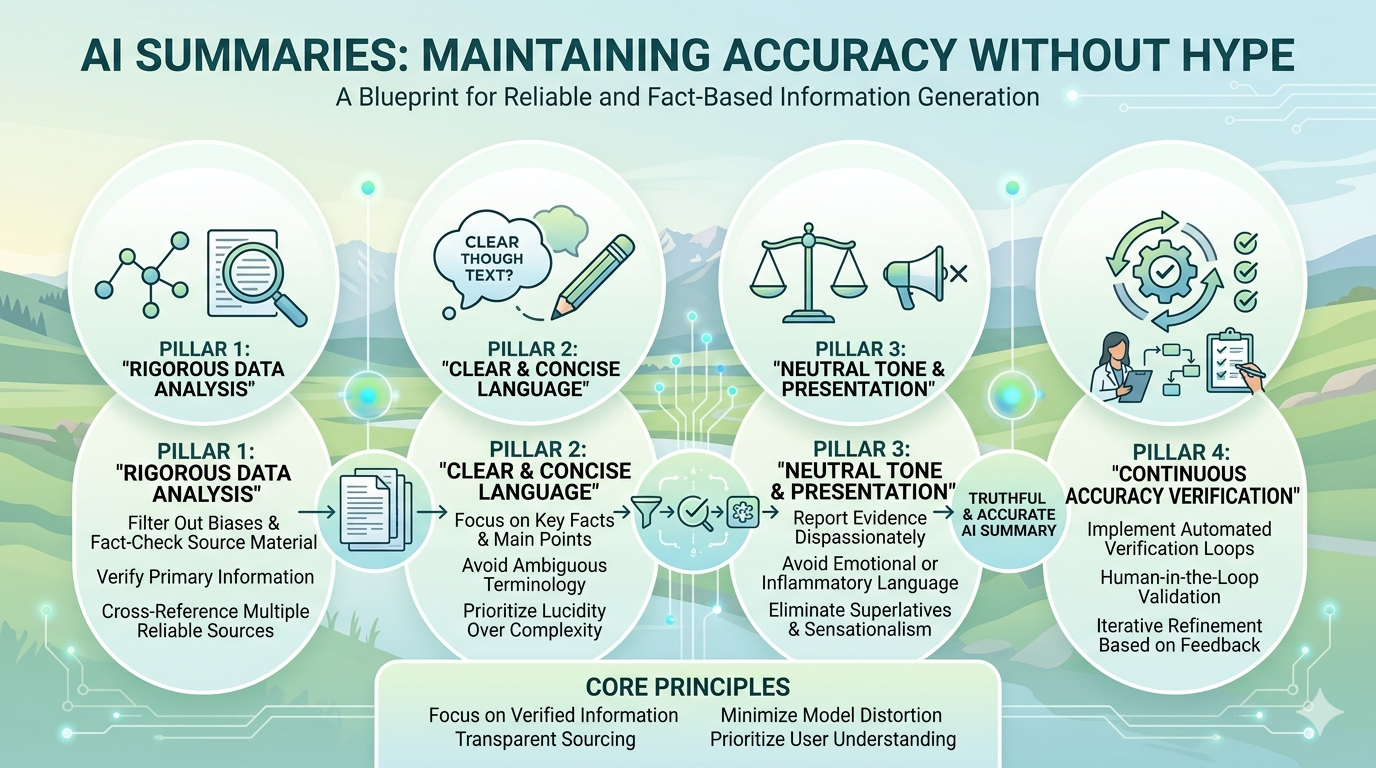
To reduce the risk of distortion in AI summaries, content creators and publishers often apply the following practices:


Clear and Literal Language

Use precise wording. Avoid ambiguous phrasing that could be interpreted in multiple ways.


Structured Information

Organize content using headings, short paragraphs, and direct statements to improve machine readability.


Verifiable Statements

Include only information that can be supported by credible, publicly available sources.


Avoidance of Speculative Claims

Do not include assumptions or projections that lack confirmation.


Neutral Tone

Present information without persuasive or emotional framing, aligning with global advertising and transparency standards.


Role of Data Privacy and Compliance

In the Philippines, the National Privacy Commission enforces the Data Privacy Act of 2012 (RA 10173), which applies to how personal data is collected and processed in digital systems, including AI-driven platforms.

AI summaries must avoid:

  • Exposure of personal or sensitive data without lawful basis
  • Misrepresentation of user-generated or third-party content
  • Use of data beyond declared purposes

Compliance with these standards supports responsible information handling and reduces legal risk.


Evolution of AI in Search

Search technologies have evolved from keyword-based indexing to systems that interpret intent and generate synthesized responses. This shift includes the integration of AI-generated summaries within search interfaces.

Under global digital standards, including guidance from entities like Federal Trade Commission, transparency and truthfulness remain central requirements, regardless of whether content is human-written or machine-generated.


FAQs

What are AI summaries in search engines?
AI summaries are condensed explanations generated by machine learning systems using information from multiple sources. They aim to provide quick, relevant answers to user queries.

Why can AI summaries sometimes be inaccurate?
Inaccuracies may occur due to missing context, outdated data, or limitations in how AI systems interpret complex information.

How does data privacy apply to AI-generated summaries?
Data privacy laws require that personal information is handled lawfully and transparently. AI systems must avoid unauthorized use or exposure of sensitive data.


Trusted Sources

  • Google Search Central
  • National Privacy Commission
  • Department of Trade and Industry Philippines
  • Federal Trade Commission


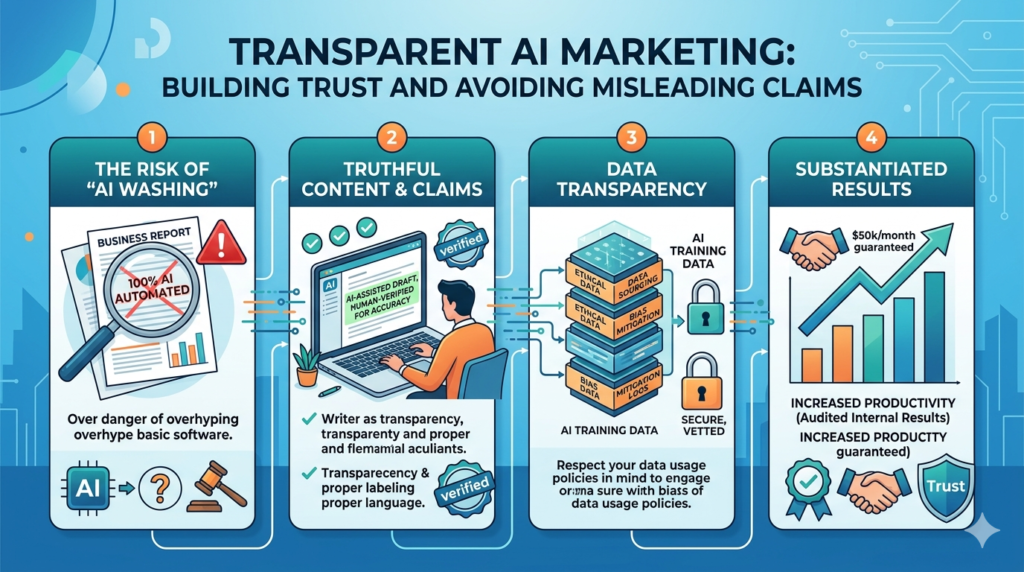
Flow diagram illustrating AI summary generation, including input sources, processing stages, and summarized output

Diagram showing stages of AI summary generation


Disclaimer

This content is for general informational and educational purposes only. It does not constitute professional marketing, legal, financial, or business advice. References to digital marketing tools, platforms, SEO strategies, or AI systems do not imply endorsement or guarantee results. Readers are encouraged to consult verified official sources and licensed professionals before making business or marketing decisions.
AI Mode in Search Engines: How AI Answers Are Generated

AI Mode in Search Engines: How AI Answers Are Generated


Understanding AI Mode in Search Engines: How AI Answers Are Generated


An educational overview of AI-assisted search responses and information retrieval systems


This article explains how AI-enabled search features—often referred to as “AI Mode”—generate answers within search engines. It outlines the role of machine learning models, indexing systems, and ranking signals, while referencing general platform documentation and data protection considerations under Philippine regulations such as the Data Privacy Act of 2012 (RA 10173). Readers will learn how AI answers are formed, what data sources may be used, and how accuracy and safety mechanisms are applied.


How AI Mode Works in Search Engines

AI Mode refers to the integration of artificial intelligence systems into search engines to generate summarized responses to user queries. These systems combine traditional search infrastructure with advanced language models.


Query Interpretation

When a user submits a search query, the system analyzes intent using natural language processing (NLP).

  • Queries may be informational, navigational, or transactional
  • AI systems attempt to understand context, phrasing, and meaning rather than relying only on keywords


Retrieval of Indexed Information

Search engines maintain large indexes of web content.

  • These indexes are built through automated crawling systems
  • Content is evaluated using ranking systems that consider relevance, quality, and other signals
  • AI Mode retrieves relevant documents before generating a response


AI Answer Generation

A language model processes retrieved content and generates a summarized response.

  • The system may combine multiple sources into a single answer
  • Responses are generated probabilistically based on patterns learned during training
  • Some systems include citations or links to source material, depending on platform design


Ranking and Safety Layers

Before being shown to users, AI-generated answers pass through additional systems:

  • Content quality and relevance checks
  • Safety filters to reduce harmful or misleading outputs
  • Policy enforcement aligned with platform guidelines


Continuous Updating

AI search systems may update responses dynamically:

  • Based on new indexed content
  • Changes in ranking signals
  • Ongoing model improvements


Data and Privacy Considerations

Under the Data Privacy Act of 2012 (RA 10173) in the Philippines:

  • Personal data processing must follow transparency, legitimate purpose, and proportionality principles
  • Search platforms may process query data to improve systems, subject to their privacy policies
  • Users are typically informed through platform disclosures about data usage and retention

Global standards such as transparency guidelines and consumer protection frameworks also influence how AI-generated answers are presented.


Evolution of Search Systems

Traditional search engines primarily returned ranked lists of links. Over time:

  • Ranking systems incorporated semantic understanding and user intent
  • Machine learning improved relevance scoring
  • AI Mode represents a shift toward direct answer generation rather than link-based navigation

This evolution reflects broader developments in artificial intelligence and large-scale data processing.


FAQs

What is AI Mode in search engines?
AI Mode refers to features that generate direct answers using artificial intelligence instead of only displaying links. These systems combine search indexing with language models.

How do AI-generated answers differ from traditional search results?
Traditional results list webpages ranked by relevance. AI-generated answers summarize information into a single response, often using multiple sources.

Are AI answers always accurate?
AI-generated responses are based on available data and system design. Accuracy may vary depending on source quality, model limitations, and how information is interpreted.


Trusted Sources

  • Google Search Central documentation
  • National Privacy Commission (Philippines) guidelines
  • Data Privacy Act of 2012 (RA 10173)
  • Platform transparency and AI policy documentation (publicly available resources)
  • Academic research on information retrieval and natural language processing


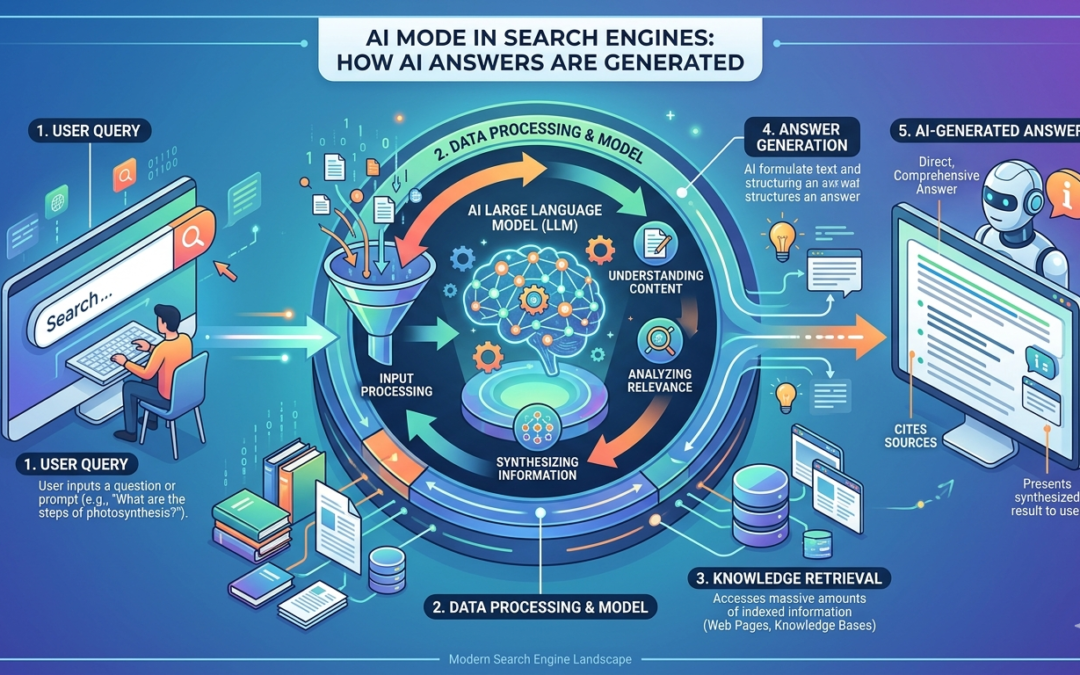
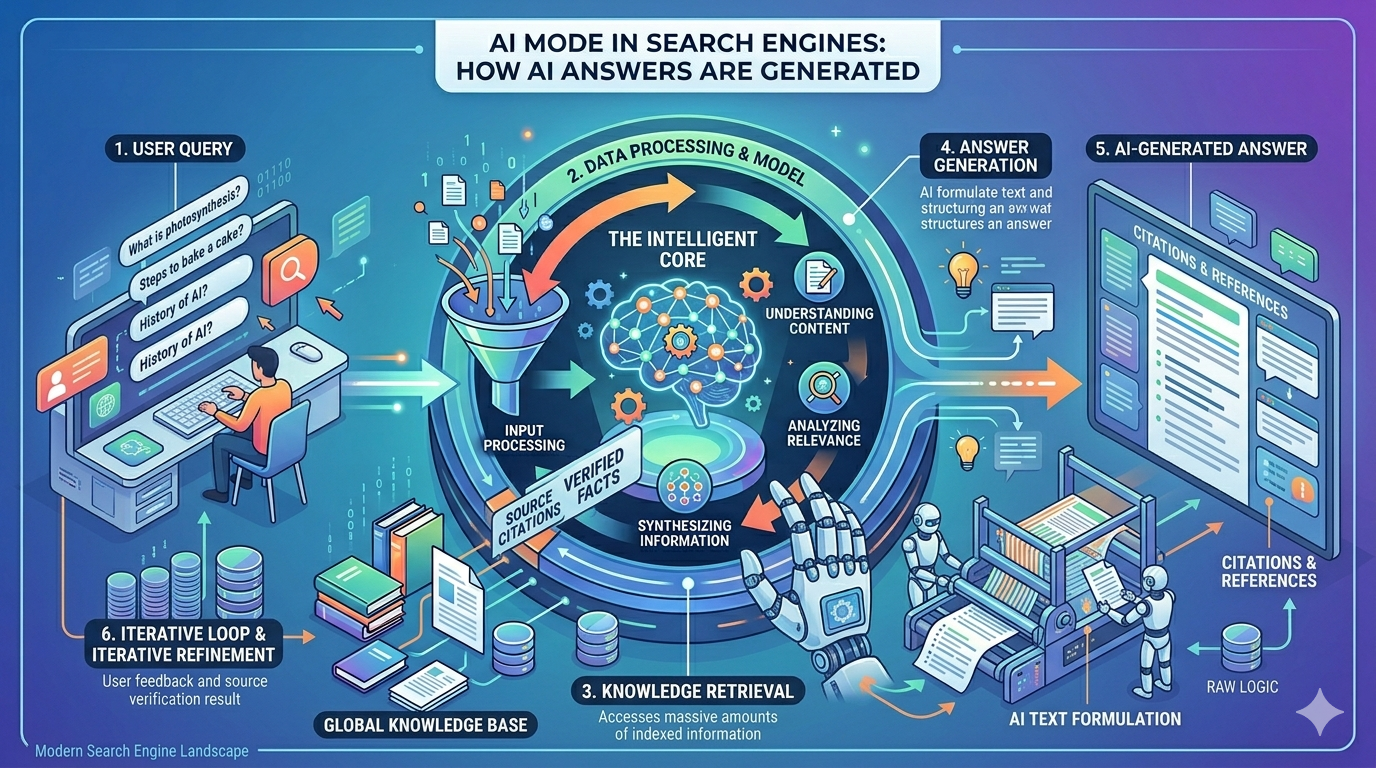
Diagram showing stages of query input, data retrieval, language model processing, and generated answer output

Visual sequence of AI search answer generation steps


Disclaimer

This content is for general informational and educational purposes only. It does not constitute professional marketing, legal, financial, or business advice. References to digital marketing tools, platforms, SEO strategies, or AI systems do not imply endorsement or guarantee results. Readers are encouraged to consult verified official sources and licensed professionals before making business or marketing decisions.