by iamrolanddiaz | Sep 12, 2025 | Artificial Intelligence, Personal Tech, SEO / Digital Optimization, Web Performance
Table of Contents
- Introduction & Scope
- Key Facts Summary
- What Is AEO?
- Who This Information Applies To
- How AEO Works in 2026
- Core Components / Types
- Benefits, Limitations & Risks
- Safety, Compliance & Standards
- Common Misunderstandings
- Evidence, Standards & Sources
- Future Developments in 2026
- Frequently Asked Questions
- Final Considerations & Next Steps
- Final CTA
Section Content Guidelines
1. Introduction & Scope
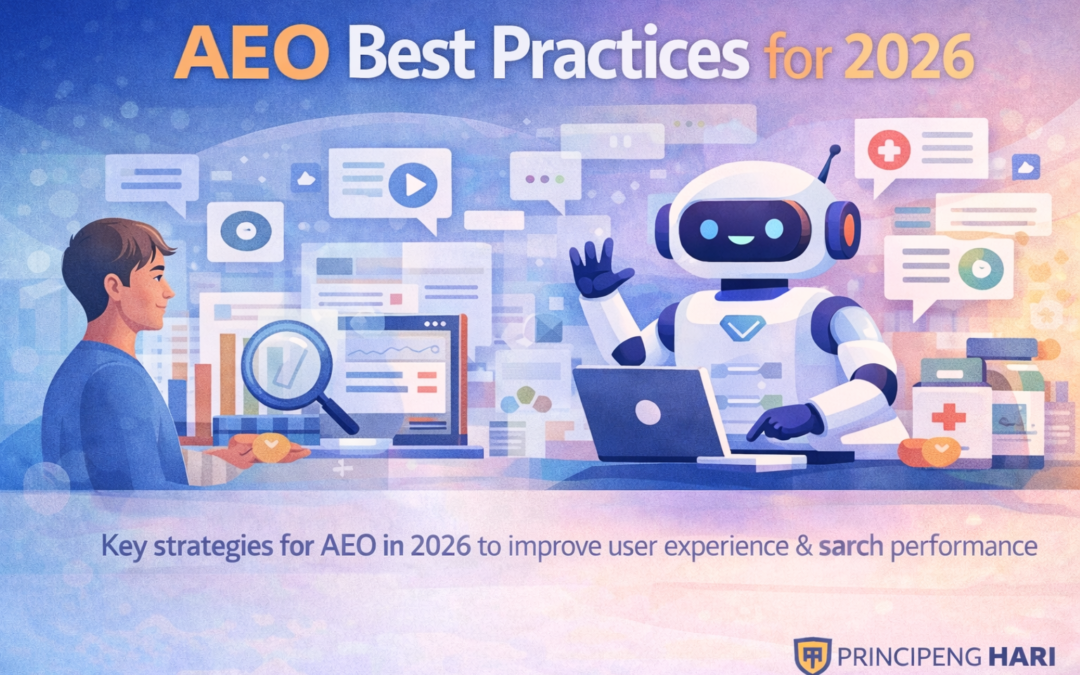
AEO (Automated Experience Optimization) is transforming digital marketing in 2026 by personalizing user experiences through AI, analytics, and automation. Modern AEO combines UX, CRO, and SEO signals to improve engagement, conversions, and search visibility.
In an era where search engines reward user satisfaction, speed, and interactivity, AEO is essential for businesses seeking to outperform competitors. By leveraging AI-driven personalization, web performance monitoring, and behavioral insights, companies can deliver highly optimized, frictionless experiences.
Link to AEO Hub
Next Funnel Link: Awareness → Consideration
2. Key Facts Summary
-
2026 AEO trends highlight AI-driven personalization, multi-device experience optimization, and data-driven testing.
-
Sites optimized for Core Web Vitals, interactive content, and accessibility outperform competitors in search rankings.
-
Businesses implementing structured AEO frameworks report up to 30% higher engagement and conversion rates.
Download Quick Stats Sheet
Next Funnel Link: Awareness
3. What Is AEO?
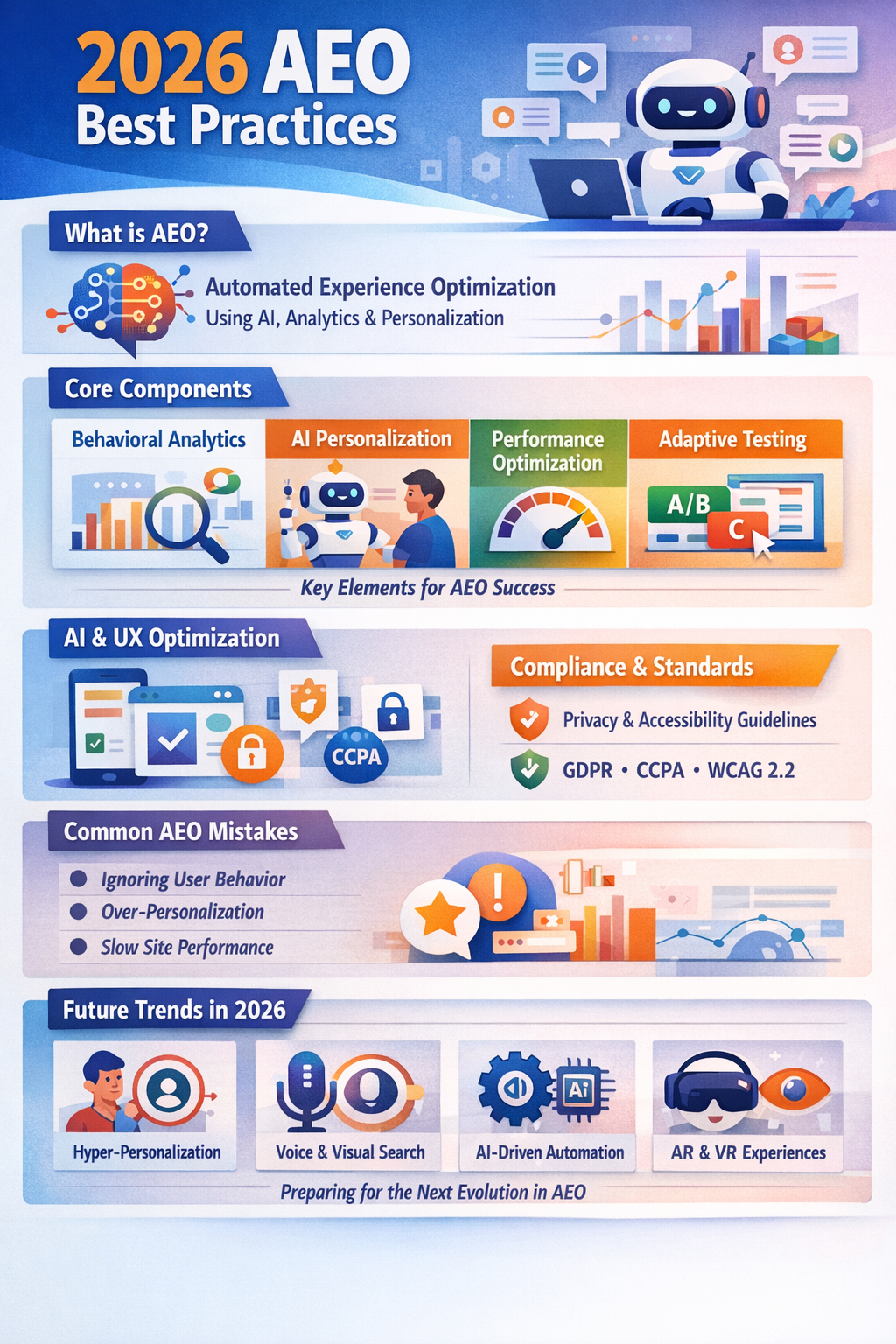
AEO (Automated Experience Optimization) is the practice of using AI, machine learning, and analytics to continuously improve website and app experiences. Unlike standard CRO, AEO focuses on real-time behavioral adaptation, testing multiple variations, and integrating SEO and UX data for optimal performance.
Introductory Guide to AEO
Next Funnel Link: Awareness
Key steps to implement effective AEO in 2026
4. Who This Information Applies To
AEO is relevant for:
Join Newsletter for Updates
Next Funnel Link: Awareness
5. How AEO Works in 2026
Key mechanisms:
-
Behavioral Analytics: Track user interactions to predict optimal pathways
-
AI Personalization: Dynamically adjust content, layout, and recommendations
-
Performance Monitoring: Optimize speed, Core Web Vitals, and responsiveness
-
Automated Testing: Run A/B or multivariate experiments automatically
Link to Technical Checklist
Next Funnel Link: Awareness
6. Core Components / Types
-
On-page Experience Optimization: Adaptive content, headings, microcopy
-
Technical AEO: Fast loading, accessibility, responsive design
-
AI & Predictive Analytics: Personalization, segmentation, and recommendations
-
Integration with SEO: Structured data, semantic optimization, and search visibility
Link to Core AEO Toolkit
Next Funnel Link: Awareness
7. Benefits, Limitations & Risks
Benefits:
-
Increased engagement and conversions
-
Improved user satisfaction and retention
-
Enhanced search engine visibility
Limitations:
Risks:
Link to Risk Mitigation Guide
Next Funnel Link: Awareness
8. Safety, Compliance & Standards
While AEO is generally low-risk for YMYL, organizations must:
-
Follow data privacy regulations (GDPR, CCPA)
-
Ensure accessibility standards (WCAG 2.2)
-
Avoid manipulative personalization that can mislead users
Link to Compliance Resource
Next Funnel Link: Awareness
9. Common Misunderstandings
-
“AEO is only for eCommerce” → FALSE, applies to all digital experiences
-
“AI replaces human optimization” → FALSE, requires monitoring and review
-
“Faster always equals better” → FALSE, UX quality and personalization matter
Link to Common Mistakes Guide
Next Funnel Link: Awareness
10. Evidence, Standards & Sources
-
Google Web Vitals & Search Central Guidelines
-
Nielsen Norman Group UX Studies
-
W3C Accessibility Standards
-
Case studies from top AI-driven marketing platforms
Access Curated Source Library
Next Funnel Link: Awareness
11. Future Developments in 2026
-
Hyper-personalization across devices and channels
-
Integration of AI, ML, and analytics for real-time optimization
-
Voice search and AR/VR experiences
-
Automated A/B and multivariate testing across segments
Sign Up for Future Trends Webinar
Next Funnel Link: Awareness
12. Frequently Asked Questions
Q1: How do I start implementing AEO?
A: Begin with behavioral analytics, set KPIs, and adopt AI-powered testing tools.
Q2: Does AEO replace CRO?
A: No, it enhances CRO with automation and real-time data adaptation.
Q3: Is AEO compliant with privacy regulations?
A: Yes, if data collection is transparent and consented.
Visit FAQ Hub
Next Funnel Link: Awareness
13. Final Considerations & Next Steps
AEO is critical for digital competitiveness in 2026. Companies must:
-
Adopt AI-driven personalization
-
Optimize Core Web Vitals and responsiveness
-
Follow privacy and accessibility standards
-
Integrate SEO with experience optimization
Link to Consideration Stage Guide
Next Funnel Link: Consideration
by iamrolanddiaz | Sep 12, 2025 | GEO, Smart Home
GEO Best Practices for 2026 – Principeng Hari
Introduction & Scope
Geo-targeting is increasingly critical in 2026, as search engines refine algorithms to prioritize location-specific relevance. Businesses and content creators must adapt to ensure they reach their intended audience in the right geography. This guide explores practical strategies for optimizing GEO signals, enhancing local search visibility, and improving user experience across regions.
By understanding the latest GEO SEO best practices, marketers can:
-
Align content with searcher intent per location
-
Improve SERP rankings in targeted regions
-
Reduce wasted traffic and increase conversion rates
CTA Placeholder: [Explore Local SEO Tools]
Next Funnel Link: Awareness → Consideration
Key Facts Summary
-
Local search accounts for over 55% of mobile searches globally.
-
Search engines now weigh hyper-local relevance more heavily.
-
GEO signals include IP, SERP localization, language, structured data, and business listings.
-
2026 emphasizes user intent + location context in search results.
Proper implementation of GEO best practices increases local engagement and drives measurable conversions.
Check Your Geo SEO Score
Next Funnel Link: Awareness
What Is GEO SEO?
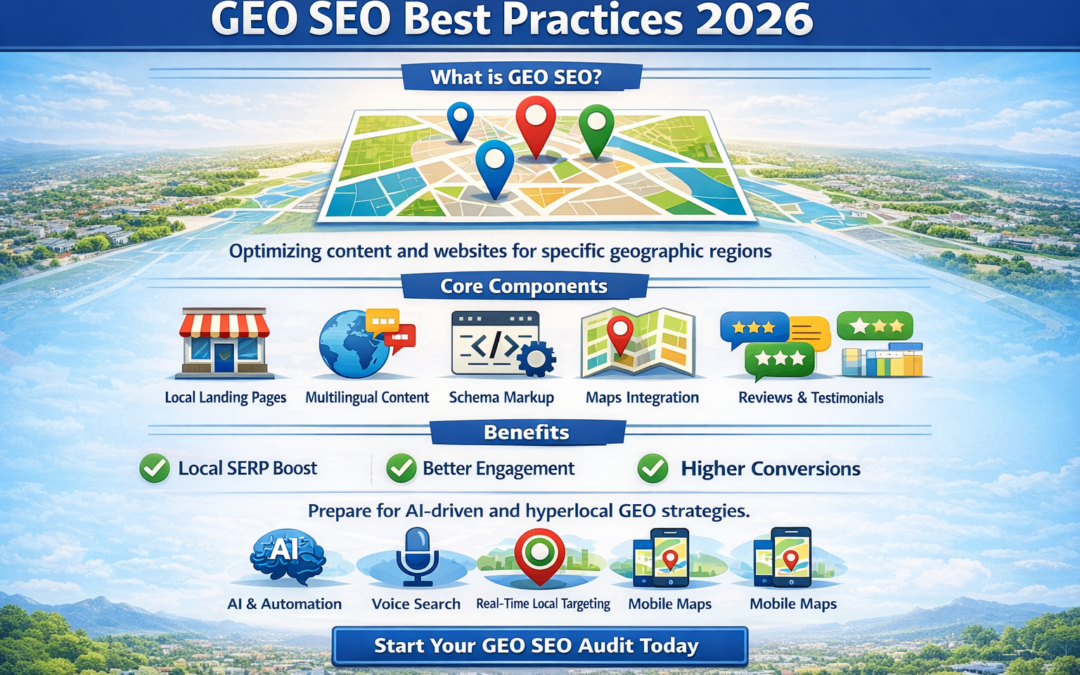
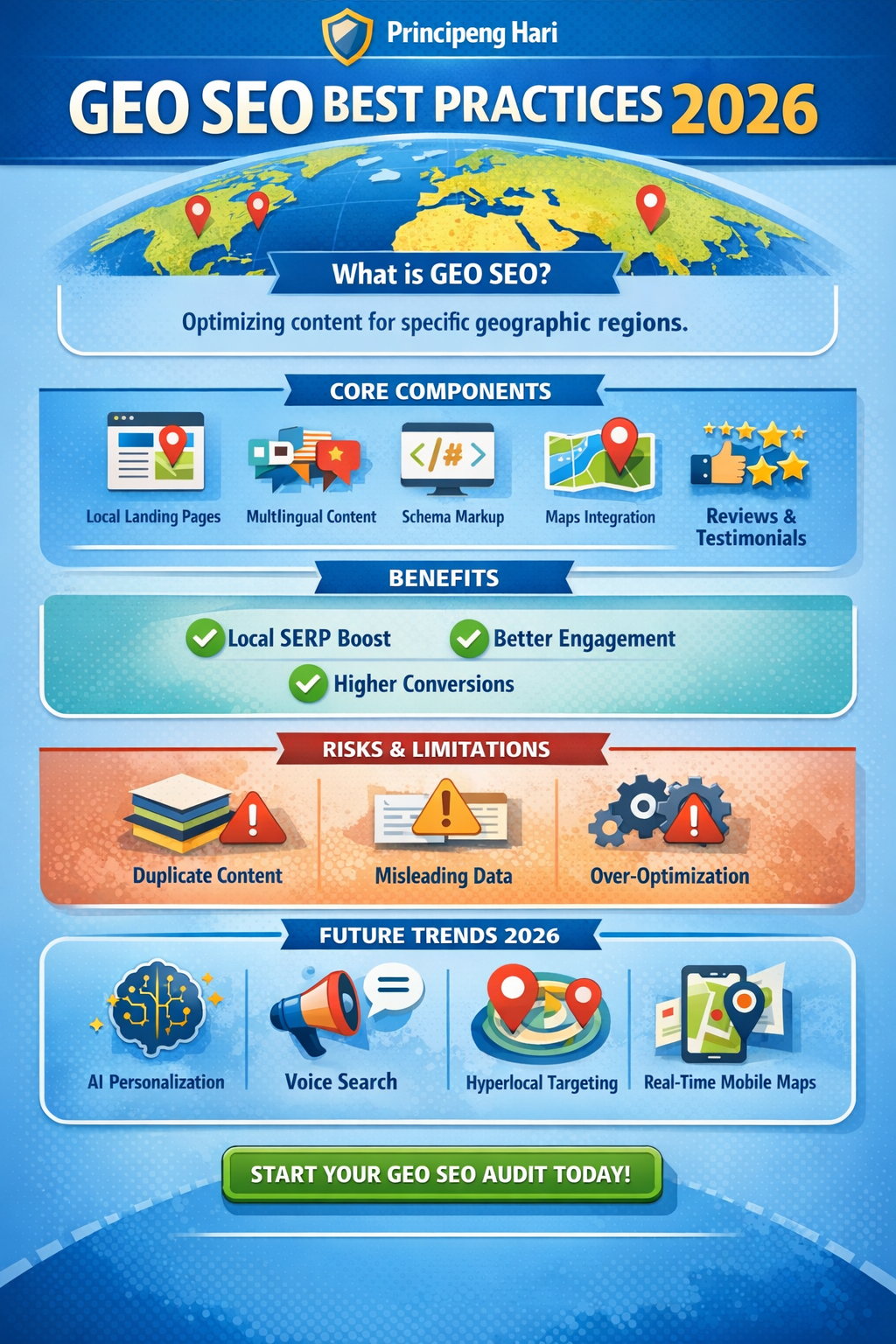
GEO SEO, or geographic search engine optimization, is the process of optimizing content and web assets to perform well for users in specific locations. It ensures that businesses appear in relevant searches for their target regions.
Key components include:
-
Localized content and landing pages
-
Structured data like LocalBusiness schema
-
Google Business Profile optimization
-
Consistent NAP (Name, Address, Phone) across directories
Learn How GEO SEO Works
Next Funnel Link: Awareness → Consideration
Who This Information Applies To
This guide is essential for:
-
Businesses targeting regional markets
-
Digital marketers managing multi-location campaigns
-
E-commerce stores with location-specific shipping
-
SEO professionals aiming to enhance local SERP performance
Even global brands can benefit by segmenting content for high-value regions.
\Evaluate Your Market Locations
Next Funnel Link: Awareness
How GEO Best Practices Work
Effective GEO SEO combines multiple signals to communicate location relevance to search engines:
- On-Page Signals: Location-specific keywords, title tags, headers
- Off-Page Signals: Local backlinks, citations, reviews
- Technical Signals: hreflang tags for multilingual content, geo-targeted sitemaps
- Behavioral Signals: CTR, dwell time, user interactions from specific regions
These strategies ensure your content aligns with both local search intent and global optimization standards.
Audit Your GEO Signals
Next Funnel Link: Consideration → Conversion
Core Components / Types
-
Local Landing Pages: Unique pages per city, region, or country
-
Multilingual Content: Translated and culturally adapted content
-
Schema Markup: LocalBusiness, Organization, and GeoCoordinates structured data
-
Maps Integration: Embedding Google Maps and location widgets
-
Reviews & Testimonials: Region-specific social proof
Download GEO Optimization Checklist
Next Funnel Link: Consideration → Conversion
Benefits, Limitations & Risks
Benefits:
-
Higher local SERP rankings
-
Better user engagement and conversions
-
Improved mobile visibility
Limitations:
Risks:
Assess Your GEO Risks
Next Funnel Link: Consideration
Safety, Compliance & Regulations
Ensure your geo-targeted content complies with local regulations:
-
Privacy laws (e.g., GDPR, CCPA) for collecting location data
-
Accurate representation of addresses and services
-
No misleading claims or false localization
Following guidelines protects your brand and avoids search penalties.
Review Regional Compliance Checklist
Next Funnel Link: Consideration
Common Misunderstandings
-
Misconception: One landing page can serve all locations
Reality: Search engines favor unique pages per region
-
Misconception: GEO SEO is only for local small businesses
Reality: Global enterprises benefit from regional targeting
-
Misconception: Backlinks are optional
Reality: Local citations and reviews impact ranking significantly
Debunk GEO SEO Myths
Next Funnel Link: Awareness → Consideration
Evidence, Standards & Sources
-
Google Search Central: Local SEO guide 2026
-
MOZ: Geo-Targeting Best Practices
-
Ahrefs: Local SERP Analysis Report
-
Search Engine Journal: Multilingual & Multi-Region SEO
Explore Full GEO Resources
Next Funnel Link: Awareness
Future Developments
In 2026 and beyond, GEO SEO is expected to evolve with:
-
AI-driven local search personalization
-
Enhanced map integration in search results
-
Voice search with geo-contextual results
-
Real-time hyperlocal targeting for mobile users
Stay Ahead with GEO Trends
Next Funnel Link: Awareness → Consideration
Frequently Asked Questions
Q1: Do I need separate pages for every city?
A: Yes, for highly competitive regions, unique pages improve ranking.
Q2: Can GEO SEO work for e-commerce?
A: Absolutely, with localized landing pages and shipping info.
Q3: How do I track GEO performance?
A: Use Google Analytics, Search Console location reports, and local SERP tracking tools.
See Full FAQ on GEO SEO
Next Funnel Link: Consideration
Final Considerations & Next Steps
Effective GEO SEO requires strategic planning, consistent updates, and compliance with both local regulations and global SEO standards. Implementing these best practices in 2026 ensures businesses can capture highly relevant traffic and maximize local engagement.
Start Your GEO SEO Audit Today
Next Funnel Link: Conversion