by iamrolanddiaz | Feb 16, 2026 | Principeng Hari
Agentic AI is a type of artificial intelligence designed to act with autonomy — meaning it can plan, make decisions, and carry out multi-step tasks with limited human supervision rather than just responding to single prompts.
Think of it as the shift from:
- Traditional AI: “Tell me what to do.”
- Generative AI: “Create something based on my request.”
- Agentic AI: “Here’s the goal — figure out the steps and execute them.”
🧠 Simple definition
Agentic AI refers to AI systems made up of AI agents that can:
- reason about goals
- plan workflows
- use tools or external systems
- take actions automatically
- adapt based on feedback or changing conditions
This moves AI from just generating answers to performing tasks.
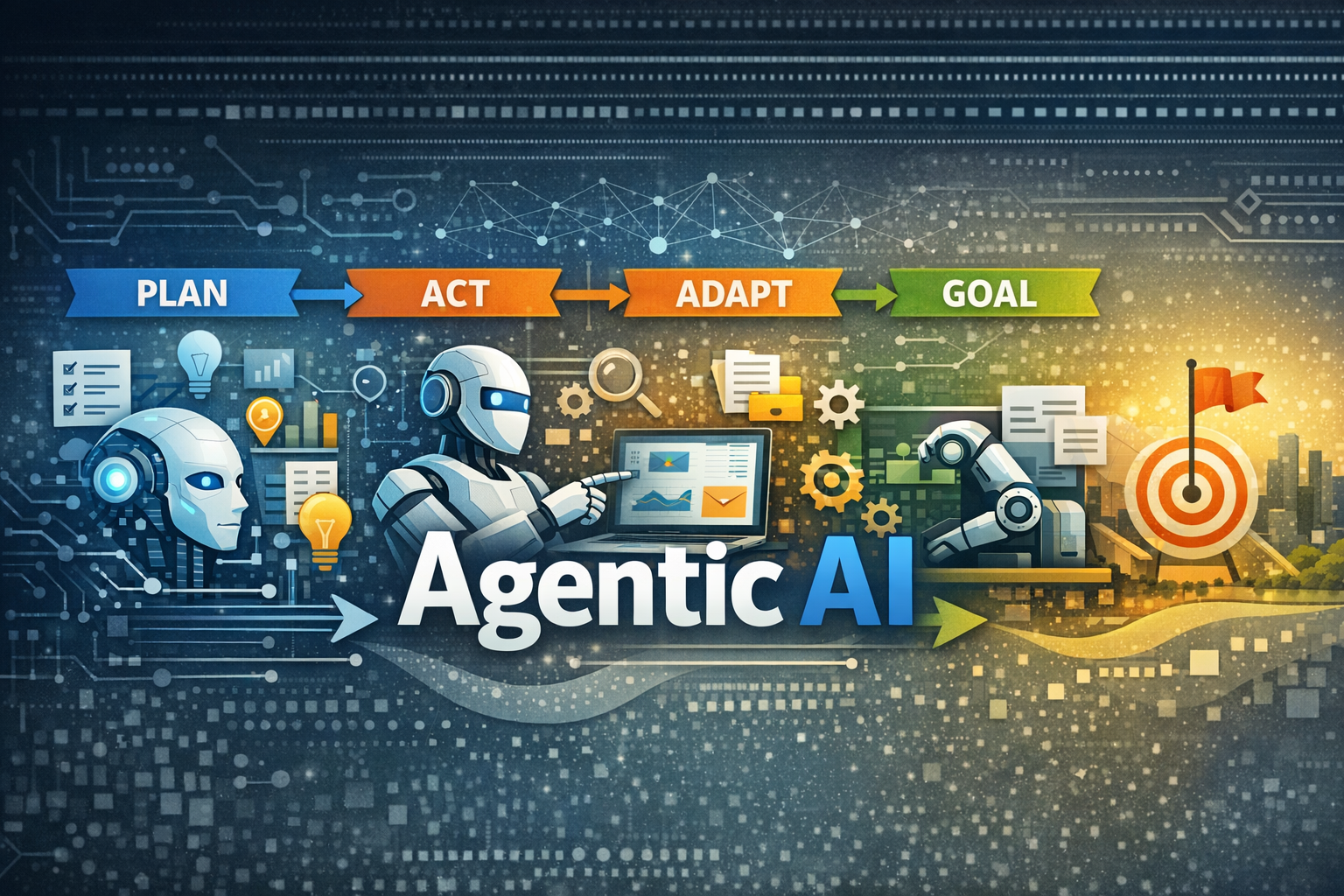
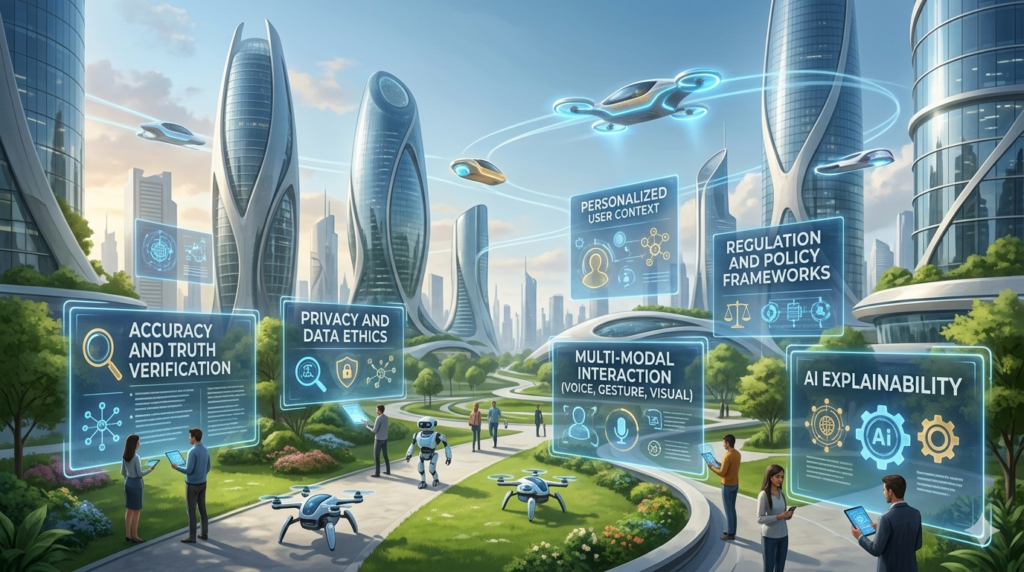
Visual layout presenting key concepts related to Agentic AI.
⚙️ Core characteristics of agentic AI
Most definitions highlight these features:
1️⃣ Autonomy
The system can operate without constant human input, handling tasks end-to-end once given a goal.
2️⃣ Planning & reasoning
Instead of a single response, it breaks problems into steps and decides how to proceed.
3️⃣ Tool use
Agentic systems can interact with APIs, databases, software, or other tools to gather information or take actions.
4️⃣ Adaptability
Agents can learn from feedback and adjust strategies over time.
5️⃣ Goal-driven behavior
The AI focuses on achieving outcomes rather than only generating text.
🆚 Agentic AI vs. regular AI
| Type |
How it works |
Example |
| Traditional automation |
Fixed rules |
Auto-reply email |
| Generative AI |
|
|
| Agentic AI |
Plans + acts |
Books meetings, gathers data, updates records automatically |
🧩 Real-world examples
- A customer support agent that checks account data, follows workflows, and completes actions instead of only answering questions.
- Systems coordinating multiple specialized agents to complete larger tasks together.
- Enterprise tools that monitor systems and take predefined actions with oversight.
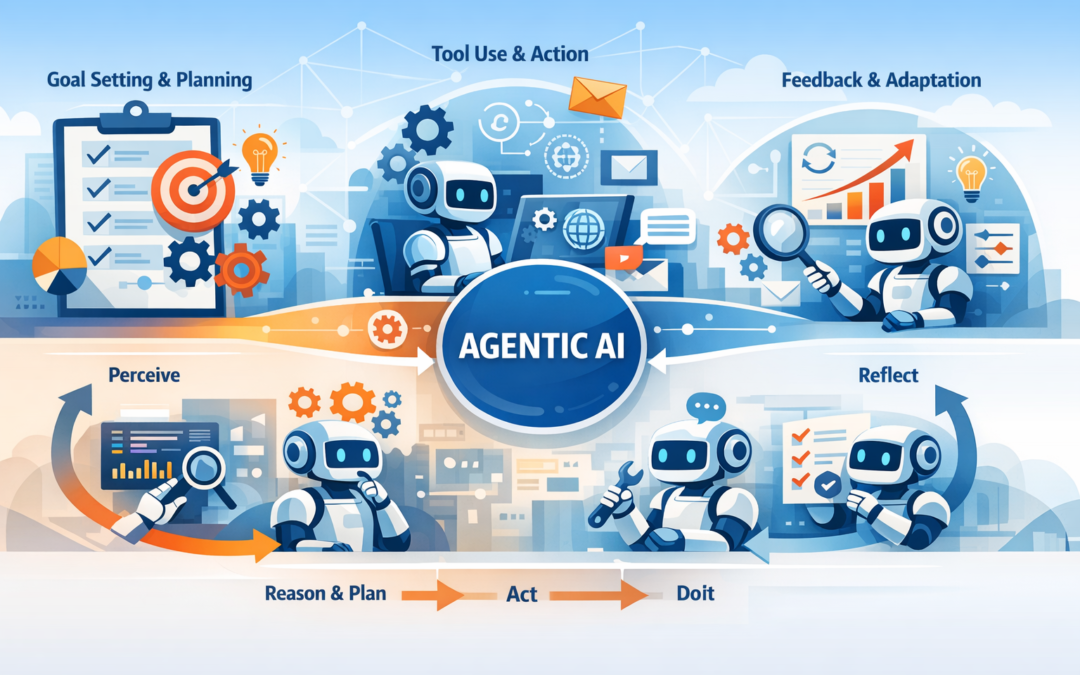
🏗️ How agentic AI usually works
- Perceive → gather data
- Reason → analyze and plan
- Act → use tools or perform actions
- Reflect → evaluate results and adjust
This repeated cycle allows longer workflows than simple prompt-response systems.
⚠️ Why people are talking about it now
Experts see agentic AI as the next step after generative AI because it moves AI:
- from knowledge → to action
- from answering → to executing workflows
At the same time, it introduces new challenges around safety, governance, and oversight because autonomous systems can make decisions independently.
🧠 One-sentence explanation
Agentic AI = AI that can set plans and take actions toward goals, not just generate responses.
Agentic AI FAQ
Q1: What is Agentic AI?
A: Agentic AI is a type of artificial intelligence designed to act autonomously. It can plan, make decisions, and complete multi-step tasks with minimal human supervision, going beyond traditional or generative AI that only responds to prompts.
Q2: How is Agentic AI different from regular AI?
A: Unlike traditional AI, which follows fixed rules, or generative AI, which creates content based on instructions, Agentic AI plans workflows, uses tools, and executes actions automatically to achieve goals.
Q3: What are the main features of Agentic AI?
A: Core features include:
- Autonomy – Operates without constant human input.
- Planning & reasoning – Breaks tasks into steps and decides the next actions.
- Tool use – Interacts with software, APIs, and databases.
- Adaptability – Learns from feedback and adjusts strategies.
- Goal-driven behavior – Focuses on completing outcomes, not just generating text.
Q4: Can you give examples of Agentic AI in the real world?
A: Examples include:
- Customer support agents that gather account data and complete workflows automatically.
- Systems coordinating multiple AI agents for complex tasks.
- Enterprise monitoring tools that detect issues and act on them autonomously.
Q5: How does Agentic AI work?
A: Agentic AI works in cycles:
- Perceive – Gather relevant data.
- Reason – Analyze information and plan next steps.
- Act – Execute tasks using tools or systems.
- Reflect – Evaluate outcomes and improve future actions.
Q6: Why is Agentic AI gaining attention now?
A: Experts view it as the next evolution after generative AI, shifting AI from knowledge and responses to independent action. It promises higher efficiency but also raises questions about safety, oversight, and governance.
Q7: Do I need technical skills to use Agentic AI?
A: While understanding workflows and AI concepts helps, many Agentic AI tools are designed to be user-friendly, enabling businesses to automate tasks without deep technical knowledge.
Q8: What are the benefits of using Agentic AI?
A: Benefits include:
- Automating repetitive or complex tasks.
- Improving efficiency and decision-making.
- Reducing reliance on human supervision for multi-step workflows.
- Enabling AI-driven goal completion rather than just information retrieval.
Q9: Is Agentic AI safe to use?
A: Safety depends on proper oversight, governance, and ethical implementation. Autonomous AI can make independent decisions, so monitoring and clear policies are essential.
Q10: Can Agentic AI replace human jobs?
A: Agentic AI is designed to assist and automate tasks rather than fully replace humans. It works best when augmenting human roles, improving efficiency, and handling repetitive or structured workflows.
by iamrolanddiaz | Feb 16, 2026 | Principeng Hari
Content Outline
- Why Understanding the Difference Matters
- What is Marketing?
- What is Growth?
- What is Brand?
- Comparing Marketing, Growth, and Brand
- How Businesses Use Each Strategically
- Key Takeaways
- Practical Checklist
- FAQ
Why Understanding the Difference Matters
In today’s competitive business landscape, terms like marketing, growth, and brand are often used interchangeably. However, each serves a unique role in shaping a company’s strategy. Understanding these differences helps leaders make informed decisions, allocate resources effectively, and communicate with stakeholders clearly.
This article provides an educational overview that is globally compliant, ethically framed, and safe for digital platforms.
What is Marketing?
Marketing is the practice of communicating a business’s products or services to an audience to create awareness, interest, and engagement. It encompasses activities such as:
-
Content creation (blogs, social media posts, videos)
-
Advertising campaigns (paid and organic)
-
Search engine optimization (SEO)
-
Customer research and insights
Marketing focuses on strategic communication and value delivery rather than instant results. It is foundational for attracting attention and maintaining relevance in a crowded market.
What is Growth?
Growth refers to the strategies and tactics aimed at scaling a business, increasing customer acquisition, revenue, or market share. Growth strategies often combine marketing efforts with product improvements, sales optimization, and user experience enhancements.
Key elements include:
-
Conversion rate optimization
-
Retention programs and loyalty initiatives
-
Experimentation and analytics-based decision-making
-
Cross-channel campaigns aligned with performance metrics
While marketing creates awareness, growth emphasizes measurable expansion and often relies on iterative testing to find what works.
What is Brand?
Brand represents the perception, reputation, and identity of a company or product in the minds of customers. Strong brands convey trust, credibility, and consistency. Branding includes:
-
Visual identity (logos, color palette, typography)
-
Messaging tone and voice
-
Mission, values, and storytelling
-
Customer experience and service standards
Branding is less about immediate conversions and more about long-term relationships and loyalty. It provides a framework that marketing and growth strategies operate within.
Comparing Marketing, Growth, and Brand
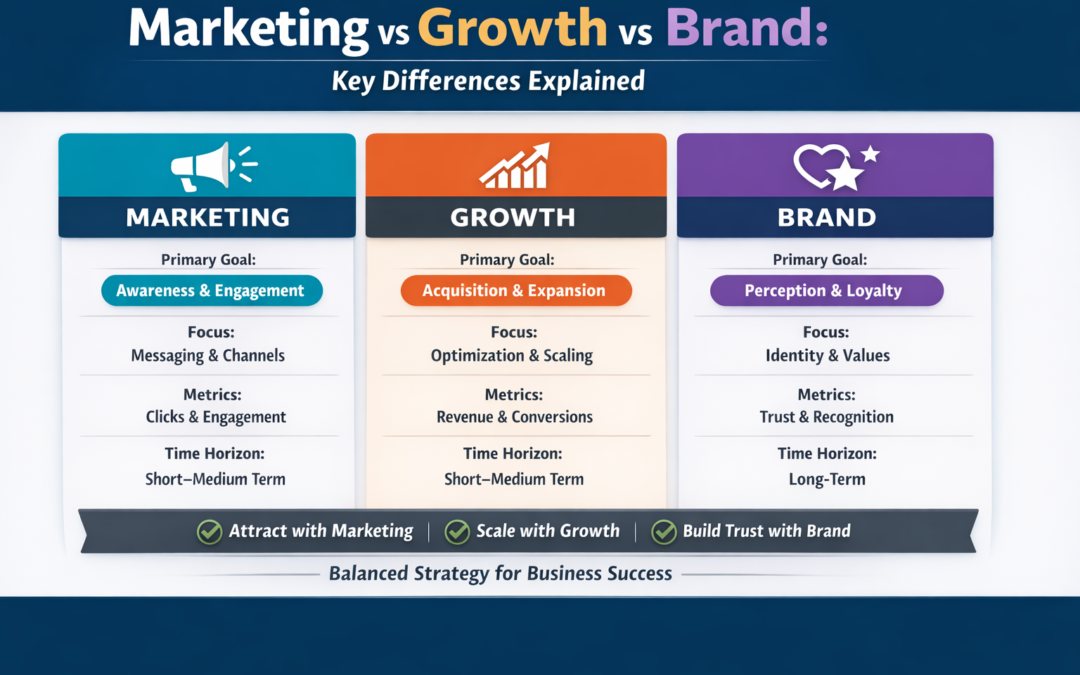
| Aspect |
Marketing |
Growth |
Brand |
| Primary Goal |
Awareness & engagement |
Acquisition & expansion |
Perception & loyalty |
| Time Horizon |
Short–medium |
Short–medium |
Long-term |
| Metrics |
Clicks, impressions, engagement |
Conversion rates, revenue growth |
Brand recall, NPS, trust |
| Focus |
Messaging & channels |
Experiments & optimization |
Identity & values |
Understanding these distinctions allows businesses to align marketing campaigns, growth initiatives, and brand development for maximum strategic impact.
How Businesses Use Each Strategically
- Marketing campaigns are often used to attract attention and educate potential customers.
- Growth strategies focus on testing channels, optimizing funnels, and scaling successful tactics.
- Brand initiatives ensure consistent messaging, build trust, and support long-term retention.
A balanced approach integrates all three, ensuring that short-term growth does not compromise brand integrity, and marketing activities are guided by a cohesive identity.
Key Takeaways
-
Marketing = Communication & awareness
-
Growth = Expansion & measurable results
-
Brand = Perception & long-term trust
-
All three should work together in a compliant, ethical, and strategic manner
Practical Checklist
-
Define your marketing objectives clearly
-
Identify growth metrics for experimentation
-
Audit brand messaging and visual identity
-
Align marketing campaigns with brand values
-
Track performance ethically and transparently
FAQ
Q1: Can growth replace marketing?
A1: No, growth often relies on marketing to generate awareness and initial engagement. They are complementary strategies.
Q2: How does brand impact conversions?
A2: Strong branding builds trust, which indirectly supports higher engagement and conversion rates over time.
Q3: Should small businesses prioritize brand or growth?
A3: Both are important. Early-stage businesses may focus on marketing and growth to establish presence while maintaining brand consistency.
Trusted Sources / Standards
-
Google Search Central (SEO & AEO Guidelines)
-
Meta Business Help Center (Advertising & Brand Policies)
-
TikTok Business Documentation (Platform Marketing Compliance)
-
FTC Consumer Guidance (Truth in Advertising)
-
Government Consumer Protection Agencies (e.g., Philippines RA 7394, RA 8792, RA 10173)
Disclaimer
“This content is provided for general educational purposes only. Digital marketing results vary depending on market conditions, platform rules, audience behavior, and execution.”
Summary
Marketing, growth, and brand serve distinct roles in business strategy. Marketing builds awareness, growth drives measurable expansion, and brand establishes long-term trust. Together, they guide decisions, optimize campaigns, and strengthen market presence. This overview provides an educational framework that is ethical, compliant, and safe for global digital marketing applications.
by iamrolanddiaz | Feb 16, 2026 | Principeng Hari
Content Outline
-
Definition and purpose
-
Stages and structure
-
Template + example map
-
Metrics and optimization
-
Tools + best practices
What Is Customer Journey Mapping?
Customer journey mapping is the process of visualizing how a customer discovers, evaluates, purchases, and continues engaging with a brand across multiple touchpoints.
Instead of focusing only on sales, a journey map helps businesses understand customer behavior, emotions, expectations, and friction points from the customer’s perspective.
A well-built journey map is commonly used to improve marketing campaigns, website experience, support processes, and customer retention strategies.
Customer Journey vs Buyer Journey
These terms are often confused, but they are not identical.
| Concept |
Focus |
Best Used For |
| Buyer Journey |
Decision-making before purchase |
Lead generation, sales funnels |
| Customer Journey |
Full lifecycle before and after purchase |
Customer experience, loyalty, retention |
In simple terms: the buyer journey often ends at purchase, while the customer journey continues after purchase.
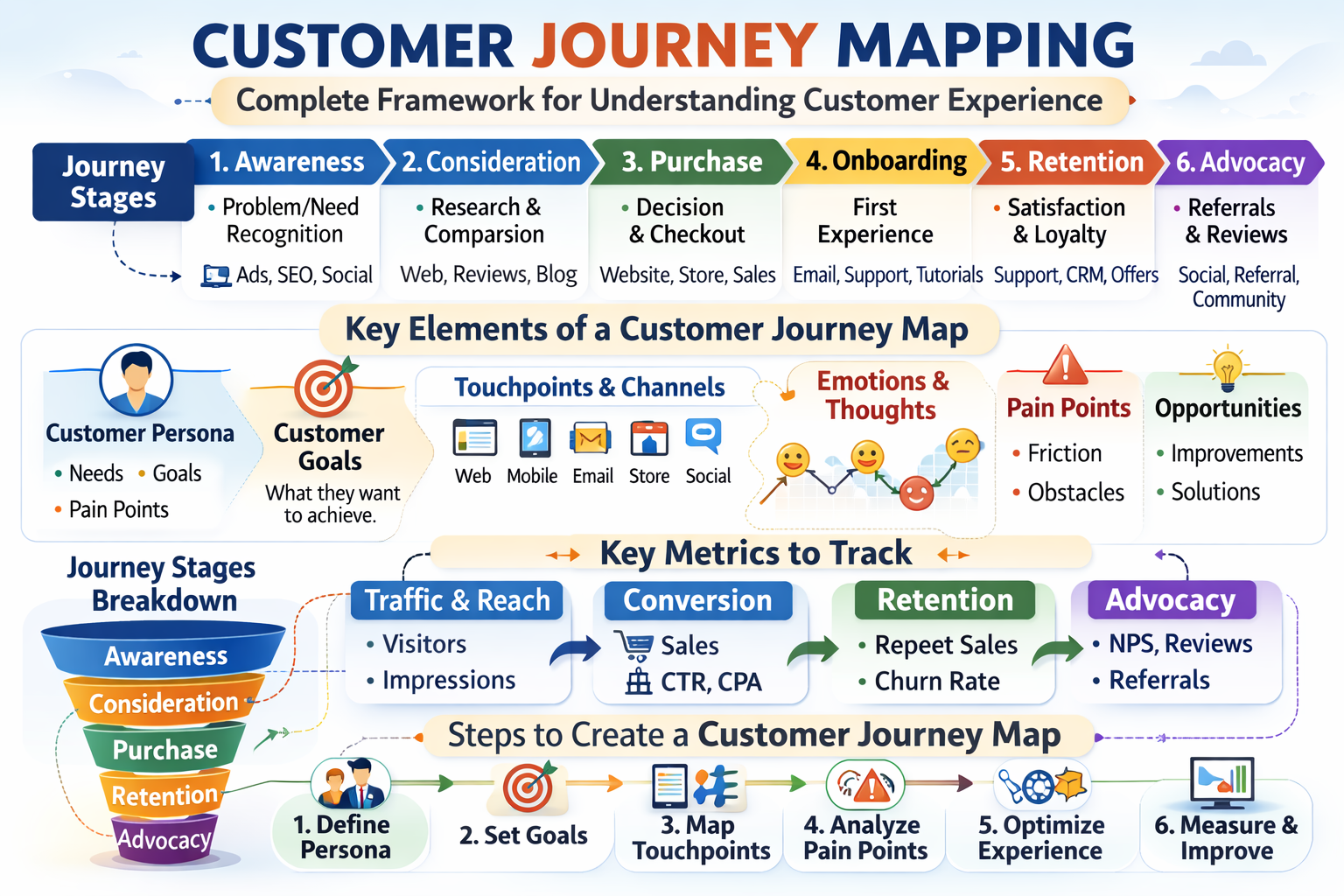
Customer journey mapping infographic showing stages, touchpoints, and measurement categories.
Why Customer Journey Mapping Matters
Customer journey mapping is useful because it helps organizations:
-
Identify what customers struggle with at each stage
-
Understand which channels influence decisions
-
Improve marketing message consistency
-
Reduce drop-offs in the funnel
-
Improve customer satisfaction and retention
-
Align sales, marketing, and customer service teams
It also supports better budgeting because you can focus resources on touchpoints that matter most.
Core Stages of a Customer Journey
Many models exist, but a globally common structure includes:
1. Awareness
The customer realizes they have a problem or need.
Common touchpoints:
Customer question:
“What is this problem, and what solutions exist?”
2. Consideration
The customer compares options and evaluates brands.
Common touchpoints:
-
product pages
-
reviews and ratings
-
webinars
-
comparison blogs
-
FAQ pages
Customer question:
“Which option fits my needs best?”
3. Conversion / Purchase
The customer decides and takes action.
Common touchpoints:
Customer question:
“Can I trust this business enough to buy?”
4. Onboarding / First Use
The customer starts using the product or service.
Common touchpoints:
-
welcome email
-
tutorials
-
packaging instructions
-
customer support
Customer question:
“Did I make the right choice?”
5. Retention / Loyalty
The customer continues purchasing or renewing.
Common touchpoints:
-
loyalty programs
-
customer success calls
-
newsletters
-
personalized offers
-
community groups
Customer question:
“Is this brand still valuable to me?”
6. Advocacy
The customer becomes a promoter and refers others.
Common touchpoints:
-
review platforms
-
referrals
-
social media sharing
-
testimonials
Customer question:
“Do I recommend this brand to others?”
Key Elements of a Customer Journey Map
A good customer journey map is more than a funnel diagram. It includes:
1. Customer Persona
A journey map should represent a specific type of customer (not “everyone”).
Examples:
2. Customer Goals
Each stage has a different goal.
Example:
-
Awareness = understand options
-
Consideration = compare solutions
-
Purchase = reduce risk and uncertainty
3. Touchpoints and Channels
List every place where customers interact with your business, such as:
-
website
-
ads
-
social media
-
email
-
customer service
-
physical store
4. Customer Emotions and Motivations
Customer decisions are not purely logical.
Your map should include likely emotions like:
5. Pain Points and Friction
These are the “drop-off triggers” that cause customers to stop.
Examples:
6. Opportunities for Improvement
This is where marketing becomes strategic.
Examples:
Step-by-Step Guide to Create a Customer Journey Map
Step 1: Choose One Customer Persona
Start with a single customer profile.
Avoid vague personas like “general audience.”
Use realistic details such as:
Step 2: Define the Customer Goal
Write the customer’s main objective.
Example:
“I want to find a safe and affordable travel package.”
Step 3: List the Journey Stages
Use a standard structure like:
Awareness → Consideration → Purchase → Onboarding → Retention → Advocacy
Keep it consistent across teams.
Step 4: Identify Touchpoints per Stage
Ask: Where does the customer interact with us here?
Examples:
-
Awareness: Instagram Reels, SEO blog
-
Consideration: product comparison page
-
Purchase: checkout and payment
-
Onboarding: email series, tutorial
-
Retention: newsletter and customer support
-
Advocacy: referral program
Step 5: Map Customer Questions
This is one of the most valuable parts.
Examples:
These questions directly become:
Step 6: Identify Barriers and Drop-Off Points
Look for:
This helps reduce wasted ad spend.
Step 7: Add Metrics for Each Stage
Attach measurable KPIs such as:
-
Awareness: impressions, organic traffic
-
Consideration: time on page, email signups
-
Purchase: conversion rate, cart abandonment
-
Retention: repeat purchase rate, churn
-
Advocacy: referral rate, reviews count
Step 8: Build Improvements and Assign Owners
A journey map is only useful if it results in action.
Assign:
-
marketing team → content improvements
-
UX team → landing page optimization
-
customer service → response workflow
-
sales team → scripts and objection handling
Customer Journey Map Template (Simple Format)
| Stage |
Customer Goal |
Touchpoints |
Customer Questions |
Pain Points |
Improvement Opportunities |
| Awareness |
Discover solutions |
Google, TikTok, blog |
“What is best?” |
confusing content |
create beginner guide |
| Consideration |
Compare options |
reviews, pricing page |
“Can I trust them?” |
unclear policies |
add trust badges & FAQ |
| Purchase |
Buy safely |
checkout, payment |
“Is payment secure?” |
too many steps |
simplify checkout |
| Onboarding |
Start using |
welcome email |
“How do I start?” |
unclear instructions |
onboarding email sequence |
| Retention |
Stay satisfied |
support, newsletter |
“Is this still worth it?” |
slow support |
faster response system |
| Advocacy |
Recommend |
referrals, reviews |
“How do I share?” |
no referral incentive |
referral program |
This format is widely used because it is easy for teams to collaborate on.
Common Mistakes to Avoid
1. Mapping the company process instead of the customer experience
A customer journey map must reflect customer reality, not internal workflow.
2. Using too many personas at once
Start with one persona, then expand.
3. Ignoring post-purchase experience
Many businesses only map until purchase, but loyalty often comes from onboarding and support.
4. Not using real data
Use:
-
analytics
-
support tickets
-
surveys
-
review insights
-
sales call notes
5. Creating a map but not updating it
Customer behavior changes as platforms and trends evolve.
Metrics to Track per Journey Stage
| Stage |
Metrics to Track |
| Awareness |
impressions, reach, organic traffic, brand searches |
| Consideration |
bounce rate, time on page, lead form submissions |
| Purchase |
conversion rate, cart abandonment, checkout completion |
| Onboarding |
activation rate, product usage, tutorial completion |
| Retention |
repeat purchase rate, churn, customer lifetime value (CLV) |
| Advocacy |
referrals, reviews, NPS (if used), social mentions |
Metrics should be interpreted carefully since performance varies by market and channel.
Tools for Customer Journey Mapping
Depending on your team setup, common tools include:
-
Google Analytics (behavior insights)
-
CRM platforms (customer lifecycle tracking)
-
spreadsheet templates (simple and accessible)
-
UX tools like Figma (visual mapping)
-
project tools like Notion or Trello (team collaboration)
Tool choice depends on company size and workflow.
Practical Checklist
✅ Choose one persona
✅ Define customer goal
✅ Break journey into stages
✅ List touchpoints per stage
✅ Add customer questions per stage
✅ Identify pain points and drop-offs
✅ Attach measurable KPIs
✅ Assign owners for improvements
✅ Review and update quarterly
FAQ
Q1: What is the main purpose of customer journey mapping?
Customer journey mapping helps businesses understand customer behavior, identify friction points, and improve marketing, sales, and customer experience across touchpoints.
Q2: How is customer journey mapping different from a sales funnel?
A sales funnel focuses on conversion stages, while a customer journey map includes emotions, touchpoints, and post-purchase experiences like retention and loyalty.
Q3: How often should a customer journey map be updated?
Many businesses update journey maps quarterly or after major product, pricing, or platform changes, since customer behavior evolves over time.
Q4: Do small businesses need customer journey mapping?
Yes. Even a simple journey map can help small businesses improve content strategy, customer support flow, and conversion messaging.
Trusted Sources / Standards
-
Google Search Central (SEO and content quality guidance)
-
Meta Business Help Center (ads and policy standards)
-
TikTok Business Help Center (advertising rules and best practices)
-
FTC Consumer Guidance (truth-in-advertising principles)
-
General GDPR/CCPA privacy principles (transparency and consent)
Disclaimer
This content is provided for general educational purposes only. Digital marketing results vary depending on market conditions, platform rules, audience behavior, and execution.
Summary
Customer journey mapping is a strategy tool used to visualize how customers discover, evaluate, purchase, and continue engaging with a business across different touchpoints. A strong journey map includes customer stages, goals, questions, emotions, pain points, and measurable metrics. Businesses often use it to improve marketing alignment, reduce funnel drop-offs, and strengthen customer retention.
by iamrolanddiaz | Feb 16, 2026 | Principeng Hari
Content Outline
- Introduction to Digital Marketing
- Key Channels of Digital Marketing
- Search Engine Optimization (SEO)
- Social Media Marketing
- Email Marketing
- Paid Advertising (PPC)
- Content Marketing
- Benefits of Digital Marketing
- Common Digital Marketing Strategies
- Measuring Digital Marketing Success
- Practical Checklist for Getting Started
Introduction to Digital Marketing
Digital marketing refers to the use of online channels, tools, and platforms to connect with audiences, promote products or services, and build brand awareness. Unlike traditional marketing, which often relies on print, broadcast, or outdoor media, digital marketing leverages the internet and digital technologies. Businesses of all sizes commonly use digital marketing to reach targeted audiences in measurable ways.
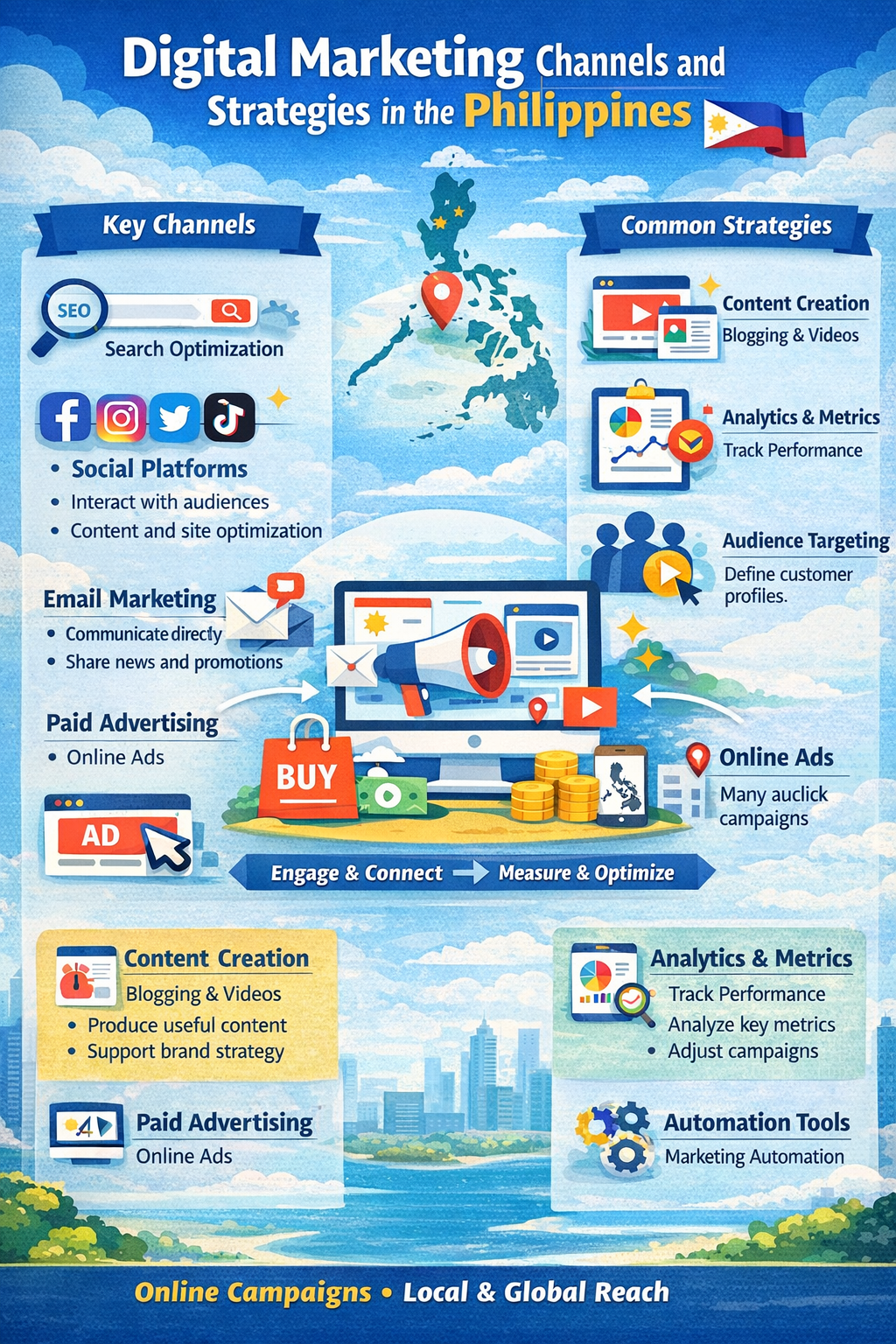
Illustrated infographic showing common digital marketing channels and workflows
Key Channels of Digital Marketing
Search Engine Optimization (SEO)
SEO involves optimizing a website or online content so that it can be discovered more easily via search engines. Techniques include keyword research, content creation, technical optimization, and link-building strategies. Results depend on consistent effort and platform updates.
Social Media Marketing
This channel uses platforms like Facebook, Instagram, TikTok, LinkedIn, and Twitter to engage audiences, share content, and promote products or services. Social media campaigns vary by region and platform rules, and performance depends on audience targeting and content quality.
Email Marketing
Email marketing is the process of sending targeted messages to subscribers. It is often used for newsletters, promotional campaigns, and customer engagement. Compliance with privacy laws and consent regulations is critical when using email marketing.
Paid Advertising (PPC)
Pay-per-click advertising allows businesses to display ads on search engines, social media, or other digital platforms. Advertisers only pay when a user clicks an ad. Campaigns must follow platform policies and local advertising regulations.
Content Marketing
Content marketing focuses on creating educational, entertaining, or informative content to attract and retain audiences. Blogs, videos, infographics, and podcasts are commonly used to provide value and support other marketing channels.
Benefits of Digital Marketing
Digital marketing offers measurable, cost-effective ways to reach specific audiences. It allows businesses to track engagement, adjust campaigns in real time, and scale marketing efforts globally or locally depending on goals.
Common Digital Marketing Strategies
-
Creating high-quality, search-optimized content
-
Engaging audiences on social media platforms
-
Running paid campaigns with clear targeting
-
Using email sequences to nurture leads
-
Analyzing data to inform strategy and improve performance
Measuring Digital Marketing Success
Success is typically measured using analytics tools to monitor key metrics like website traffic, conversion rates, social engagement, and return on ad spend. Metrics vary depending on objectives and platforms used.
Practical Checklist for Getting Started
-
Define target audience and marketing objectives
-
Choose appropriate digital channels for your business
-
Develop a content calendar and campaign plan
-
Track metrics using analytics tools
-
Adjust strategies based on performance insights
FAQ
1. Is digital marketing only for large companies?
No. Many small businesses use digital marketing to reach local and global audiences cost-effectively.
2. How long does it take to see results in digital marketing?
Results vary by channel, strategy, and execution. SEO often takes several months, while paid ads may show more immediate engagement.
3. Do I need technical skills for digital marketing?
Basic knowledge of platforms, analytics, and content creation is helpful, but many tools simplify management for beginners.
Overview Summary
Digital marketing is the practice of promoting products or services using online channels, including SEO, social media, email, and paid ads. It focuses on audience engagement, measurable results, and content creation. Effectiveness depends on strategy, platform policies, and audience context.
Trusted Sources / Standards
-
Google Search Central: SEO and digital marketing guidelines
-
Meta Business Help Center: Social media marketing best practices
-
TikTok Business Help Center: Platform-safe advertising
-
FTC Consumer Guidance: Advertising transparency
-
Philippine Consumer Act (RA 7394) and Data Privacy Act (RA 10173)
Disclaimer
“This content is provided for general educational purposes only. Digital marketing results vary depending on market conditions, platform rules, audience behavior, and execution.
by iamrolanddiaz | Sep 12, 2025 | Healthcare SEO, Pharmaceuticals, Principeng Hari
1. Introduction & Scope
In 2026, search engine optimization (SEO) has become a critical tool for healthcare and pharmaceutical organizations seeking visibility online. Unlike traditional SEO, healthcare SEO operates under stringent YMYL (Your Money or Your Life) guidelines, meaning that content must be accurate, evidence-based, and legally compliant.
Healthcare patients, caregivers, and professionals increasingly rely on search engines to find safe, reliable, and up-to-date medical information. For pharmaceutical companies, clinics, and health startups, a strong SEO strategy is essential not only for visibility but also to build trust, maintain compliance, and avoid legal penalties.
With AI-driven search results, semantic indexing, and voice search adoption in 2026, healthcare organizations must optimize both technical and content aspects of their websites. From structured data implementation to authoritative citations, SEO in healthcare demands meticulous planning and adherence to ethical standards.
Link to Healthcare SEO Hub
Next Funnel Link: Awareness → Consideration
2. Key Facts Summary
Healthcare and pharmaceutical searches have skyrocketed over the last five years, with Google reporting over 70% of health-related queries now conducted via mobile devices. AI-powered search algorithms, including BERT and MUM, prioritize authoritative, reliable, and locally relevant content, making E-E-A-T signals more important than ever.
YMYL content, which includes drug information, treatment guidance, and health advice, requires strict adherence to regulatory frameworks such as HIPAA, GDPR, FDA regulations, and Australia’s TGA standards. Failure to comply can result in penalties, delisting from search engines, or legal action.
In 2026, best practice healthcare SEO integrates:
-
Structured data and schema markup for medical content
-
Expert-reviewed and evidence-based content
-
Geo-targeted optimization for local healthcare providers
-
AI-friendly content formats such as FAQs and conversational queries
Download Quick Stats Sheet
Next Funnel Link: Awareness
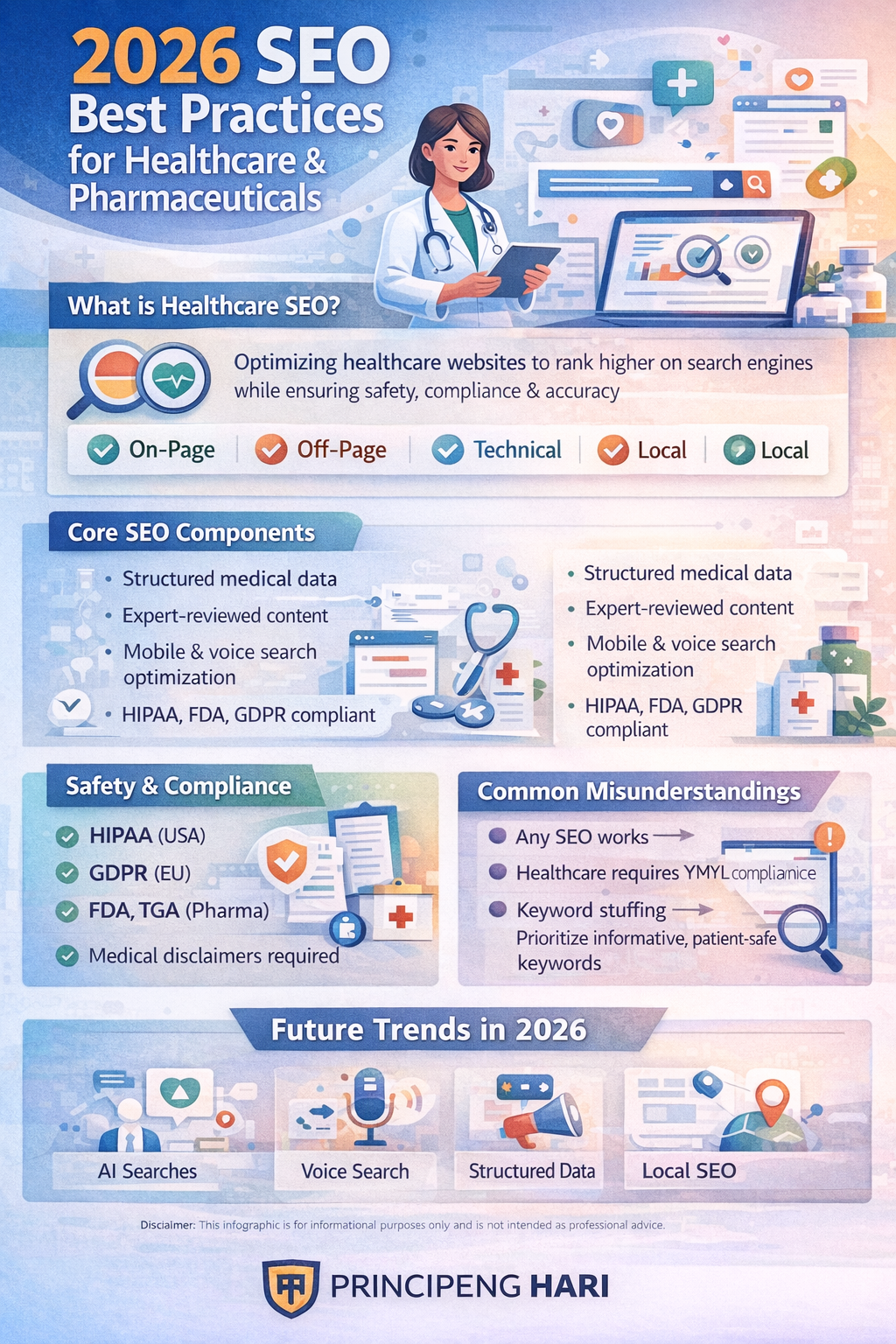
Key steps to optimize healthcare and pharmaceutical websites safely in 2026
3. What Is Healthcare SEO?
Healthcare SEO refers to search engine optimization specifically designed for the healthcare and pharmaceutical industries. Unlike general SEO, healthcare SEO must balance visibility with accuracy, compliance, and patient safety.
Key elements include:
-
On-page optimization: Meta tags, headings, keyword placement, and readability
-
Technical SEO: Fast loading pages, mobile-first design, secure HTTPS, and structured data
-
Off-page SEO: Backlinks from reputable medical sources and institutions
-
Local SEO: Optimizing for clinics, hospitals, and pharmacy locations
Healthcare SEO ensures that patients and professionals can find trusted information easily, while companies remain compliant with YMYL rules. This specialized SEO strategy is essential in 2026 due to increased regulatory scrutiny and AI-driven search results.
Link to Introductory Guide
Next Funnel Link: Awareness
4. Who This Information Applies To
This guide is essential for:
-
Digital marketers in healthcare and pharma
-
Pharmaceutical companies managing product information online
-
Hospital administrators and clinic managers seeking to attract patients safely
-
Health startups building digital presence for telehealth services
The information ensures that professionals can optimize their websites effectively while adhering to regulatory standards and maintaining trustworthiness. By implementing these best practices, organizations can increase visibility, protect patients, and enhance credibility.
Join Newsletter for Updates
Next Funnel Link: Awareness
5. How SEO Works in Pharmaceuticals
SEO in pharmaceuticals involves a multi-layered approach to content, technical architecture, and compliance. It includes:
-
Content Strategy: Writing evidence-based articles, FAQs, and guides reviewed by certified experts.
-
Technical SEO: Fast load times, secure connections, structured data for drugs and treatments.
-
Authority Signals: Citations from peer-reviewed journals, trusted health institutions, and official medical organizations.
-
AI Optimization: Using conversational queries and semantic search-friendly content.
In pharmaceuticals, accuracy is paramount. A poorly optimized website risks misinforming patients, harming brand trust, and violating regulations. 2026 SEO requires both digital marketing expertise and medical domain knowledge.
Link to Technical SEO Checklist
Next Funnel Link: Awareness
6. Core Components / Types
Healthcare and pharmaceutical SEO relies on several core components:
1. On-Page SEO: Clear headings, meta descriptions, alt text, and structured content optimized for readability and compliance.
2. Off-Page SEO: Backlinks from verified medical sources, scientific journals, or government health agencies.
3. Local SEO: Google Business Profiles for clinics, pharmacies, and hospitals; geo-targeted content.
4. Technical SEO: Fast mobile-friendly pages, HTTPS security, sitemap submission, structured data (Schema.org MedicalEntity, Drug, FAQPage).
These elements ensure visibility, compliance, and trust while meeting modern search engine requirements.
Link to Core SEO Toolkit
Next Funnel Link: Awareness
7. Benefits, Limitations & Risks
Benefits:
-
Higher visibility for patients and professionals
-
Enhanced trust and credibility
-
Increased patient acquisition and engagement
Limitations:
-
Slow adoption due to compliance constraints
-
Complexity of managing YMYL content
-
High competition in pharma and healthcare niches
Risks:
-
Penalties for misinformation or non-compliance
-
Reduced rankings if E-E-A-T standards are not met
-
Potential legal liabilities under HIPAA, GDPR, or TGA regulations
A thoughtful approach balances visibility, compliance, and patient safety while minimizing exposure to risk.
Link to Risk Mitigation Guide
Next Funnel Link: Awareness
8. Safety, Compliance & Regulations
Healthcare SEO is governed by:
-
HIPAA (US): Protects patient privacy and data security
-
GDPR (EU): Governs user data processing and consent
-
FDA (US): Regulates online pharmaceutical claims
-
TGA (Australia): Ensures drug information accuracy
-
Local medical boards globally
Content must include:
Compliant websites build trust, avoid penalties, and ensure patient safety.
Link to Compliance Resource
Next Funnel Link: Awareness
9. Common Misunderstandings
-
“Any SEO strategy works in healthcare” → FALSE, requires compliance
-
“Keyword stuffing is safe” → FALSE, harms rankings and credibility
-
“AI-generated content replaces expert review” → FALSE, human verification is mandatory
Understanding these pitfalls prevents legal issues and maintains authority.
Link to Common Mistakes Guide
Next Funnel Link: Awareness
10. Evidence, Standards & Sources
Use peer-reviewed and official sources:
-
World Health Organization (WHO)
-
U.S. Food & Drug Administration (FDA)
-
Therapeutic Goods Administration (TGA, Australia)
-
PubMed and medical journals
-
Google’s Search Quality Evaluator Guidelines
Evidence-based SEO ensures compliance, trust, and effectiveness.
Access Curated Source Library
Next Funnel Link: Awareness
11. Future Developments in 2026
Key trends:
-
AI-driven SEO: Semantic search, conversational queries
-
Voice search optimization for patients seeking urgent info
-
Enhanced structured data for medical FAQs, treatments, and drug information
-
Geo-targeted and hyper-local content for clinics and pharmacies
Healthcare organizations must adapt quickly to emerging technologies while maintaining regulatory compliance.
Sign Up for Future Trends Webinar
Next Funnel Link: Awareness
12. Frequently Asked Questions
Q1: How do I optimize medical content safely?
A: Always use certified experts, cite authoritative sources, and include disclaimers.
Q2: Which schema types are mandatory?
A: MedicalEntity, Drug, FAQPage, Article, and Organization for health providers.
Q3: How can I rank locally for my pharmacy?
A: Optimize Google Business Profile, include local schema, and geo-targeted content.
Visit FAQ Hub
Next Funnel Link: Awareness
13. Final Considerations & Next Steps
To succeed in 2026, healthcare and pharmaceutical organizations must:
-
Prioritize accuracy and compliance
-
Implement structured data and E-E-A-T signals
-
Optimize for mobile and AI-driven search
-
Maintain regular expert review
By following these guidelines, organizations can move from Awareness to Consideration, building both visibility and trust.
Link to Consideration Stage Guide
Next Funnel Link: Consideration