Content Outline
- Why Understanding the Difference Matters
- What is Marketing?
- What is Growth?
- What is Brand?
- Comparing Marketing, Growth, and Brand
- How Businesses Use Each Strategically
- Key Takeaways
- Practical Checklist
- FAQ
Why Understanding the Difference Matters
In today’s competitive business landscape, terms like marketing, growth, and brand are often used interchangeably. However, each serves a unique role in shaping a company’s strategy. Understanding these differences helps leaders make informed decisions, allocate resources effectively, and communicate with stakeholders clearly.
This article provides an educational overview that is globally compliant, ethically framed, and safe for digital platforms.
What is Marketing?
Marketing is the practice of communicating a business’s products or services to an audience to create awareness, interest, and engagement. It encompasses activities such as:
-
Content creation (blogs, social media posts, videos)
-
Advertising campaigns (paid and organic)
-
Search engine optimization (SEO)
-
Customer research and insights
Marketing focuses on strategic communication and value delivery rather than instant results. It is foundational for attracting attention and maintaining relevance in a crowded market.
What is Growth?
Growth refers to the strategies and tactics aimed at scaling a business, increasing customer acquisition, revenue, or market share. Growth strategies often combine marketing efforts with product improvements, sales optimization, and user experience enhancements.
Key elements include:
-
Conversion rate optimization
-
Retention programs and loyalty initiatives
-
Experimentation and analytics-based decision-making
-
Cross-channel campaigns aligned with performance metrics
While marketing creates awareness, growth emphasizes measurable expansion and often relies on iterative testing to find what works.
What is Brand?
Brand represents the perception, reputation, and identity of a company or product in the minds of customers. Strong brands convey trust, credibility, and consistency. Branding includes:
-
Visual identity (logos, color palette, typography)
-
Messaging tone and voice
-
Mission, values, and storytelling
-
Customer experience and service standards
Branding is less about immediate conversions and more about long-term relationships and loyalty. It provides a framework that marketing and growth strategies operate within.
Comparing Marketing, Growth, and Brand
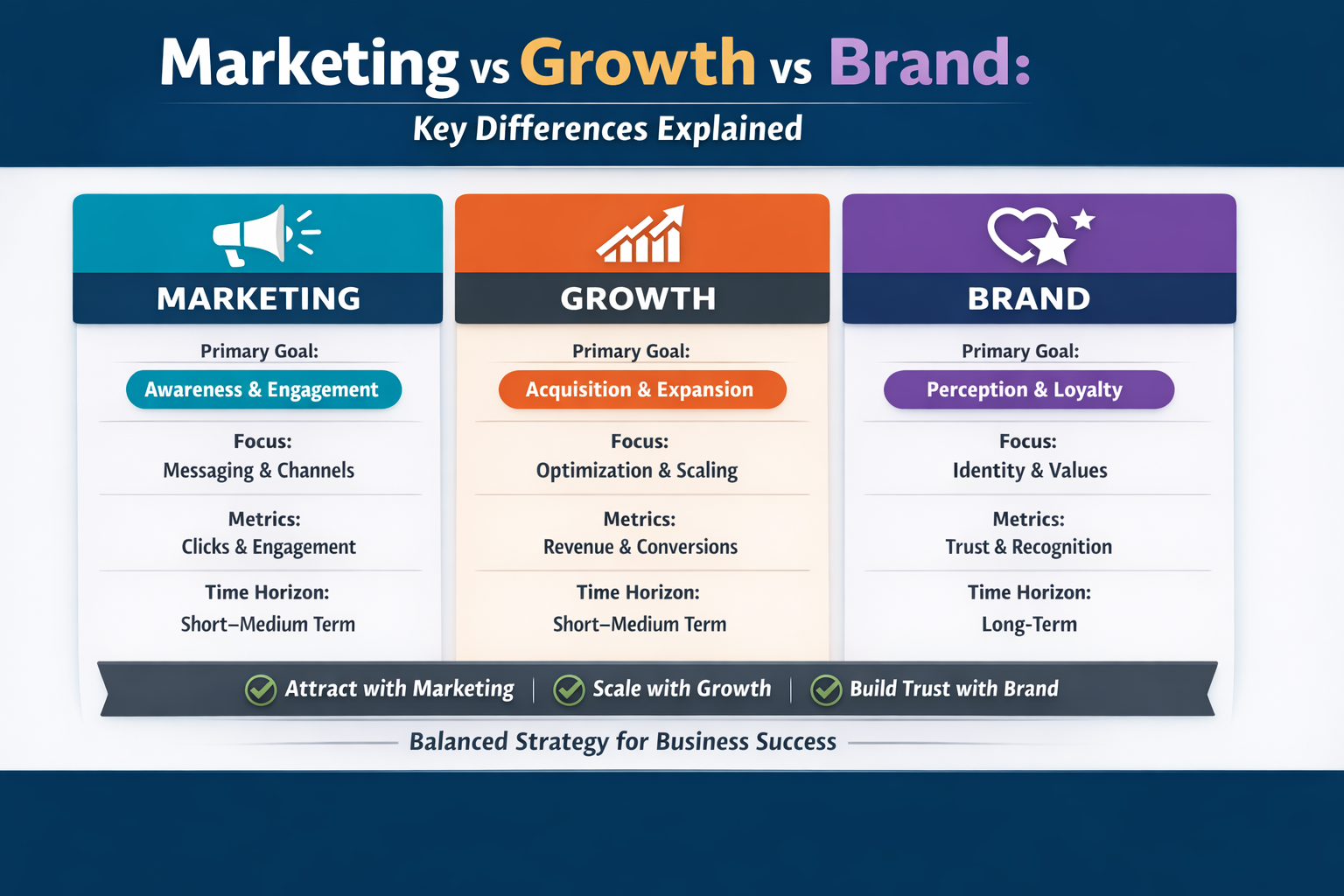
| Aspect | Marketing | Growth | Brand |
|---|---|---|---|
| Primary Goal | Awareness & engagement | Acquisition & expansion | Perception & loyalty |
| Time Horizon | Short–medium | Short–medium | Long-term |
| Metrics | Clicks, impressions, engagement | Conversion rates, revenue growth | Brand recall, NPS, trust |
| Focus | Messaging & channels | Experiments & optimization | Identity & values |
Understanding these distinctions allows businesses to align marketing campaigns, growth initiatives, and brand development for maximum strategic impact.
How Businesses Use Each Strategically
- Marketing campaigns are often used to attract attention and educate potential customers.
- Growth strategies focus on testing channels, optimizing funnels, and scaling successful tactics.
- Brand initiatives ensure consistent messaging, build trust, and support long-term retention.
A balanced approach integrates all three, ensuring that short-term growth does not compromise brand integrity, and marketing activities are guided by a cohesive identity.
Key Takeaways
-
Marketing = Communication & awareness
-
Growth = Expansion & measurable results
-
Brand = Perception & long-term trust
-
All three should work together in a compliant, ethical, and strategic manner
Practical Checklist
-
Define your marketing objectives clearly
-
Identify growth metrics for experimentation
-
Audit brand messaging and visual identity
-
Align marketing campaigns with brand values
-
Track performance ethically and transparently
FAQ
Q1: Can growth replace marketing?
A1: No, growth often relies on marketing to generate awareness and initial engagement. They are complementary strategies.
Q2: How does brand impact conversions?
A2: Strong branding builds trust, which indirectly supports higher engagement and conversion rates over time.
Q3: Should small businesses prioritize brand or growth?
A3: Both are important. Early-stage businesses may focus on marketing and growth to establish presence while maintaining brand consistency.
Trusted Sources / Standards
-
Google Search Central (SEO & AEO Guidelines)
-
Meta Business Help Center (Advertising & Brand Policies)
-
TikTok Business Documentation (Platform Marketing Compliance)
-
FTC Consumer Guidance (Truth in Advertising)
-
Government Consumer Protection Agencies (e.g., Philippines RA 7394, RA 8792, RA 10173)
Disclaimer
“This content is provided for general educational purposes only. Digital marketing results vary depending on market conditions, platform rules, audience behavior, and execution.”
Summary
Marketing, growth, and brand serve distinct roles in business strategy. Marketing builds awareness, growth drives measurable expansion, and brand establishes long-term trust. Together, they guide decisions, optimize campaigns, and strengthen market presence. This overview provides an educational framework that is ethical, compliant, and safe for global digital marketing applications.