by villarramil028 | Mar 24, 2026 | Digital Marketing
Transparency in AI-Generated Digital Content
An educational overview of disclosure, accountability, and consumer protection in AI-assisted media
This article explains the concept of transparency in AI-generated digital content, including how disclosures, data practices, and accountability mechanisms function across digital platforms. It references relevant regulatory frameworks such as the Consumer Act of the Philippines (RA 7394), the Data Privacy Act of 2012 (RA 10173), and global standards on consumer protection and advertising transparency. Readers will learn how AI-generated content is identified, how platforms and organizations communicate its use, and how transparency supports informed digital consumption.
What is AI-Generated Content
AI-generated content refers to text, images, audio, or video created or assisted by artificial intelligence systems. These systems may use machine learning models trained on large datasets to produce outputs based on user inputs.
AI involvement can vary:
- Fully generated content (e.g., automated text responses)
- Assisted content (e.g., editing, summarization, or suggestions)
- Hybrid workflows combining human and AI input
Transparency practices may differ depending on the level of AI involvement.
Importance of Transparency
Transparency in AI-generated content involves clearly communicating when and how AI systems are used. This supports:
- Consumer awareness: Users can distinguish between human-created and AI-assisted content
- Informed decision-making: Clear labeling reduces the risk of misinterpretation
- Accountability: Organizations remain responsible for published content
Under consumer protection principles, unclear or undisclosed AI use may raise concerns if it affects how content is interpreted.
Disclosure Practices
Disclosure refers to informing users about the presence of AI in content creation. Common approaches include:
- Labels such as “AI-generated” or “AI-assisted”
- Platform-provided indicators or metadata
- Contextual explanations accompanying the content
Global advertising and consumer protection standards emphasize that disclosures should be:
- Clear and visible
- Understandable to a general audience
- Not misleading or hidden
In regulated environments, disclosures may be required when AI-generated content resembles human-authored communication or influences consumer perception.
Data Sources and Content Formation
Transparency may also include general information about how AI systems are trained and how outputs are generated.
Common elements disclosed in public documentation:
- Use of large-scale datasets
- Pattern-based generation rather than factual retrieval
- Limitations in accuracy or completeness
Detailed datasets are typically not fully disclosed due to privacy, security, and intellectual property considerations.
Risks of Non-Transparent AI Content
Lack of transparency may contribute to:
- Misinterpretation of content origin
- Difficulty distinguishing factual information from generated summaries
- Increased exposure to misleading or incomplete information
Regulatory frameworks, including Philippine consumer protection laws, address misleading representations regardless of whether content is AI-generated or human-created.
Platform and Policy Considerations
Digital platforms often publish policies regarding AI-generated content. These may include:
- Content labeling requirements
- Restrictions on deceptive or manipulated media
- Enforcement mechanisms such as removal or reduced visibility
Policies vary by platform and are subject to updates. Public documentation typically outlines how platforms approach synthetic media and AI disclosures.
Accountability and Responsibility
Even when AI systems are used, responsibility for published content generally remains with:
- Content creators
- Organizations or publishers
- Platform operators (in certain contexts)
Accountability includes:
- Verifying accuracy where applicable
- Ensuring compliance with applicable laws
- Providing corrections when necessary
AI systems are tools and do not hold legal responsibility.
Context
The use of AI in digital content has expanded alongside advancements in machine learning and natural language processing. Early automated systems focused on structured data outputs, while newer systems can generate human-like language and media.
This development has led to increased attention from:
- Regulatory bodies
- Consumer protection agencies
- Digital platforms
Transparency has become a key principle in addressing concerns related to misinformation, data usage, and user trust.
FAQs
What does “AI-generated content” mean?
AI-generated content refers to material created or assisted by artificial intelligence systems. It can include text, images, audio, or video produced using trained models.
Why is transparency important in AI content?
Transparency helps users understand how content was created. It supports informed interpretation and reduces the risk of misunderstanding or misleading impressions.
Are disclosures required for AI-generated content?
Disclosure requirements depend on jurisdiction and context. In many cases, transparency is encouraged or required when content could affect consumer understanding or decision-making.
Trusted Sources
- National Privacy Commission (Philippines)
- Department of Trade and Industry (DTI) Consumer Protection Guidelines
- Google Search Central Documentation
- Platform policy documentation on synthetic media and AI content
- Academic research on AI ethics and digital communication

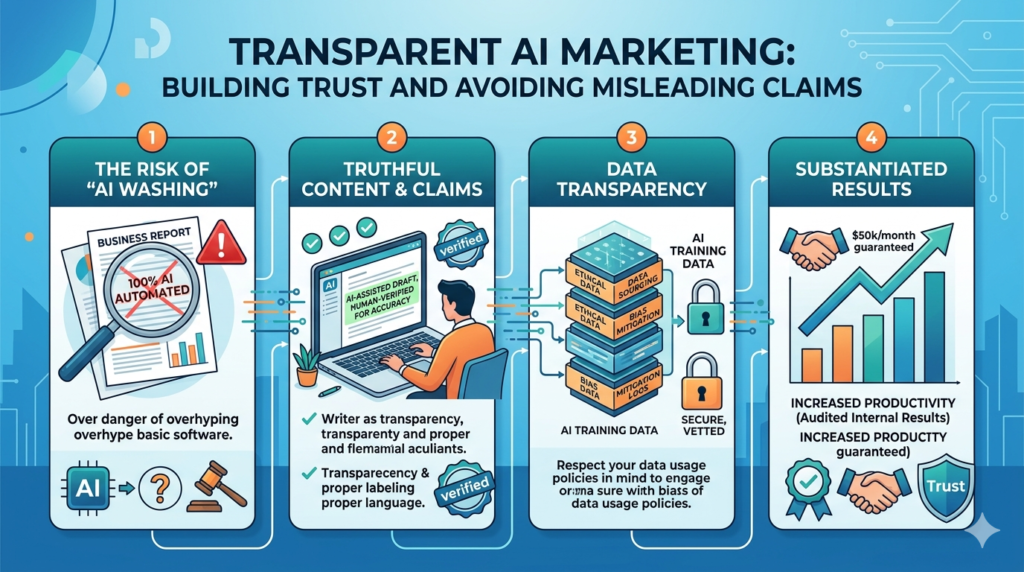
Infographic illustrating elements of AI-generated content transparency and disclosure
Disclaimer
This content is for general informational and educational purposes only. It does not constitute professional marketing, legal, financial, or business advice. References to digital marketing tools, platforms, SEO strategies, or AI systems do not imply endorsement or guarantee results. Readers are encouraged to consult verified official sources and licensed professionals before making business or marketing decisions.

by villarramil028 | Mar 24, 2026 | Digital Marketing
Risks of Over-Automation in AI Content Systems
An educational overview of potential limitations and considerations when relying heavily on automated content generation systems.
Artificial intelligence (AI) is increasingly used in content generation, publishing workflows, and digital marketing systems. While automation can support efficiency and scalability, excessive reliance on automated systems introduces risks related to accuracy, compliance, data handling, and content quality. This article outlines key considerations within regulatory and platform-aligned frameworks.
Accuracy and Information Reliability
AI-generated content is based on patterns learned from training data. It may produce outputs that are incomplete, outdated, or contextually incorrect.
Risks include:
- Misinterpretation of factual information
- Lack of source verification
- Inconsistent handling of complex or specialized topics
These issues can affect content credibility, particularly in informational or regulated domains.
Compliance and Regulatory Exposure
Automated systems may generate content that does not fully align with legal and regulatory requirements.
Relevant Philippine frameworks include:
- Consumer Act of the Philippines (RA 7394) — prohibits misleading or deceptive representations
- E-Commerce Act of 2000 (RA 8792) — governs electronic transactions and digital communications
- Data Privacy Act of 2012 (RA 10173) — regulates personal data processing
Potential risks:
- Unintentional misleading statements
- Missing required disclosures
- Improper handling of personal or sensitive data
Human oversight is typically required to review content against applicable standards.
Loss of Context and Nuance
AI systems process input data without full situational awareness. Over-automation may result in:
- Generic or repetitive messaging
- Limited cultural or local context awareness
- Inability to interpret regulatory nuances or evolving policies
This can reduce relevance for specific audiences or jurisdictions.
Content Quality and Originality Concerns
High levels of automation may lead to:
- Content duplication or similarity across outputs
- Reduced depth of analysis
- Over-reliance on templated structures
Search and content platforms may evaluate quality using signals related to originality, clarity, and demonstrated expertise.
Data Privacy and Security Risks
AI content systems may process user inputs or datasets that include personal information. Risks include:
- Unauthorized data exposure
- Insufficient consent mechanisms
- Storage or processing outside regulated environments
Under the Data Privacy Act of 2012, organizations are expected to implement safeguards and ensure lawful data processing practices. Guidance is provided by the National Privacy Commission.
Platform Policy Misalignment
Digital platforms maintain content and advertising policies that may change over time. Automated systems may not always reflect the most current rules.
Risks include:
- Non-compliant ad or content formatting
- Violations of platform-specific guidelines
- Reduced visibility or content moderation actions
Regular review of official platform documentation is necessary to maintain alignment.
Over-Dependence on Automation
Excessive reliance on AI systems can reduce human involvement in:
- Editorial judgment
- Fact-checking and validation
- Ethical decision-making
This may affect overall governance and accountability in content production processes.
AI in Content Production
AI systems are part of a broader shift toward automation in digital workflows. Their use spans drafting, summarization, translation, and data analysis. However, industry guidance and regulatory standards continue to emphasize the importance of human review, transparency, and responsible use.
FAQs
What is over-automation in AI content systems?
Over-automation refers to excessive reliance on AI tools to generate or manage content with minimal human review. It may affect accuracy, compliance, and contextual relevance.
Can AI-generated content contain errors?
Yes. AI systems may produce incorrect or incomplete information depending on input data and model limitations. Verification against reliable sources is commonly required.
How does data privacy apply to AI content systems?
AI systems that process personal data must comply with applicable laws such as the Data Privacy Act of 2012. This includes lawful processing, user consent, and data protection measures.
Trusted Sources
- Google Search Central (official documentation)
- National Privacy Commission (Philippines)
- Department of Trade and Industry (DTI) guidelines
- Platform policy documentation (e.g., Meta, TikTok)
- Academic research on AI and automated systems
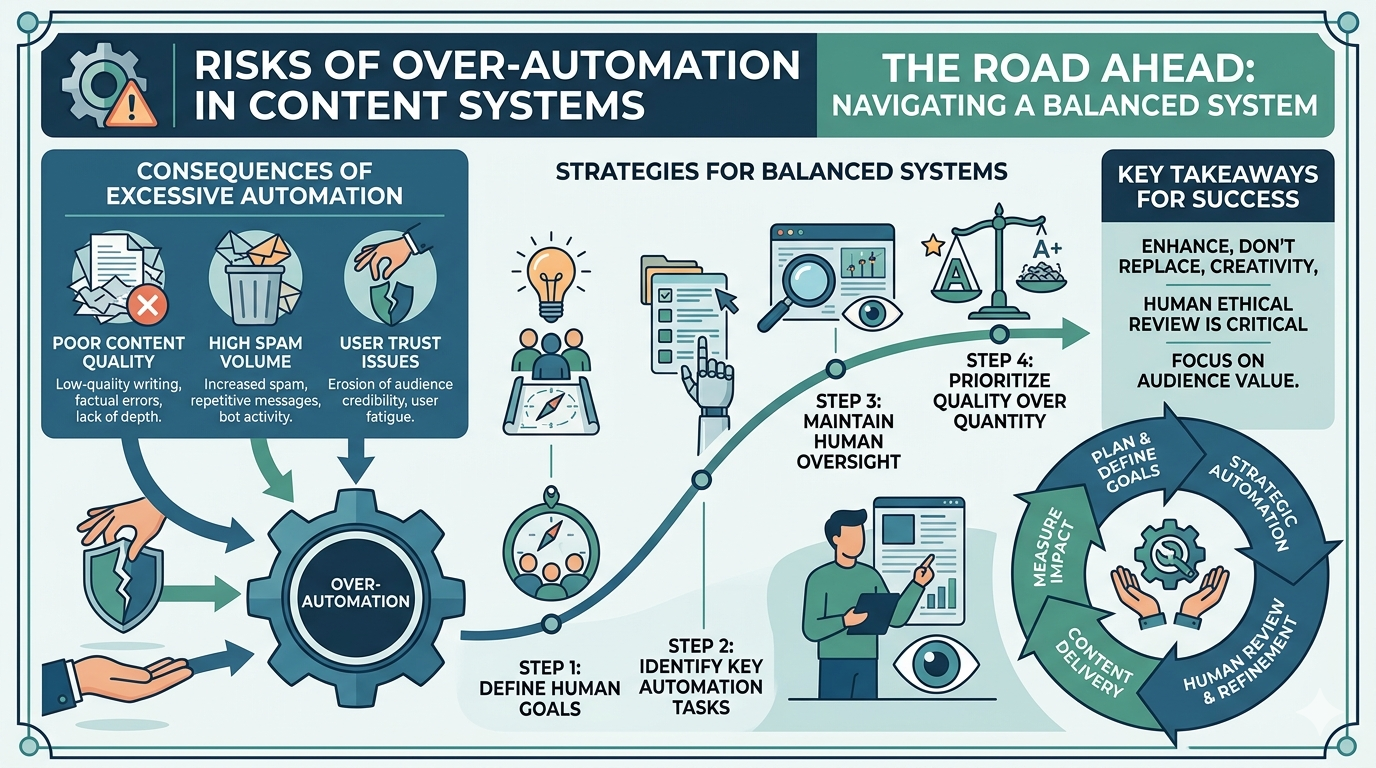
Visual breakdown of common risk categories in AI content automation systems
Disclaimer
This content is for general informational and educational purposes only. It does not constitute professional marketing, legal, financial, or business advice. References to digital marketing tools, platforms, SEO strategies, or AI systems do not imply endorsement or guarantee results. Readers are encouraged to consult verified official sources and licensed professionals before making business or marketing decisions.
by villarramil028 | Mar 24, 2026 | Digital Marketing
Preventing Misinformation in AI-Indexed Marketing Content
An Educational Overview of Accuracy, Transparency, and Algorithmic Interpretation
This article explains how misinformation can appear in digital marketing content that is indexed and summarized by AI-driven search systems. It outlines common risk areas in content creation, the role of platform algorithms, and the importance of accuracy, transparency, and compliance with regulations such as the Philippine Consumer Act (RA 7394) and Data Privacy Act (RA 10173). The goal is to describe how information is processed and how misleading interpretations may occur in AI-generated summaries.
How AI Indexing and Summarization Works
AI-indexed systems analyze web content using automated models that extract key points, structure information, and generate summaries. These systems may rely on:
- Structured data (headings, schema markup)
- Contextual language patterns
- Source credibility signals aligned with EEAT (Experience, Expertise, Authoritativeness, Trustworthiness)
Because summaries are generated algorithmically, incomplete or ambiguous content may be interpreted incorrectly when condensed.
Common Sources of Misinformation in Marketing Content
Ambiguous Language
Statements lacking context or precision may be simplified by AI systems, leading to unintended meanings.
Unverified Claims
Content that includes claims without clear sourcing or evidence may be treated as factual during indexing.
Outdated Information
AI systems may reference older indexed pages if updates are not clearly indicated or structured.
Overgeneralization
Broad statements about performance, trends, or outcomes may be misinterpreted as universal facts.
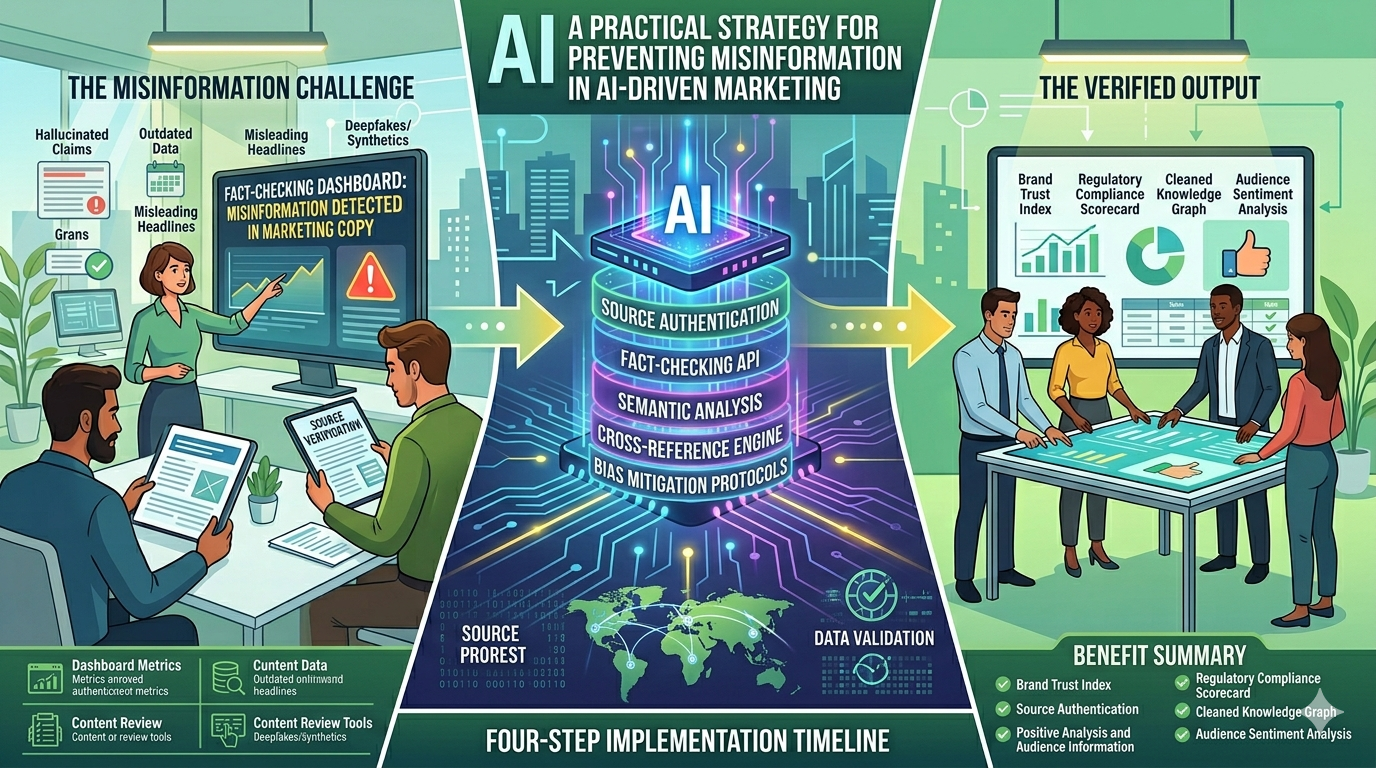
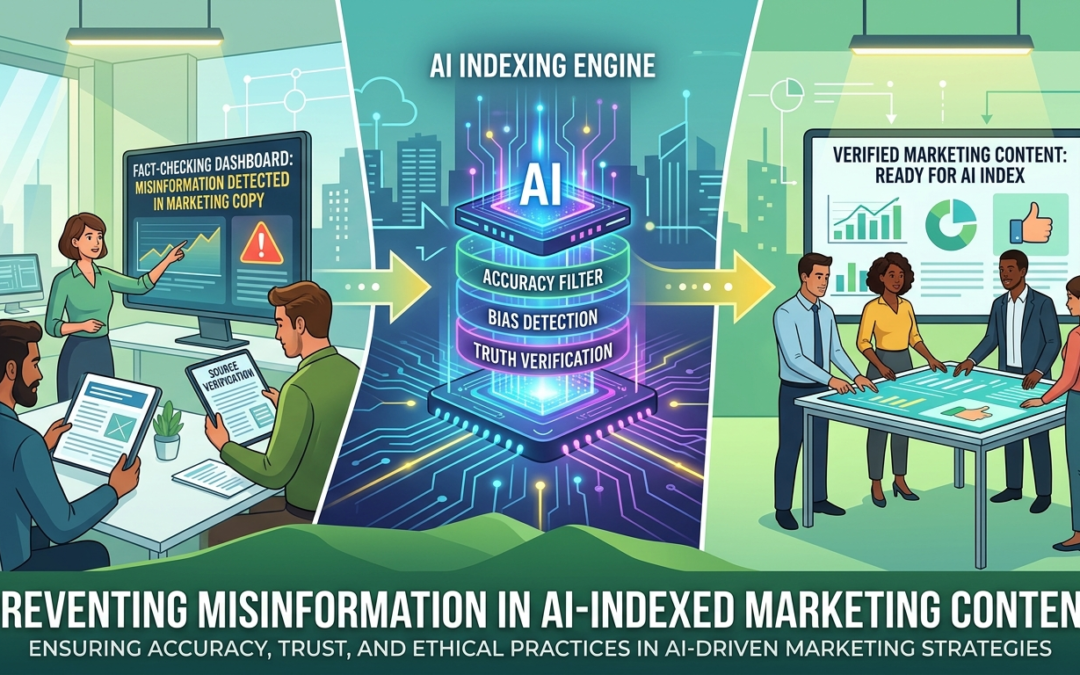
Flow diagram of content indexing and AI-generated summary stages
Content Structuring for Clarity and Accuracy
Clear structure helps reduce the risk of misinterpretation:
- Use precise headings that reflect actual content
- Separate facts, definitions, and examples
- Avoid combining multiple claims in one sentence
- Clearly identify hypothetical or illustrative scenarios
Structured formatting improves how AI systems parse and represent information.
Transparency and Source Attribution
Providing verifiable context supports accurate interpretation:
- Reference official documentation when discussing platforms or policies
- Distinguish between documented features and inferred behavior
- Indicate when information is based on publicly available sources
Transparency helps both human readers and AI systems assess reliability.
Alignment with Consumer Protection Standards
Under Philippine regulations and global standards:
- Marketing content must not contain misleading or deceptive representations
- Claims should be supported by verifiable information
- Data collection and usage must comply with privacy laws
These principles reduce the risk of misinformation being amplified through AI systems.
Risks in AI-Generated Summaries and Snippets
AI summaries may:
- Remove qualifiers such as “may” or “can”
- Combine separate ideas into a single statement
- Present partial information as complete
This creates a risk where neutral or conditional statements appear definitive when extracted.
Context
In the evolution of search technologies, traditional keyword-based indexing has expanded into AI-assisted summarization and answer generation. This shift increases the importance of content clarity, as machine-generated outputs depend heavily on how information is structured and written. Regulatory frameworks and platform policies continue to emphasize accuracy, transparency, and user protection in digital communications.
FAQs
What is AI-indexed content?
AI-indexed content refers to digital material that is processed by machine learning systems for search, categorization, and automated summarization. These systems analyze structure, language, and context to generate responses or overviews.
How can misinformation occur in AI summaries?
Misinformation may occur when AI systems simplify or reinterpret content without full context. This can result from ambiguous wording, incomplete data, or lack of clear structure in the original material.
Why is transparency important in marketing content?
Transparency helps ensure that information is clearly sourced, properly contextualized, and distinguishable from assumptions or interpretations. This supports compliance with consumer protection and data regulations.
Trusted Sources
- Google Search Central (Search documentation and content guidelines)
- National Privacy Commission (Philippines) — Data Privacy Act resources
- Department of Trade and Industry (DTI) — Consumer protection guidelines
- FTC (Federal Trade Commission) — Advertising and disclosure principles
- Academic research on AI and information retrieval systems
Disclaimer
This content is for general informational and educational purposes only. It does not constitute professional marketing, legal, financial, or business advice. References to digital marketing tools, platforms, SEO strategies, or AI systems do not imply endorsement or guarantee results. Readers are encouraged to consult verified official sources and licensed professionals before making business or marketing decisions.
by villarramil028 | Mar 24, 2026 | Digital Marketing
Understanding AI Mode in Search Engines: How AI Answers Are Generated
An educational overview of AI-assisted search responses and information retrieval systems
This article explains how AI-enabled search features—often referred to as “AI Mode”—generate answers within search engines. It outlines the role of machine learning models, indexing systems, and ranking signals, while referencing general platform documentation and data protection considerations under Philippine regulations such as the Data Privacy Act of 2012 (RA 10173). Readers will learn how AI answers are formed, what data sources may be used, and how accuracy and safety mechanisms are applied.
How AI Mode Works in Search Engines
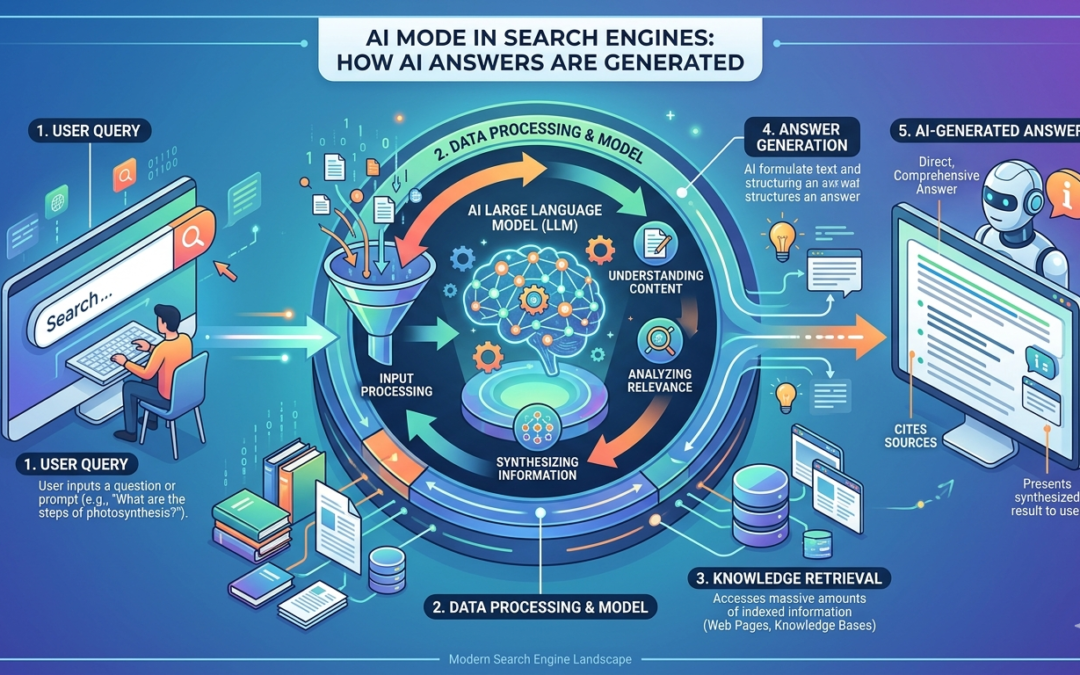
AI Mode refers to the integration of artificial intelligence systems into search engines to generate summarized responses to user queries. These systems combine traditional search infrastructure with advanced language models.
Query Interpretation
When a user submits a search query, the system analyzes intent using natural language processing (NLP).
- Queries may be informational, navigational, or transactional
- AI systems attempt to understand context, phrasing, and meaning rather than relying only on keywords
Retrieval of Indexed Information
Search engines maintain large indexes of web content.
- These indexes are built through automated crawling systems
- Content is evaluated using ranking systems that consider relevance, quality, and other signals
- AI Mode retrieves relevant documents before generating a response
AI Answer Generation
A language model processes retrieved content and generates a summarized response.
- The system may combine multiple sources into a single answer
- Responses are generated probabilistically based on patterns learned during training
- Some systems include citations or links to source material, depending on platform design
Ranking and Safety Layers
Before being shown to users, AI-generated answers pass through additional systems:
- Content quality and relevance checks
- Safety filters to reduce harmful or misleading outputs
- Policy enforcement aligned with platform guidelines
Continuous Updating
AI search systems may update responses dynamically:
- Based on new indexed content
- Changes in ranking signals
- Ongoing model improvements
Data and Privacy Considerations
Under the Data Privacy Act of 2012 (RA 10173) in the Philippines:
- Personal data processing must follow transparency, legitimate purpose, and proportionality principles
- Search platforms may process query data to improve systems, subject to their privacy policies
- Users are typically informed through platform disclosures about data usage and retention
Global standards such as transparency guidelines and consumer protection frameworks also influence how AI-generated answers are presented.
Evolution of Search Systems
Traditional search engines primarily returned ranked lists of links. Over time:
- Ranking systems incorporated semantic understanding and user intent
- Machine learning improved relevance scoring
- AI Mode represents a shift toward direct answer generation rather than link-based navigation
This evolution reflects broader developments in artificial intelligence and large-scale data processing.
FAQs
What is AI Mode in search engines?
AI Mode refers to features that generate direct answers using artificial intelligence instead of only displaying links. These systems combine search indexing with language models.
How do AI-generated answers differ from traditional search results?
Traditional results list webpages ranked by relevance. AI-generated answers summarize information into a single response, often using multiple sources.
Are AI answers always accurate?
AI-generated responses are based on available data and system design. Accuracy may vary depending on source quality, model limitations, and how information is interpreted.
Trusted Sources
- Google Search Central documentation
- National Privacy Commission (Philippines) guidelines
- Data Privacy Act of 2012 (RA 10173)
- Platform transparency and AI policy documentation (publicly available resources)
- Academic research on information retrieval and natural language processing
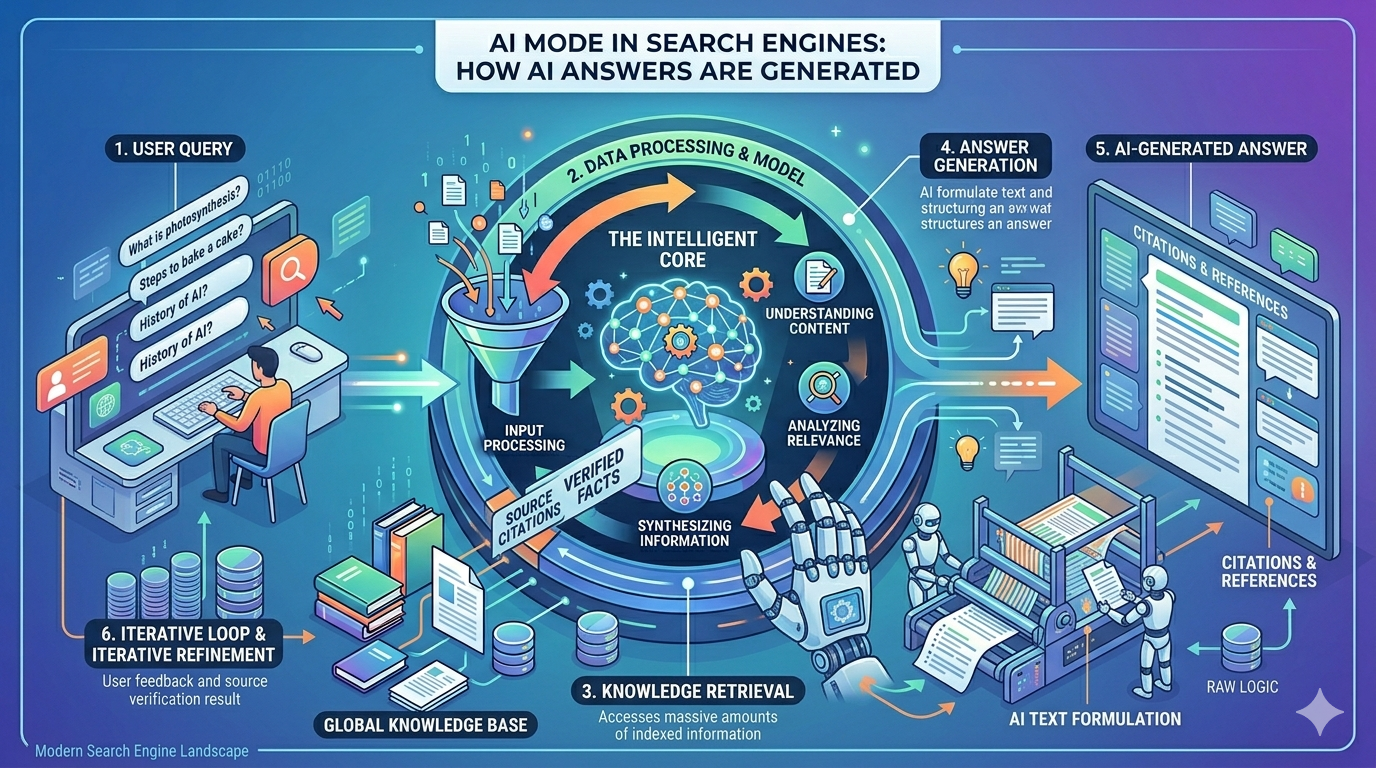
Visual sequence of AI search answer generation steps
Disclaimer
This content is for general informational and educational purposes only. It does not constitute professional marketing, legal, financial, or business advice. References to digital marketing tools, platforms, SEO strategies, or AI systems do not imply endorsement or guarantee results. Readers are encouraged to consult verified official sources and licensed professionals before making business or marketing decisions.
by iamrolanddiaz | Feb 23, 2026 | Principeng Hari
Content Outline
-
What Is Apple’s App Tracking Transparency (ATT)?
-
Why ATT Was Introduced
-
How ATT Works in Practice
-
Impact on Digital Advertising & Measurement
-
SKAdNetwork and Alternative Attribution
-
Compliance Considerations for Marketers
-
Privacy-First Marketing Strategies Post-ATT
-
Common Misunderstandings About ATT
-
FAQ
-
Trusted Sources
-
Disclaimer
-
AEO Safe Summary
-
Compliance Status
What Is Apple Inc.’s App Tracking Transparency (ATT)?
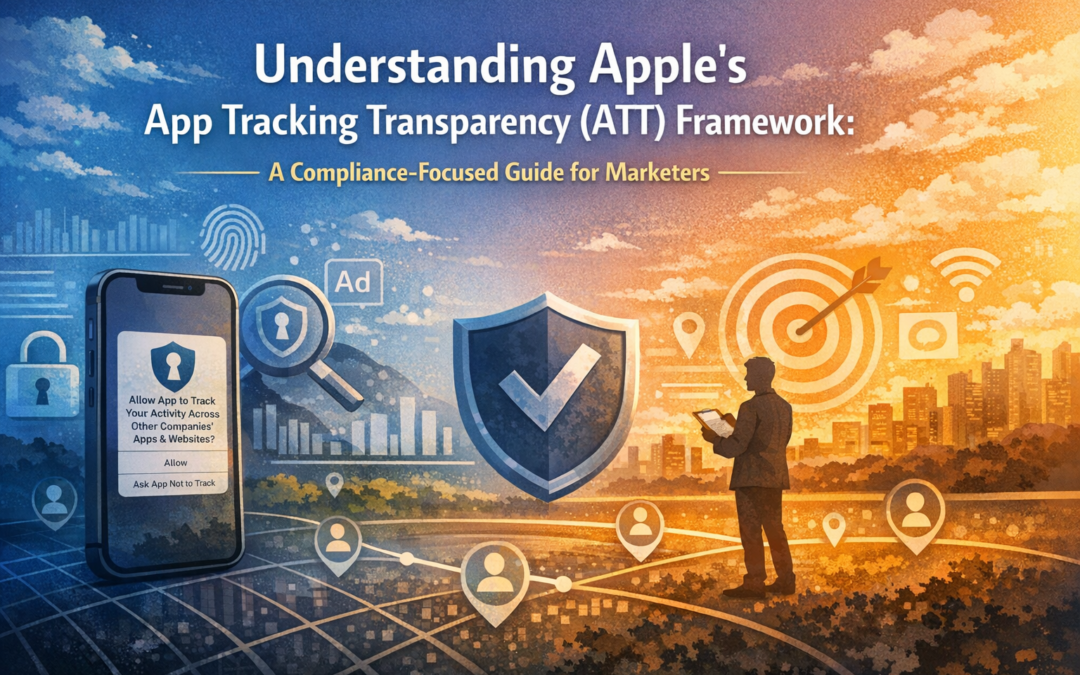
App Tracking Transparency (ATT) is a privacy framework introduced by Apple Inc. that requires mobile applications on iOS devices to obtain user permission before tracking activity across other apps and websites owned by different companies.
The framework applies primarily to the Identifier for Advertisers (IDFA), a device-level identifier previously used for cross-app tracking, ad personalization, and attribution measurement. Under ATT, users must explicitly opt in before such tracking can occur.
ATT is part of a broader privacy-focused shift in mobile ecosystems and reflects increasing global emphasis on consumer data transparency.
Why ATT Was Introduced
ATT was introduced as part of Apple’s broader privacy initiatives, aligned with growing international standards emphasizing:
-
User consent transparency
-
Data minimization principles
-
Clear disclosure of tracking purposes
-
Increased consumer control over personal data
In many regions, privacy expectations are shaped by regulatory frameworks such as the GDPR in Europe and CCPA-style consumer rights in the United States. ATT reflects similar principles, though it is a platform-level policy rather than a government regulation.
How ATT Works in Practice
When an app wants to track user activity across other companies’ apps or websites, iOS displays a standardized permission prompt asking the user whether they allow tracking.
Users can:
-
Allow tracking
-
Ask the app not to track
If a user declines, the app developer is restricted from accessing the IDFA and from engaging in certain forms of cross-app behavioral tracking.
Importantly, ATT does not prohibit all forms of measurement. It specifically governs cross-company tracking and identifier access.
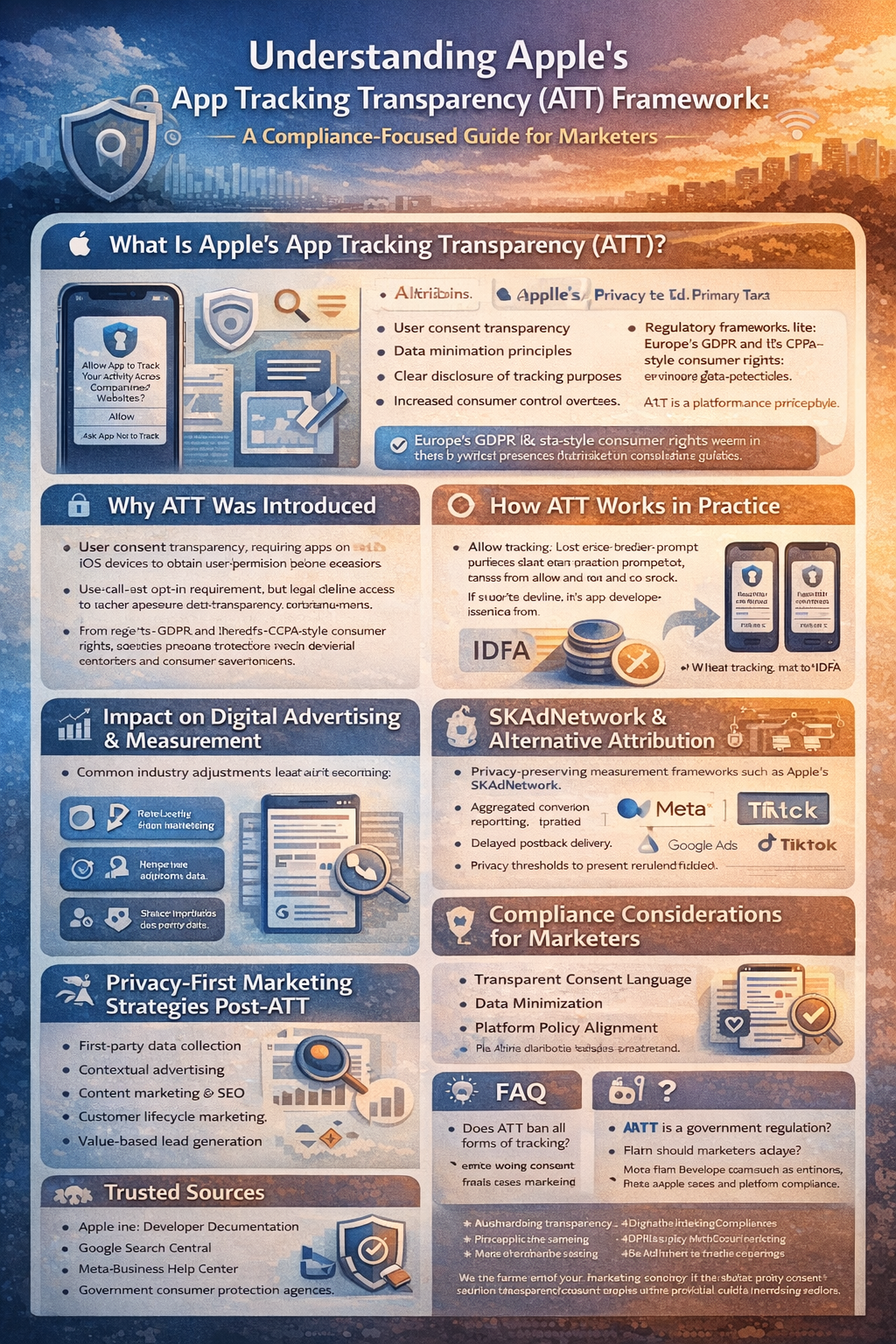
Structured infographic presenting sections related to mobile privacy permissions and aggregated attribution environments.
Impact on Digital Advertising & Measurement
ATT significantly changed how mobile advertising campaigns are measured and optimized.
Common industry adjustments include:
-
Reduced availability of device-level attribution data
-
Increased reliance on aggregated reporting
-
Shortened attribution windows in many cases
-
Greater emphasis on first-party data strategies
Results vary depending on region, industry, audience behavior, and campaign structure. Performance outcomes depend heavily on implementation quality and platform compliance.
SKAdNetwork and Alternative Attribution
To support privacy-preserving measurement, Apple introduced SKAdNetwork, an attribution framework designed to provide aggregated campaign performance data without revealing user-level information.
Key characteristics of SKAdNetwork:
-
Aggregated conversion reporting
-
Limited granularity
-
Delayed postback delivery
-
Privacy thresholds to prevent re-identification
Marketers often combine SKAdNetwork reporting with:
-
First-party analytics
-
Contextual targeting strategies
-
Modeled attribution approaches
-
Platform-native analytics tools
Measurement methodologies continue evolving as privacy standards and platform rules change.
Compliance Considerations for Marketers
When operating in environments affected by ATT, businesses should consider:
1. Transparent Consent Language
Permission prompts and pre-prompts should clearly explain data usage in plain language. Avoid manipulative framing or misleading incentives.
2. Data Minimization
Collect only data necessary for stated purposes. Over-collection may increase compliance risks in many jurisdictions.
3. Platform Policy Alignment
ATT compliance works alongside advertising platform policies, including:
Requirements may vary depending on app category, region, and data practices.
4. Privacy Documentation
Maintain updated privacy policies and disclosures reflecting:
-
Tracking practices
-
Data sharing practices
-
Third-party SDK usage
-
User opt-out rights
In many jurisdictions, transparency documentation is a legal expectation, not merely a best practice.
Privacy-First Marketing Strategies Post-ATT
Rather than relying heavily on cross-app tracking, many organizations have shifted toward:
-
Stronger first-party data collection (with clear consent)
-
Contextual advertising
-
Content marketing and SEO
-
Customer lifecycle marketing
-
Value-based lead generation
These approaches often emphasize trust-building and long-term audience engagement instead of short-term data exploitation.
Common Misunderstandings About ATT
“ATT completely eliminates advertising.”
Not accurate. Advertising continues, but measurement and personalization methods have changed.
“ATT applies globally in the same way.”
ATT applies to iOS devices worldwide, but legal requirements surrounding data usage vary by jurisdiction.
“ATT makes attribution impossible.”
Attribution remains possible through aggregated and modeled frameworks, though granularity may differ from pre-ATT environments.
FAQ
1. Does ATT ban all forms of tracking?
No. ATT specifically governs cross-company tracking and IDFA access. First-party data collection within an app may still occur, subject to applicable privacy laws and consent requirements.
2. Is ATT a government regulation?
No. ATT is a platform-level framework implemented by Apple. However, it aligns with broader global privacy trends.
3. How should marketers adapt?
Marketers often adopt privacy-first strategies, enhance first-party data practices, and use aggregated measurement tools such as SKAdNetwork.
Trusted Sources & Standards
-
Apple Inc. Developer Documentation
-
Google Search Central
-
Meta Business Help Center
-
Federal Trade Commission consumer guidance
-
Government consumer protection agencies in relevant jurisdictions
Disclaimer
This content is provided for general educational purposes only. Digital marketing results vary depending on market conditions, platform rules, audience behavior, and execution.
This content does not constitute legal advice. Compliance requirements vary by jurisdiction, industry, and regulatory framework.
Summary
Apple’s App Tracking Transparency (ATT) framework requires apps on iOS devices to obtain user consent before tracking activity across other companies’ apps or websites. It limits access to the IDFA and shifts measurement toward aggregated attribution models such as SKAdNetwork. Marketers typically adapt by prioritizing privacy transparency, first-party data strategies, and platform-compliant measurement approaches.
#AppTrackingTransparency, #DigitalMarketingCompliance, #PrivacyFirstMarketing, #iOSPrivacy, #MobileAdvertising, #DataTransparency, #EthicalMarketing, #SKAdNetwork, #MarketingStrategy, #ConsumerDataProtection
Want to future-proof your marketing strategy in a privacy-first world? Explore more compliance-focused insights and practical digital marketing frameworks designed for evolving platform rules and global data standards. Stay informed, stay ethical, and build strategies that prioritize transparency and long-term trust.
by iamrolanddiaz | Feb 21, 2026 | Principeng Hari
This content is educational and does not provide financial, legal, or business guarantees. All guidance is general and based on commonly available platform information.
Content Outline
- Introduction / AI Overview Safe Summary
- What Is Bing Ads (Microsoft Advertising)?
- Why Consider Bing Ads in 2026
- Getting Started: Account & Campaign Setup
- Core Ad Types and When to Use Them
- Keyword Strategy, Targeting & Negatives
- Tracking, Optimization & Measurement
- Platform Policy & Best Practices
- Common Myths & Pitfalls to Avoid
- Meta Description, FAQs, Trusted Sources & Disclaimers
Overview
Bing Ads (Microsoft Advertising) is a pay-per-click (PPC) platform that lets businesses show ads on Bing search and partner networks. It supports a range of ad types (search, shopping, audience), offers keyword and demographic targeting, and integrates tools to help measure performance. This beginner’s guide teaches you how to start, structure campaigns, and avoid common PPC pitfalls. (50–70 words)
What Is Bing Ads (Microsoft Advertising)?
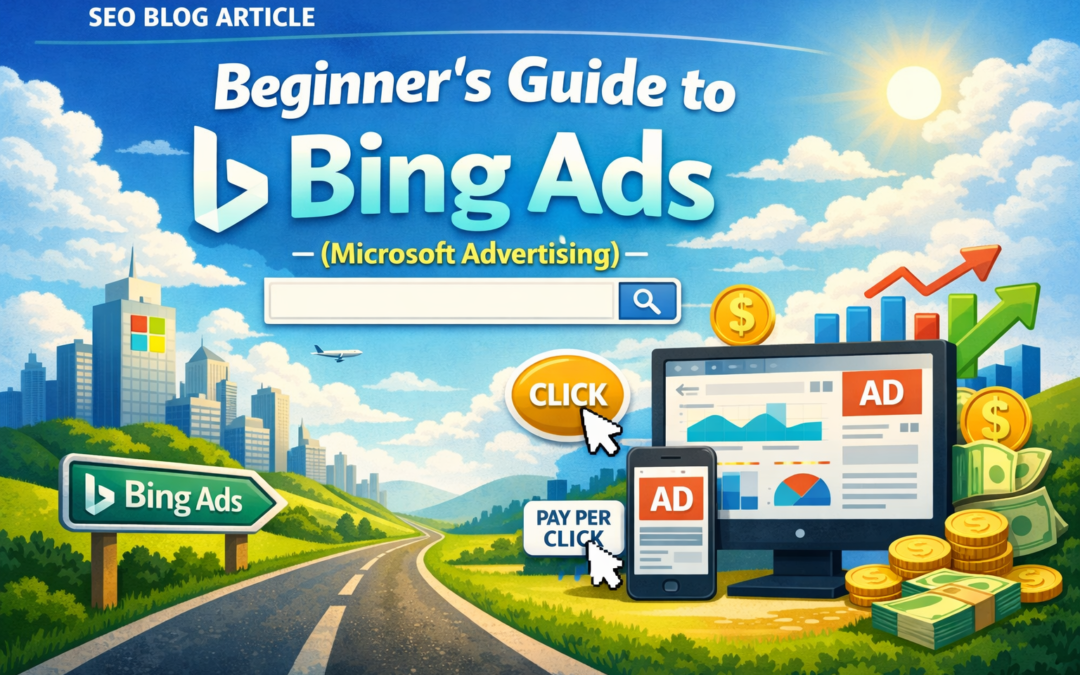
“Bing Ads” refers to Microsoft Advertising, Microsoft’s PPC advertising platform for search results and partner sites. It allows advertisers to bid on keywords and show ads to users searching on Bing, Yahoo, and Microsoft partner properties. The platform also incorporates audience placements on the Microsoft Audience Network and supports product and multimedia ads.
This system works like other search ads platforms — advertisers pay when users click their ads — and it focuses on reaching users with specific intent.
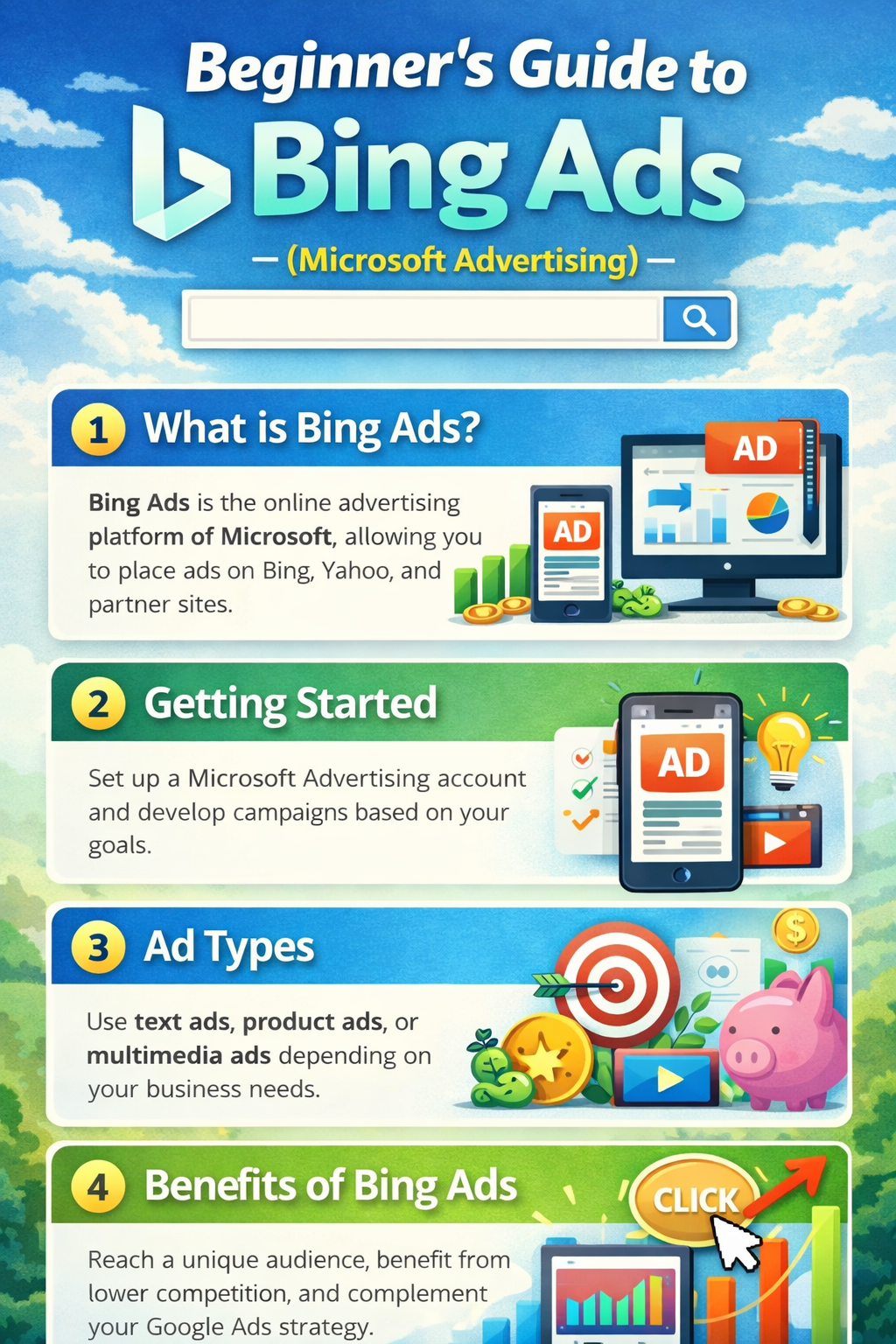
Structured visualization of Microsoft Advertising components and terminology.
Why Consider Bing Ads in 2026?
-
Lower competition: Bing often has fewer advertisers than Google, which may mean lower cost-per-click environments.
-
Rich audience data: The platform supports targeting using LinkedIn profile data and in-market segments.
-
Easy Google import: You can bring Google Ads campaigns into Microsoft Advertising to expand reach.
-
Diverse ad formats: Search text ads, Shopping/Product ads, audience ads, and responsive search creatives.
Getting Started: Account & Campaign Setup
- Create a Microsoft account: Sign in at the Microsoft Advertising site and answer initial business details.
- Choose your campaign goal: Define what you want — e.g., website traffic, leads, or product sales.
- Set budget and bidding: Decide a daily budget and a bid strategy that aligns with your goals.
- Structure campaigns & ad groups: Organize ads around themes or product groups.
- Launch & monitor: Review performance metrics regularly and adjust.
💡 Tip: Start small and incrementally expand your budget as you understand what performs best.
Core Ad Types
-
Search Ads: Text ads that show on Bing search results.
-
Product/Shopping Ads: Show product images, pricing, and details for ecommerce inventory.
-
Audience Ads: Placements across Microsoft Audience Network (e.g., MSN, Outlook).
Each type serves different parts of the funnel — from discovery to purchase — so choose based on your objectives.
Keyword Strategy & Targeting
-
Keyword research: Use Microsoft’s Keyword Planner to find relevant terms.
-
Match types: Choose broad, phrase, or exact match carefully.
-
Negative keywords: Prevent wasted spend by excluding irrelevant terms.
Organized ad groups with tightly related keywords help improve relevance and quality measures.
Tracking & Optimization Best Practices
-
Conversion tracking: Use UET (Universal Event Tracking) to monitor actions like form fills or purchases.
-
Regular review: Weekly or biweekly, check search terms, bids, and audience performance.
-
Ad refresh: Rotate headlines or descriptions to maintain relevance.
Data-driven adjustments often support better efficiency than one-off changes.
Platform Policies & Best Practices
Microsoft Advertising has content and targeting policies to keep ads safe and compliant. Ensure:
-
Accurate business info and billing details
-
No deceptive or prohibited content
-
Measurement tags implemented with user consent and privacy disclosures
Always check region-specific ad policies inside the Microsoft Advertising portal.
Common Myths & Pitfalls
-
“Lower CPC guaranteed”: Click costs vary widely by industry and keyword.
-
Import = optimization: Imported Google campaigns often need refinements.
-
Easy traffic = conversions: Cheap clicks are not always high quality — test and measure carefully.
Meta Description
Beginner’s guide to Bing Ads (Microsoft Advertising) in 2026: setup, ad types, keyword strategy, tracking basics, and compliance-safe best practices for search marketing.
FAQ
Q1: Is Bing Ads still relevant in 2026?
A: Yes. Microsoft Advertising continues to support search and audience campaigns across Bing and partner properties.
Q2: Can I reuse Google Ads campaigns?
A: You can import them, but it’s often beneficial to tailor them to Microsoft’s audience profiles.
Q3: What’s UET tracking?
A: UET (Universal Event Tracking) helps measure conversions and user actions from your ads.
Trusted Sources & Standards
-
Microsoft Advertising official support and documentation (general platform guidelines)
-
PPC industry best practices for search advertising
-
SEO & digital marketing educational resources
Disclaimer
This content is provided for general educational purposes only. Advertising results vary by platform rules, audience behavior, business context, and execution. This content does not constitute legal, financial, or business advice.

by iamrolanddiaz | Feb 21, 2026 | Principeng Hari
What Is Meta Pixel?
Meta Pixel is a browser-based tracking tool provided through Meta Platforms advertising ecosystem. It allows website owners to measure user actions after interacting with ads on platforms such as Facebook and Instagram.
In practical terms, it helps advertisers understand whether users completed actions like purchases, sign-ups, or page views after seeing or clicking an ad. Results vary depending on implementation, audience behavior, and platform attribution models.
How Meta Pixel Works in 2026
In 2026, Meta Pixel operates within a more privacy-focused digital advertising environment. Many regions require transparent data disclosure, user consent mechanisms, and clear opt-out options.
Meta Pixel typically works by:
- Placing a small JavaScript snippet on your website
- Recording predefined or custom user events
- Sending event data to Meta’s advertising system
- Using aggregated data for reporting and campaign optimization
Due to browser restrictions and privacy updates, many advertisers also explore server-side tracking options such as Conversions API to support more stable measurement. Implementation approaches may vary depending on regional regulations and platform requirements.
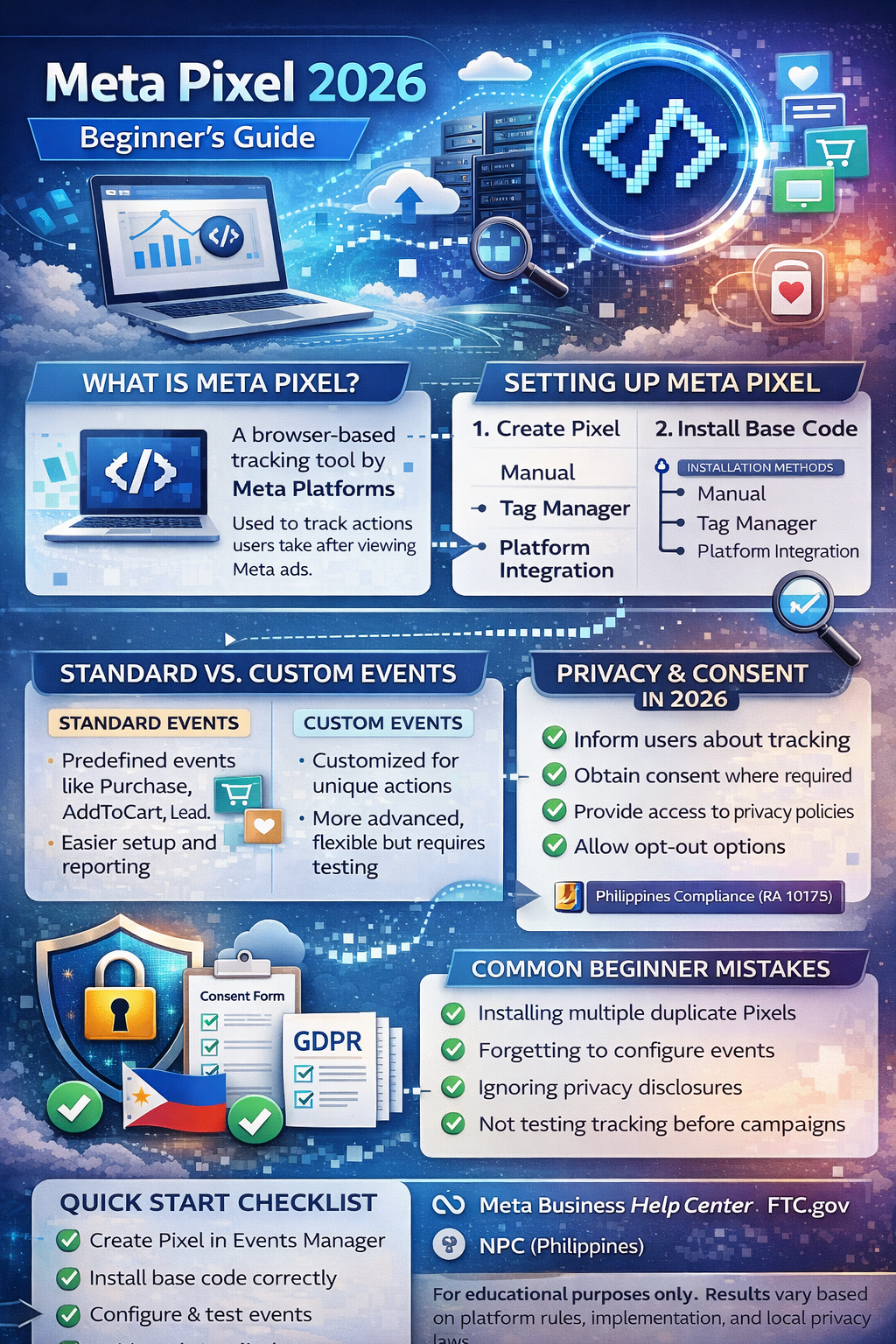
Structured overview of Meta Pixel components and digital measurement framework.
How to Install Meta Pixel (Beginner Steps)
The general setup process often includes:
- Creating a Pixel inside Meta Events Manager
- Copying the base code
- Installing it via:
- Manual website header insertion
- Tag management systems
- E-commerce platform integrations
- Verifying installation using Meta’s testing tools
Some website builders offer built-in integration options. Always review platform documentation before deployment.
Understanding Standard Events
Standard events are predefined actions recognized by Meta’s system. Examples commonly include:
-
PageView
-
ViewContent
-
AddToCart
-
InitiateCheckout
-
Purchase
-
Lead
-
CompleteRegistration
Using standardized naming improves reporting consistency and campaign optimization. However, outcomes depend on accurate implementation and audience relevance.
Custom Events vs Standard Events
Standard Events
Custom Events
-
Used for unique website interactions
-
Require manual configuration
-
Offer flexibility but may require more testing
Choosing between them depends on business goals and technical capability.
Privacy & Consent Considerations in 2026
Data transparency is increasingly important across many jurisdictions. In many regions, websites using tracking tools must:
-
Inform users about tracking technologies
-
Obtain consent where required
-
Provide access to privacy policies
-
Allow opt-out or preference management
Frameworks such as GDPR-style and CCPA-style regulations emphasize user rights and data minimization. Businesses operating in the Philippines should also consider the Data Privacy Act (RA 10173).
It is generally recommended to integrate Meta Pixel with a consent management system to align with platform and regional expectations.
Common Beginner Mistakes
- Installing multiple duplicate Pixels
- Forgetting to configure events properly
- Not testing events before launching ads
- Ignoring privacy disclosures
- Relying solely on pixel data without cross-checking analytics
Careful setup and regular audits can help improve reporting accuracy.
Practical Implementation Checklist
✔ Create Pixel in Events Manager
✔ Install base code correctly
✔ Configure standard events
✔ Test using Meta diagnostics tools
✔ Connect to ad account
✔ Review privacy policy disclosures
✔ Implement consent management (if required)
✔ Monitor event matching quality
FAQ
1. Is Meta Pixel still relevant in 2026?
Meta Pixel remains commonly used for ad performance measurement, although many advertisers supplement it with server-side solutions to adapt to evolving privacy environments.
2. Does Meta Pixel track users without consent?
Consent requirements depend on local regulations. In many regions, websites are expected to disclose tracking technologies and obtain user permission where legally required.
3. Can beginners install Meta Pixel without coding?
Many website platforms provide integration tools that reduce the need for manual coding, though technical validation is still recommended.
Trusted Sources / Standards
-
Meta Business Help Center
-
Meta Events Manager
-
Google Search Central
-
Federal Trade Commission (FTC) consumer advertising guidance
-
National Privacy Commission (Philippines)
Disclaimer
This content is provided for general educational purposes only. Digital marketing results vary depending on market conditions, platform rules, audience behavior, technical implementation, and execution.
Summary
Meta Pixel is a website tracking tool used to measure ad-related actions such as purchases and sign-ups. In 2026, proper installation, event configuration, and privacy compliance are essential. Businesses should implement transparent consent practices and follow platform documentation to ensure accurate measurement and responsible data handling.

by iamrolanddiaz | Feb 20, 2026 | Principeng Hari
A neutral overview of certification categories and examples that align with evolving workforce needs.
This article provides an informational overview of professional certifications that are widely discussed in workforce development research and industry competency frameworks. It highlights certification areas associated with skill development, emerging labor market relevance, and internationally recognized standardization bodies. Content is presented without guarantees of employment or income outcomes.
Information Technology and Cybersecurity
Examples
-
Cloud certifications from major cloud providers (e.g., foundational and associate levels)
-
Cybersecurity fundamentals and specialized pathways
-
IT service management frameworks
Context:
Cloud computing and cybersecurity skills continue to be part of global digital infrastructure trends noted in workforce studies. Industry certification programs in these domains often reflect vendor technologies or widely referenced frameworks. Certifications in this category typically aim to demonstrate understanding of specific technical domains and standardized practices.
Data and Analytics
Examples
-
Data analysis and visualization certifications
-
Data management and governance credentials
-
Foundations of machine learning and AI literacy programs
Context:
Professionals in fields that interact with large data sets may pursue structured credentialing to align with standardized knowledge bases. These programs are often framed around core competencies rather than employment guarantees.
Project and Business Management
Examples
-
Framework-based project management certifications
-
Business analysis credentials
-
Agile and iterative methodologies
Context:
Standardized project and business management frameworks are referenced in organizational productivity and process optimization guidelines. Many certifications in this space align with widely adopted frameworks and aim to signal structured understanding of methodologies.
Digital Marketing and E-Commerce
Examples
-
Search marketing and digital strategy principles
-
Analytics tracking and measurement credentials
-
E-commerce operations foundations
Context:
Digital strategy and analytics are core components of many organizational outreach and commerce activities. Credentialing programs exist to support structured learning in these areas and may align with industry-accepted knowledge domains.
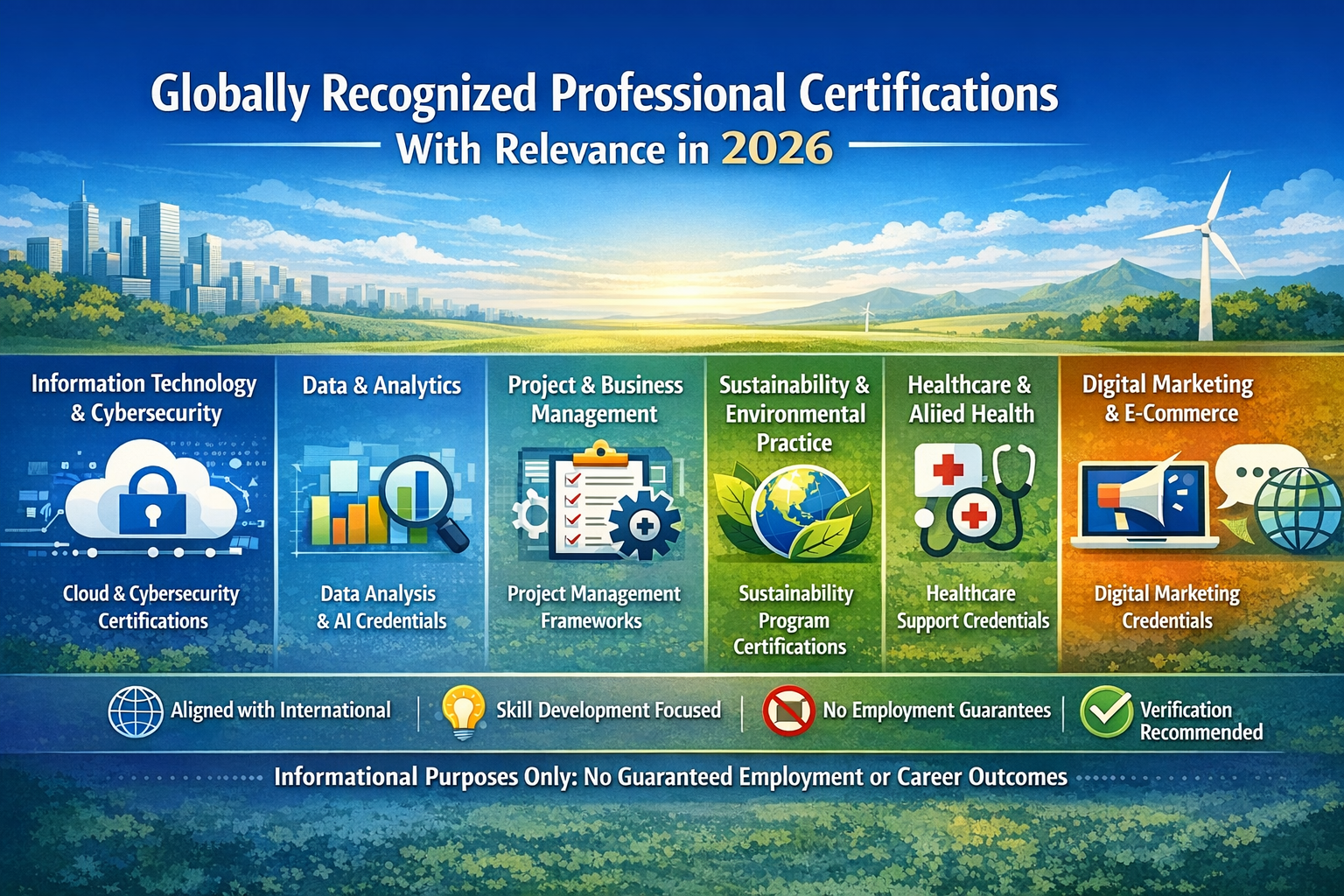
Infographic outlining widely recognized certification categories across industries in 2026.
Healthcare and Allied Health Support
Examples
-
Foundational credentials in health informatics
-
Patient care support certificates aligned with regional standards
-
Public health and health systems operations programs
Context:
Healthcare credentialing systems vary by jurisdiction and often include regulated licensing alongside optional certifications. Internationally referenced programs in health informatics or systems operations may support knowledge development in non-clinical roles.
Sustainability and Environmental Practice
Examples
-
Sustainability fundamentals and climate-aligned program certificates
-
Environmental management system frameworks
-
Energy and resource efficiency program credentials
Context:
Global sustainability frameworks, such as those referenced in UN and OECD skills discussions, underscore the integration of environmental considerations into organizational operations. Credentialing programs may reflect recognized standards for environmental and resource stewardship.
Language and Communication
Examples
Context:
Language proficiency and communication are foundational skills across sectors. Some assessments are independently administered with formally recognized scales tied to international standards.
FAQ
What is a professional certification?
A professional certification is a credential indicating that an individual has completed a set of learning objectives or assessments aligned with a defined body of knowledge.
How is a certification different from a license?
A license is typically a mandatory regulatory authorization to practice in certain professions, whereas a certification is often voluntary and related to demonstrating competency in a subject area.
Do certifications guarantee job offers?
No. Certifications represent learning and assessment outcomes; they do not, by themselves, guarantee employment, income, immigration status, or career advancement.
Trusted Sources
-
International Labour Organization (ILO) workforce development analyses
-
UNESCO global education standards and competence frameworks
-
OECD skills and labor market studies
-
National or regional professional standards authorities (where jurisdictionally relevant)
Disclaimer
This article is for general informational and educational purposes only. It does not constitute professional career, legal, immigration, or financial advice. References to certifications, training areas, or professional development pathways do not imply endorsement or guarantee of employment, income, or career outcomes. Readers are encouraged to verify information through official regulatory bodies and accreditation authorities and exercise independent judgment when making educational or professional decisions.
by iamrolanddiaz | Feb 20, 2026 | Principeng Hari
Introduction
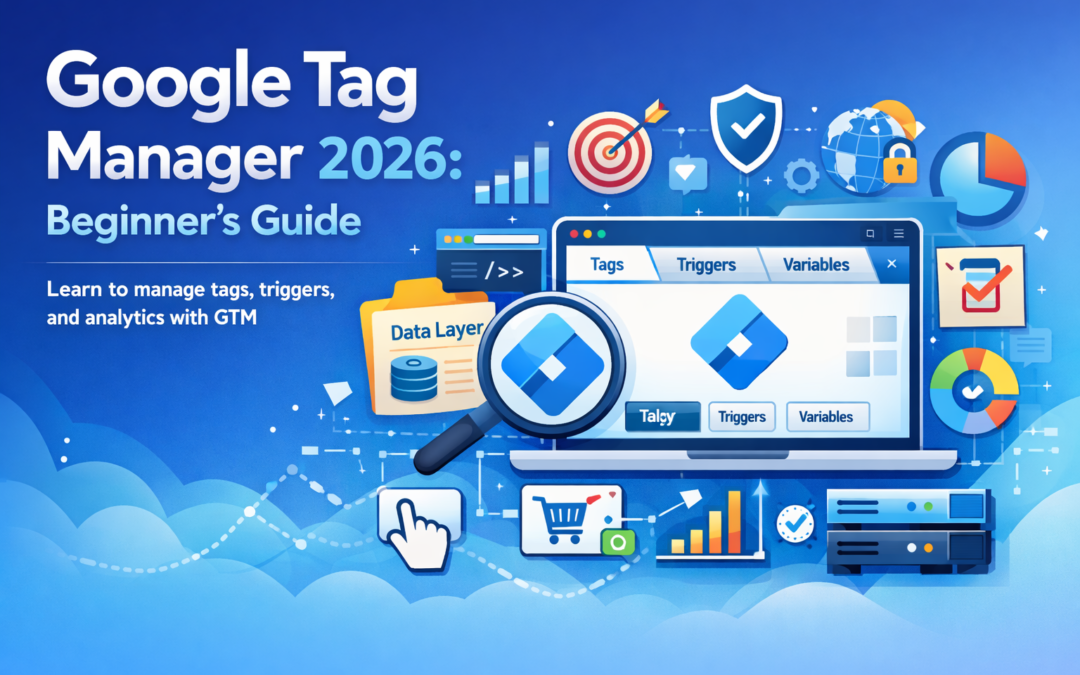
Google Tag Manager (GTM) is commonly used in digital marketing to manage tracking codes without directly editing website source files. Many businesses use tag management systems to streamline analytics deployment, improve workflow efficiency, and reduce reliance on repeated developer updates. Implementation approaches and results may vary depending on website structure, platform rules, and measurement strategy.
Developed by Google, Google Tag Manager continues evolving alongside privacy updates, browser restrictions, and platform measurement standards in 2026. Beginners often use GTM to organize analytics tags, marketing pixels, and event tracking in a structured and scalable way.
What Is Google Tag Manager?
Google Tag Manager is a tag management system (TMS) that allows users to deploy and manage tracking scripts (called tags) through a centralized interface. Instead of adding multiple code snippets manually across pages, GTM enables structured tag deployment using triggers and variables.
In many implementations, GTM acts as a bridge between websites and measurement tools, helping marketers organize:
Actual measurement accuracy depends on correct configuration and ongoing validation.
Why Google Tag Manager Matters in 2026
Modern digital marketing increasingly relies on event-based tracking and privacy-aware data collection. Changes in browser policies and platform rules have encouraged marketers to use more structured measurement frameworks.
Common reasons GTM is used include:
-
Centralized tracking management
-
Reduced need for repeated code changes
-
Easier testing environments
-
Better alignment with event-driven analytics models
Requirements and best practices may differ across regions due to data privacy regulations and consent requirements.
Core Components of Google Tag Manager
Understanding the three core building blocks helps beginners implement GTM more effectively.
1. Tags
Tags are snippets of code used to send data to analytics or advertising platforms.
Examples may include:
Performance outcomes depend on correct trigger conditions and validation.
2. Triggers
Triggers define when a tag should fire.
Common trigger examples include:
-
Page views
-
Button clicks
-
Form submissions
-
Scroll depth tracking
Trigger accuracy varies based on website structure and user interaction patterns.
3. Variables
Variables store dynamic values used by tags and triggers.
Examples include:
-
Page URLs
-
Click text
-
Form IDs
-
Custom data layer values
Variables help make measurement setups more flexible and scalable.
Basic Google Tag Manager Setup (Beginner Workflow)
While implementation details vary by platform, a simplified workflow often includes:
-
Create a GTM account and container
-
Install the container snippet on your website
-
Configure a basic analytics tag
-
Set a page-view trigger
-
Use preview mode for validation
-
Publish the container after testing
Testing is commonly recommended to reduce tracking inconsistencies.
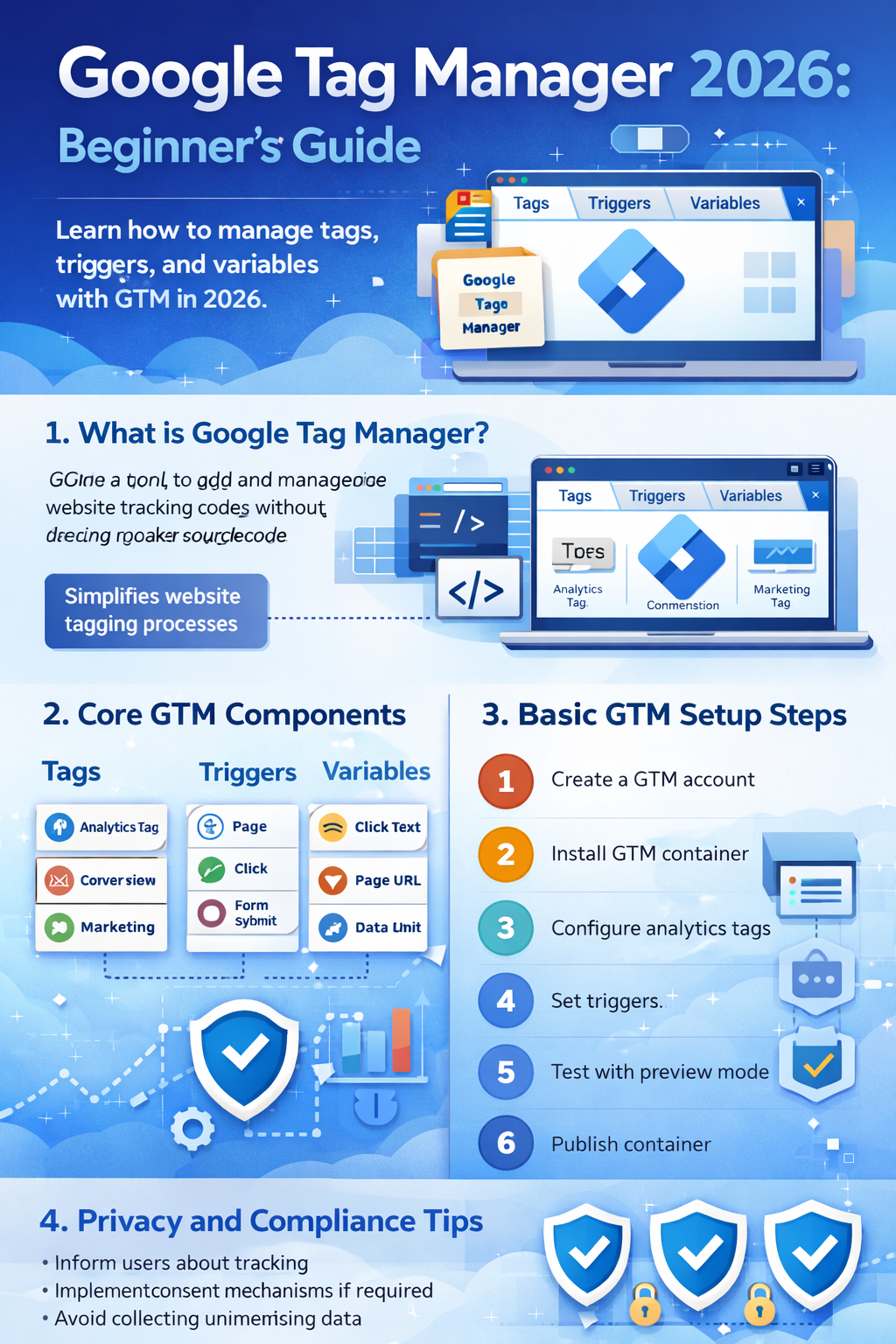
Overview infographic of Google Tag Manager 2026 features and setup workflow.
Understanding the Data Layer (Beginner Concept)
The data layer is a structured method used to pass information from a website into GTM. It helps organize event data more reliably compared to relying only on page elements.
Examples of data layer usage may include:
Implementation approaches often depend on website frameworks and developer collaboration.
Privacy and Compliance Considerations
Tracking implementation should follow transparent data practices and applicable privacy standards.
In many regions, commonly recommended practices include:
-
Informing users about tracking technologies
-
Implementing consent mechanisms where required
-
Avoiding unnecessary data collection
-
Reviewing platform policies regularly
Privacy requirements differ by jurisdiction and platform.
Platforms Commonly Integrated with Google Tag Manager
Google Tag Manager is often used alongside analytics and advertising ecosystems, depending on campaign strategy.
Common integrations may include:
Examples of platforms businesses frequently connect include:
-
Meta Platforms advertising tools
-
TikTok advertising measurement
-
YouTube engagement tracking
Implementation methods vary depending on platform requirements.
Beginner Mistakes to Avoid
Some common setup issues include:
-
Publishing containers without testing
-
Tracking duplicate events
-
Missing trigger conditions
-
Not documenting tag configurations
-
Ignoring consent requirements
Regular audits are often recommended to maintain tracking accuracy.
Practical Beginner Checklist
Google Tag Manager Starter Checklist
-
Install GTM container correctly
-
Use preview mode before publishing
-
Document tags and triggers
-
Validate event tracking
-
Review privacy and consent setup
-
Monitor analytics after deployment
Measurement reliability depends on ongoing testing and updates.
FAQ
Is Google Tag Manager difficult for beginners?
Google Tag Manager has a learning curve due to its event-based structure. With structured tutorials and practice, many beginners gradually become comfortable with basic configurations.
Does Google Tag Manager replace analytics tools?
Google Tag Manager does not replace analytics platforms. It is commonly used to deploy and manage tracking tags that send data to analytics systems.
Do I need coding skills to use Google Tag Manager?
Basic setups often require minimal coding, but more advanced implementations may involve developer collaboration depending on website complexity.
Trusted Sources & Standards
-
Google Search Central documentation
-
Google Analytics Help Center
-
Meta Business Help Center
-
TikTok Business Help Center
-
Global consumer protection and privacy guidance (general educational reference)
Summary
Google Tag Manager is a tag management system widely used to organize website tracking without editing source code repeatedly. Beginners typically learn how tags, triggers, and variables work together to manage analytics and marketing measurement. Implementation practices vary depending on platform rules, privacy requirements, and website structure, and results depend on correct configuration and ongoing testing.
Disclaimer
This content is provided for general educational purposes only. Digital marketing results vary depending on market conditions, platform rules, audience behavior, and execution.
by iamrolanddiaz | Feb 20, 2026 | Principeng Hari
What Is Google Analytics 4?
Google Analytics 4 (GA4) is the current generation of analytics offered by Google. It uses an event-based tracking model to measure website and app interactions across devices.
Unlike older session-focused models, GA4 tracks user interactions as events. This approach allows businesses to analyze engagement, conversions, and user journeys in a more flexible way. Features and data availability may vary depending on configuration and regional privacy requirements.
Why GA4 Matters in 2026
In 2026, GA4 remains central to digital measurement because:
-
It supports cross-device tracking.
-
It integrates with advertising platforms such as Google Ads.
-
It is designed with privacy-aware data controls.
-
It supports machine-learning-powered insights (where available).
Analytics tools evolve over time, and platform interfaces may change. However, understanding GA4’s structure helps marketers interpret performance data responsibly and improve campaigns based on measurable insights.
How GA4 Works: The Event-Based Model Explained
GA4 tracks every interaction as an event. Examples include:
-
Page views
-
Scroll depth
-
Video plays
-
Form submissions
-
Purchases
Each event can include parameters (additional details), such as product ID, page title, or traffic source.
This model provides flexibility, but results depend on correct configuration. Proper implementation typically involves structured tagging and validation to ensure accurate reporting.
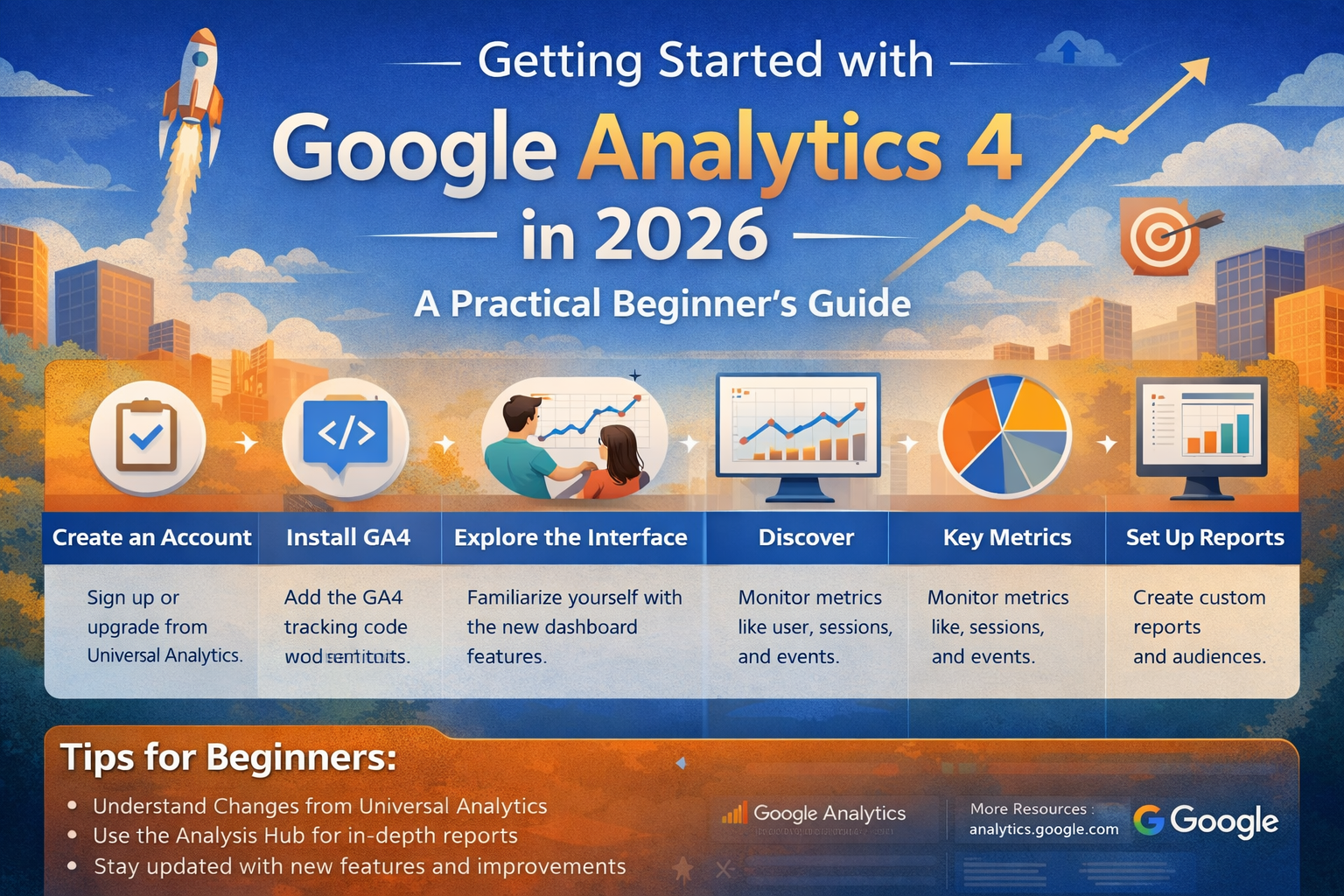
Infographic presenting structural elements commonly associated with analytics platforms.
Step-by-Step: Setting Up GA4 in 2026
1. Create a GA4 Property
Log into your Google Analytics account and create a new GA4 property.
2. Add a Data Stream
Choose your platform:
3. Install Tracking Code
You can implement tracking using:
Implementation steps may vary depending on your website platform and technical environment.
4. Configure Enhanced Measurement
GA4 allows automatic tracking for certain events such as scrolls and outbound clicks. Review settings to ensure they align with your data collection policies.
5. Define Conversions
Mark important events (e.g., purchases, lead submissions) as conversions inside the GA4 interface.
Always ensure tracking complies with applicable privacy regulations and user consent requirements in your region.
Understanding GA4 Reports
GA4 includes several core reporting sections:
-
Reports Snapshot: Overview of key metrics
-
Realtime: Current user activity
-
Acquisition: Traffic sources
-
Engagement: User interactions
-
Monetization: Revenue-related insights (if applicable)
-
Retention: Returning user behavior
Interpret metrics cautiously. Analytics data provides directional insight rather than guaranteed outcomes.
Configuring Events and Conversions
Event strategy should align with business goals. Common categories include:
-
Micro-conversions (newsletter sign-ups)
-
Macro-conversions (purchases or bookings)
-
Engagement signals (video views, downloads)
Avoid tracking unnecessary data. Collect only information that supports business analysis and respects user privacy standards.
Privacy and Data Compliance Considerations
GA4 includes configurable data retention settings and consent-related adjustments. In many regions, businesses are expected to:
-
Provide transparent privacy notices
-
Obtain user consent for certain cookies or tracking
-
Allow users to manage data preferences
Guidance may differ by jurisdiction, including frameworks inspired by GDPR-style or CCPA-style principles. Always review local regulatory requirements before deploying analytics tracking.
Common Beginner Mistakes
-
Tracking everything without a measurement plan
-
Failing to test events before launch
-
Ignoring consent management
-
Misinterpreting metrics without context
-
Not connecting GA4 to advertising platforms (if relevant)
Structured implementation often improves reporting clarity.
Practical GA4 Setup Checklist
✅ Create GA4 property
✅ Install tracking correctly
✅ Enable enhanced measurement (if appropriate)
✅ Define clear conversion events
✅ Test event firing
✅ Review privacy disclosures
✅ Document your measurement plan
FAQ
1. Is GA4 difficult to learn for beginners?
GA4 has a learning curve due to its event-based structure. With structured setup and practice, many users find it manageable over time.
2. Does GA4 automatically track conversions?
GA4 tracks events, but you must manually mark specific events as conversions.
3. Is GA4 compliant with privacy laws?
GA4 includes configurable privacy controls, but compliance depends on how it is implemented and how consent is managed in your region.
Trusted Sources / Standards
-
Google Search Central
-
Google Analytics Help Center
-
Federal Trade Commission consumer guidance
-
Regional data protection authorities (varies by jurisdiction)
Disclaimer
This content is provided for general educational purposes only. Digital marketing results vary depending on market conditions, platform rules, audience behavior, and execution.
Summary
Google Analytics 4 (GA4) is an event-based analytics platform designed to measure website and app interactions. In 2026, it supports cross-device tracking, customizable events, and privacy-aware controls. Proper setup involves creating a property, installing tracking, defining conversions, and aligning data collection with regional privacy requirements. Results depend on accurate configuration and responsible implementation.