by iamrolanddiaz | Feb 19, 2026 | Principeng Hari
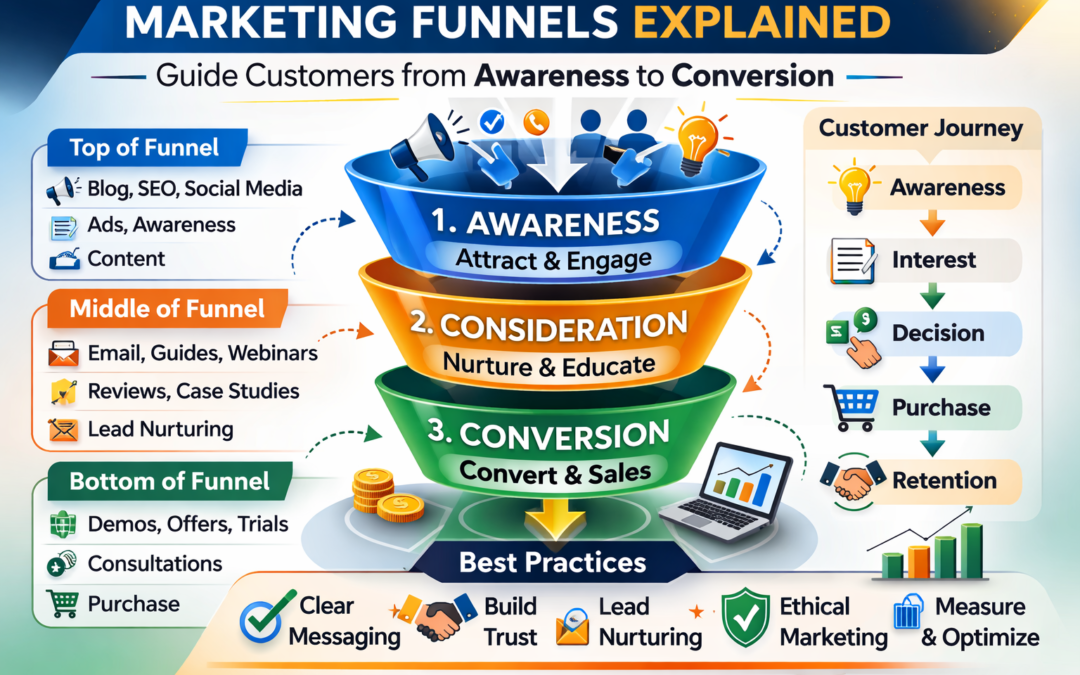
A marketing funnel is a framework used to illustrate the stages a potential customer passes through before making a purchase or completing a desired action. Funnels help marketers understand audience behavior, tailor messaging, and provide value at each stage of the customer journey.
The Stages of a Marketing Funnel
Top of Funnel (Awareness)
At this stage, the goal is to make your audience aware of your brand or product. Common strategies include content marketing, social media engagement, and search engine optimization. This stage focuses on education and information rather than direct selling.
Middle of Funnel (Consideration)
Potential customers are now evaluating options. Marketers can provide detailed guides, case studies, email newsletters, and webinars to help prospects understand solutions available. Nurturing trust and credibility is key.
Bottom of Funnel (Conversion)
This stage focuses on converting interested leads into customers. Tactics may include product demos, free trials, consultations, or comparison tools. Ethical funnel design ensures transparency, avoids pressure tactics, and clearly communicates value and costs.
How Marketing Funnels Help Businesses
-
Organize marketing activities according to the buyer’s journey.
-
Identify content and messaging gaps.
-
Measure engagement and optimize campaigns responsibly.
-
Improve lead nurturing without resorting to manipulative tactics.
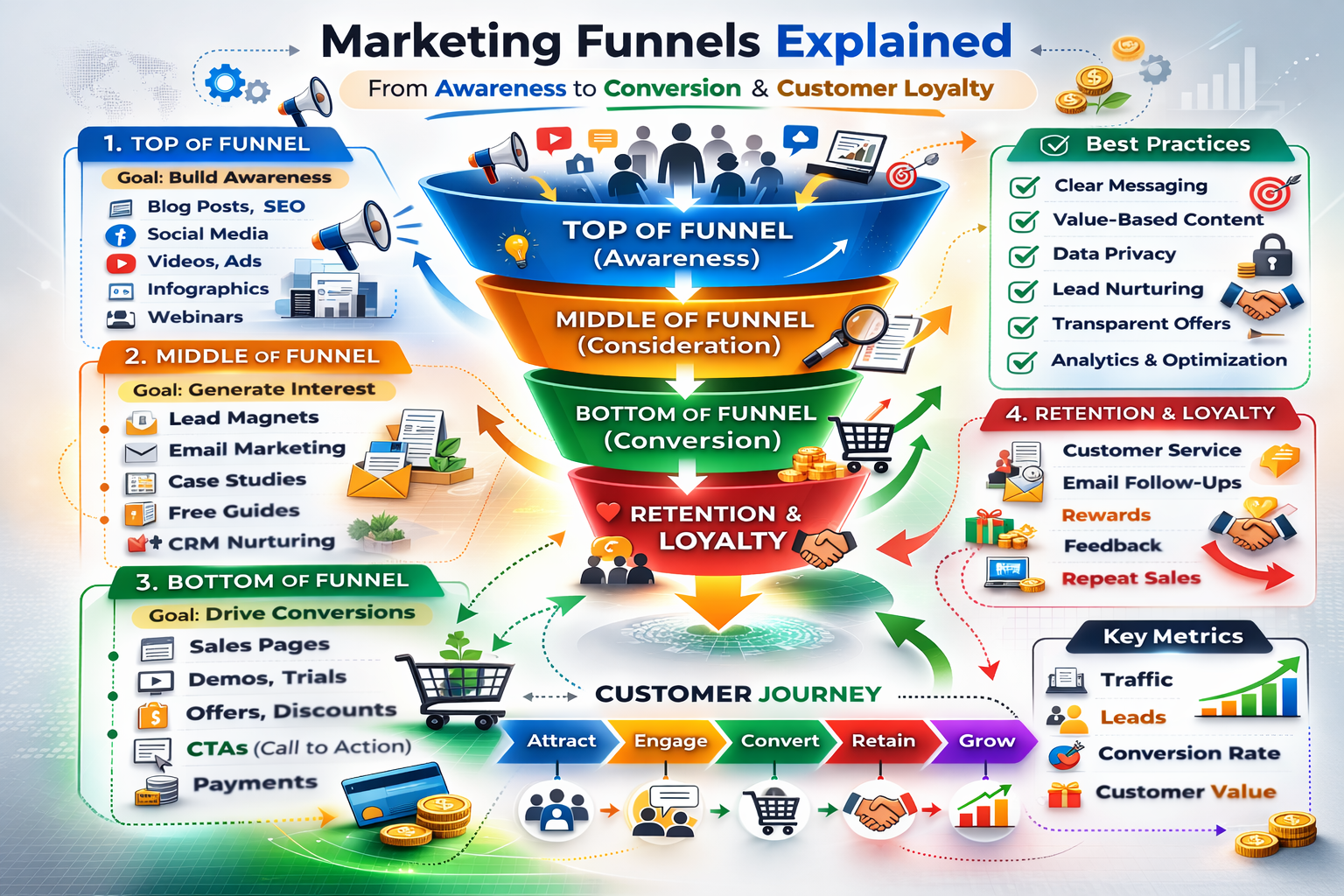
Infographic depicting stages of marketing funnels and key engagement points globally.
Best Practices for Ethical Funnel Management
-
Provide clear information and disclosures.
-
Avoid misleading claims about outcomes or performance.
-
Respect data privacy and consent regulations.
-
Align messaging with audience needs and expectations.
Common Funnel Mistakes to Avoid
-
Using clickbait or fake urgency.
-
Ignoring customer feedback and engagement data.
-
Skipping nurture stages and pushing for early conversions.
-
Collecting personal data without proper disclosure.
Checklist: Building a Simple Marketing Funnel
FAQ
Q1: Can a funnel work for small businesses?
A1: Yes, marketing funnels can be adapted to businesses of any size, depending on resources and audience needs.
Q2: Do all leads go through the same funnel?
A2: No, funnels may vary depending on product, audience segment, and customer behavior.
Q3: How do I measure funnel success?
A3: Metrics can include engagement rates, lead quality, conversion rates, and customer retention while respecting privacy regulations.
Trusted Sources / Standards
Disclaimer
“This content is provided for general educational purposes only. Digital marketing results vary depending on market conditions, platform rules, audience behavior, and execution.”
Summary
Marketing funnels outline the journey potential customers take from awareness to purchase. By mapping top, middle, and bottom funnel stages, businesses can deliver relevant content, nurture leads, and guide conversions responsibly. Ethical funnel management ensures transparency, data privacy, and audience trust while helping marketers optimize campaigns in many regions without using manipulative tactics.
by iamrolanddiaz | Feb 16, 2026 | Principeng Hari
Content Outline
- Introduction to Digital Marketing
- Key Channels of Digital Marketing
- Search Engine Optimization (SEO)
- Social Media Marketing
- Email Marketing
- Paid Advertising (PPC)
- Content Marketing
- Benefits of Digital Marketing
- Common Digital Marketing Strategies
- Measuring Digital Marketing Success
- Practical Checklist for Getting Started
Introduction to Digital Marketing
Digital marketing refers to the use of online channels, tools, and platforms to connect with audiences, promote products or services, and build brand awareness. Unlike traditional marketing, which often relies on print, broadcast, or outdoor media, digital marketing leverages the internet and digital technologies. Businesses of all sizes commonly use digital marketing to reach targeted audiences in measurable ways.
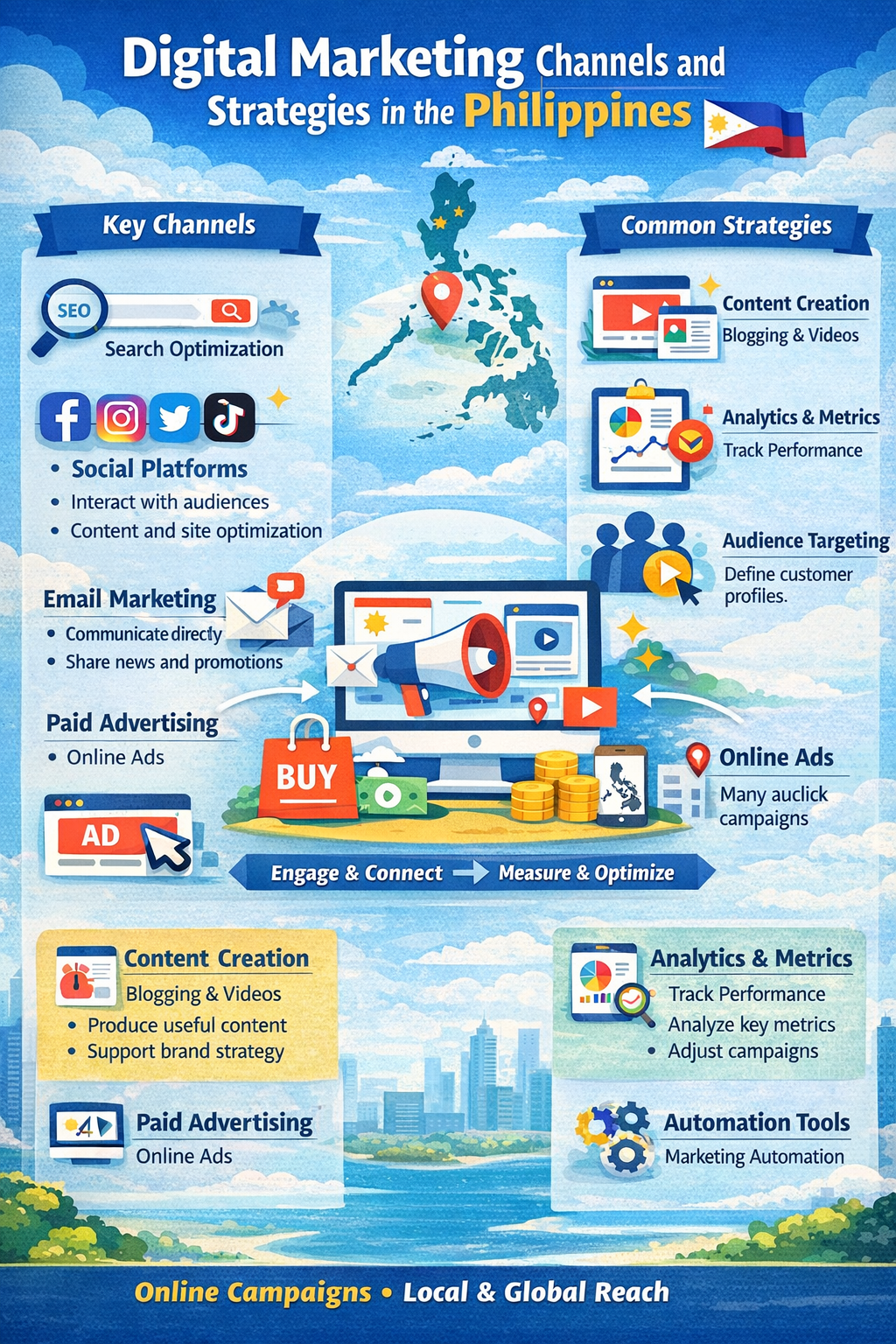
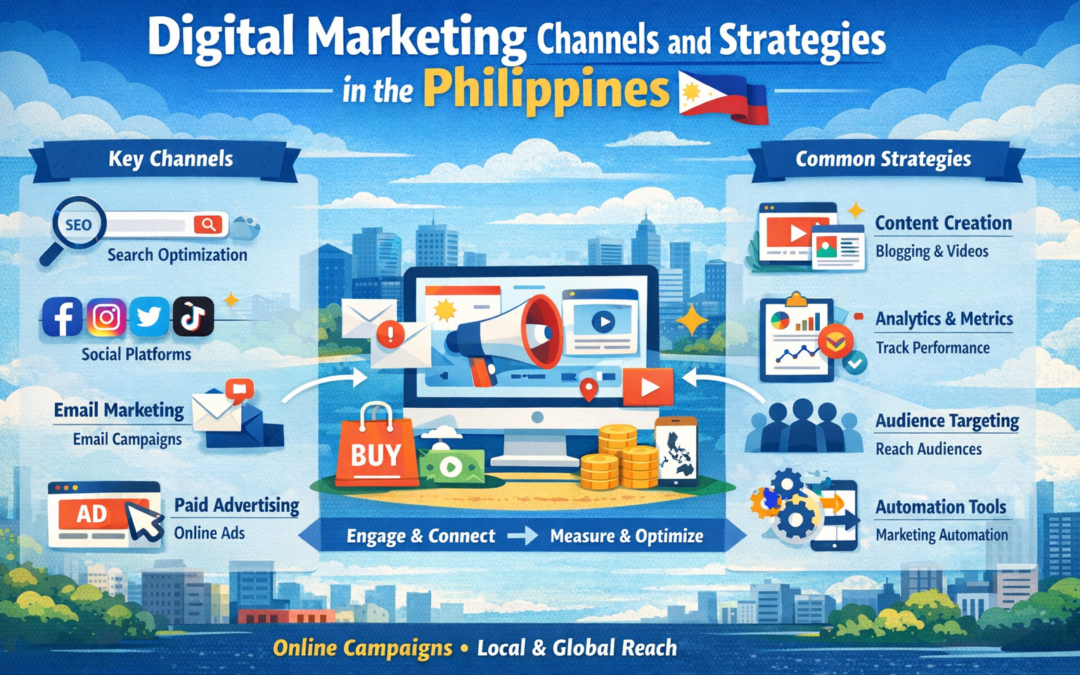
Illustrated infographic showing common digital marketing channels and workflows
Key Channels of Digital Marketing
Search Engine Optimization (SEO)
SEO involves optimizing a website or online content so that it can be discovered more easily via search engines. Techniques include keyword research, content creation, technical optimization, and link-building strategies. Results depend on consistent effort and platform updates.
Social Media Marketing
This channel uses platforms like Facebook, Instagram, TikTok, LinkedIn, and Twitter to engage audiences, share content, and promote products or services. Social media campaigns vary by region and platform rules, and performance depends on audience targeting and content quality.
Email Marketing
Email marketing is the process of sending targeted messages to subscribers. It is often used for newsletters, promotional campaigns, and customer engagement. Compliance with privacy laws and consent regulations is critical when using email marketing.
Paid Advertising (PPC)
Pay-per-click advertising allows businesses to display ads on search engines, social media, or other digital platforms. Advertisers only pay when a user clicks an ad. Campaigns must follow platform policies and local advertising regulations.
Content Marketing
Content marketing focuses on creating educational, entertaining, or informative content to attract and retain audiences. Blogs, videos, infographics, and podcasts are commonly used to provide value and support other marketing channels.
Benefits of Digital Marketing
Digital marketing offers measurable, cost-effective ways to reach specific audiences. It allows businesses to track engagement, adjust campaigns in real time, and scale marketing efforts globally or locally depending on goals.
Common Digital Marketing Strategies
-
Creating high-quality, search-optimized content
-
Engaging audiences on social media platforms
-
Running paid campaigns with clear targeting
-
Using email sequences to nurture leads
-
Analyzing data to inform strategy and improve performance
Measuring Digital Marketing Success
Success is typically measured using analytics tools to monitor key metrics like website traffic, conversion rates, social engagement, and return on ad spend. Metrics vary depending on objectives and platforms used.
Practical Checklist for Getting Started
-
Define target audience and marketing objectives
-
Choose appropriate digital channels for your business
-
Develop a content calendar and campaign plan
-
Track metrics using analytics tools
-
Adjust strategies based on performance insights
FAQ
1. Is digital marketing only for large companies?
No. Many small businesses use digital marketing to reach local and global audiences cost-effectively.
2. How long does it take to see results in digital marketing?
Results vary by channel, strategy, and execution. SEO often takes several months, while paid ads may show more immediate engagement.
3. Do I need technical skills for digital marketing?
Basic knowledge of platforms, analytics, and content creation is helpful, but many tools simplify management for beginners.
Overview Summary
Digital marketing is the practice of promoting products or services using online channels, including SEO, social media, email, and paid ads. It focuses on audience engagement, measurable results, and content creation. Effectiveness depends on strategy, platform policies, and audience context.
Trusted Sources / Standards
-
Google Search Central: SEO and digital marketing guidelines
-
Meta Business Help Center: Social media marketing best practices
-
TikTok Business Help Center: Platform-safe advertising
-
FTC Consumer Guidance: Advertising transparency
-
Philippine Consumer Act (RA 7394) and Data Privacy Act (RA 10173)
Disclaimer
“This content is provided for general educational purposes only. Digital marketing results vary depending on market conditions, platform rules, audience behavior, and execution.
by iamrolanddiaz | Feb 16, 2026 | Principeng Hari
Content Outline
- Why Understanding the Difference Matters
- What is Marketing?
- What is Growth?
- What is Brand?
- Comparing Marketing, Growth, and Brand
- How Businesses Use Each Strategically
- Key Takeaways
- Practical Checklist
- FAQ
Why Understanding the Difference Matters
In today’s competitive business landscape, terms like marketing, growth, and brand are often used interchangeably. However, each serves a unique role in shaping a company’s strategy. Understanding these differences helps leaders make informed decisions, allocate resources effectively, and communicate with stakeholders clearly.
This article provides an educational overview that is globally compliant, ethically framed, and safe for digital platforms.
What is Marketing?
Marketing is the practice of communicating a business’s products or services to an audience to create awareness, interest, and engagement. It encompasses activities such as:
-
Content creation (blogs, social media posts, videos)
-
Advertising campaigns (paid and organic)
-
Search engine optimization (SEO)
-
Customer research and insights
Marketing focuses on strategic communication and value delivery rather than instant results. It is foundational for attracting attention and maintaining relevance in a crowded market.
What is Growth?
Growth refers to the strategies and tactics aimed at scaling a business, increasing customer acquisition, revenue, or market share. Growth strategies often combine marketing efforts with product improvements, sales optimization, and user experience enhancements.
Key elements include:
-
Conversion rate optimization
-
Retention programs and loyalty initiatives
-
Experimentation and analytics-based decision-making
-
Cross-channel campaigns aligned with performance metrics
While marketing creates awareness, growth emphasizes measurable expansion and often relies on iterative testing to find what works.
What is Brand?
Brand represents the perception, reputation, and identity of a company or product in the minds of customers. Strong brands convey trust, credibility, and consistency. Branding includes:
-
Visual identity (logos, color palette, typography)
-
Messaging tone and voice
-
Mission, values, and storytelling
-
Customer experience and service standards
Branding is less about immediate conversions and more about long-term relationships and loyalty. It provides a framework that marketing and growth strategies operate within.
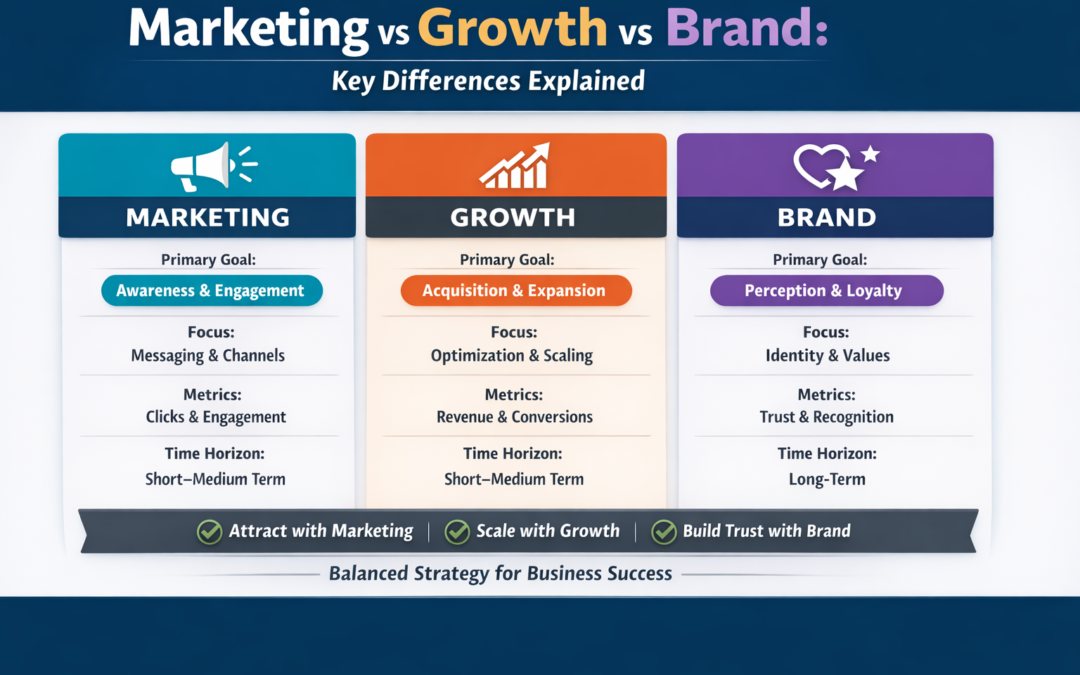
Comparing Marketing, Growth, and Brand
| Aspect |
Marketing |
Growth |
Brand |
| Primary Goal |
Awareness & engagement |
Acquisition & expansion |
Perception & loyalty |
| Time Horizon |
Short–medium |
Short–medium |
Long-term |
| Metrics |
Clicks, impressions, engagement |
Conversion rates, revenue growth |
Brand recall, NPS, trust |
| Focus |
Messaging & channels |
Experiments & optimization |
Identity & values |
Understanding these distinctions allows businesses to align marketing campaigns, growth initiatives, and brand development for maximum strategic impact.
How Businesses Use Each Strategically
- Marketing campaigns are often used to attract attention and educate potential customers.
- Growth strategies focus on testing channels, optimizing funnels, and scaling successful tactics.
- Brand initiatives ensure consistent messaging, build trust, and support long-term retention.
A balanced approach integrates all three, ensuring that short-term growth does not compromise brand integrity, and marketing activities are guided by a cohesive identity.
Key Takeaways
-
Marketing = Communication & awareness
-
Growth = Expansion & measurable results
-
Brand = Perception & long-term trust
-
All three should work together in a compliant, ethical, and strategic manner
Practical Checklist
-
Define your marketing objectives clearly
-
Identify growth metrics for experimentation
-
Audit brand messaging and visual identity
-
Align marketing campaigns with brand values
-
Track performance ethically and transparently
FAQ
Q1: Can growth replace marketing?
A1: No, growth often relies on marketing to generate awareness and initial engagement. They are complementary strategies.
Q2: How does brand impact conversions?
A2: Strong branding builds trust, which indirectly supports higher engagement and conversion rates over time.
Q3: Should small businesses prioritize brand or growth?
A3: Both are important. Early-stage businesses may focus on marketing and growth to establish presence while maintaining brand consistency.
Trusted Sources / Standards
-
Google Search Central (SEO & AEO Guidelines)
-
Meta Business Help Center (Advertising & Brand Policies)
-
TikTok Business Documentation (Platform Marketing Compliance)
-
FTC Consumer Guidance (Truth in Advertising)
-
Government Consumer Protection Agencies (e.g., Philippines RA 7394, RA 8792, RA 10173)
Disclaimer
“This content is provided for general educational purposes only. Digital marketing results vary depending on market conditions, platform rules, audience behavior, and execution.”
Summary
Marketing, growth, and brand serve distinct roles in business strategy. Marketing builds awareness, growth drives measurable expansion, and brand establishes long-term trust. Together, they guide decisions, optimize campaigns, and strengthen market presence. This overview provides an educational framework that is ethical, compliant, and safe for global digital marketing applications.
by iamrolanddiaz | Sep 12, 2025 | GEO, Smart Home
GEO Best Practices for 2026 – Principeng Hari
Introduction & Scope
Geo-targeting is increasingly critical in 2026, as search engines refine algorithms to prioritize location-specific relevance. Businesses and content creators must adapt to ensure they reach their intended audience in the right geography. This guide explores practical strategies for optimizing GEO signals, enhancing local search visibility, and improving user experience across regions.
By understanding the latest GEO SEO best practices, marketers can:
-
Align content with searcher intent per location
-
Improve SERP rankings in targeted regions
-
Reduce wasted traffic and increase conversion rates
CTA Placeholder: [Explore Local SEO Tools]
Next Funnel Link: Awareness → Consideration
Key Facts Summary
-
Local search accounts for over 55% of mobile searches globally.
-
Search engines now weigh hyper-local relevance more heavily.
-
GEO signals include IP, SERP localization, language, structured data, and business listings.
-
2026 emphasizes user intent + location context in search results.
Proper implementation of GEO best practices increases local engagement and drives measurable conversions.
Check Your Geo SEO Score
Next Funnel Link: Awareness
What Is GEO SEO?
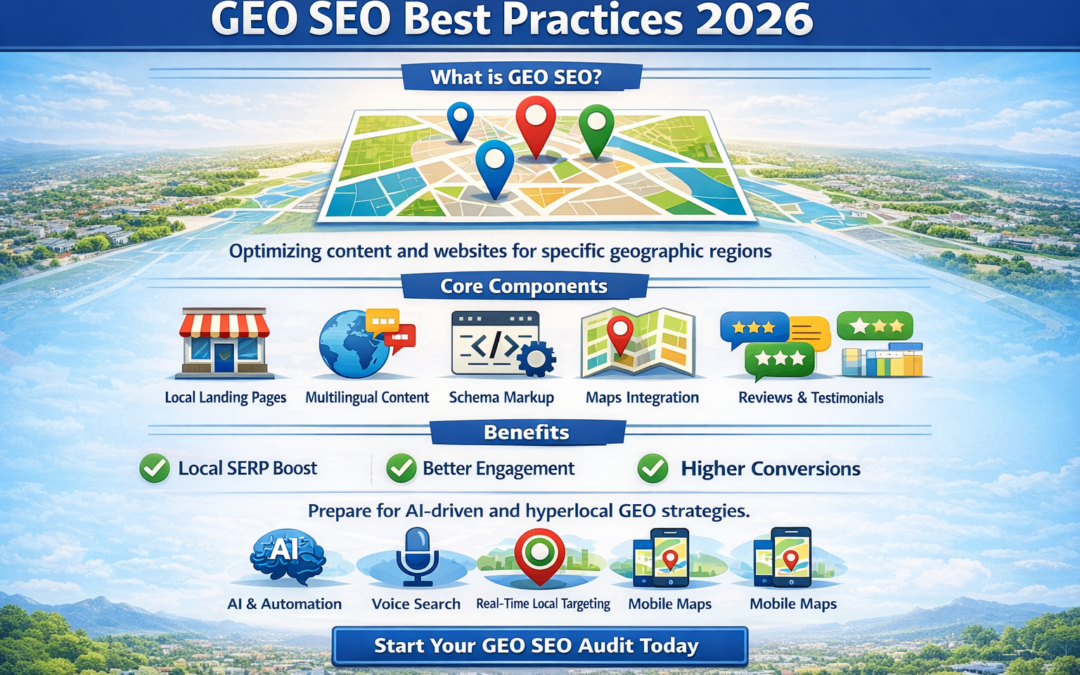
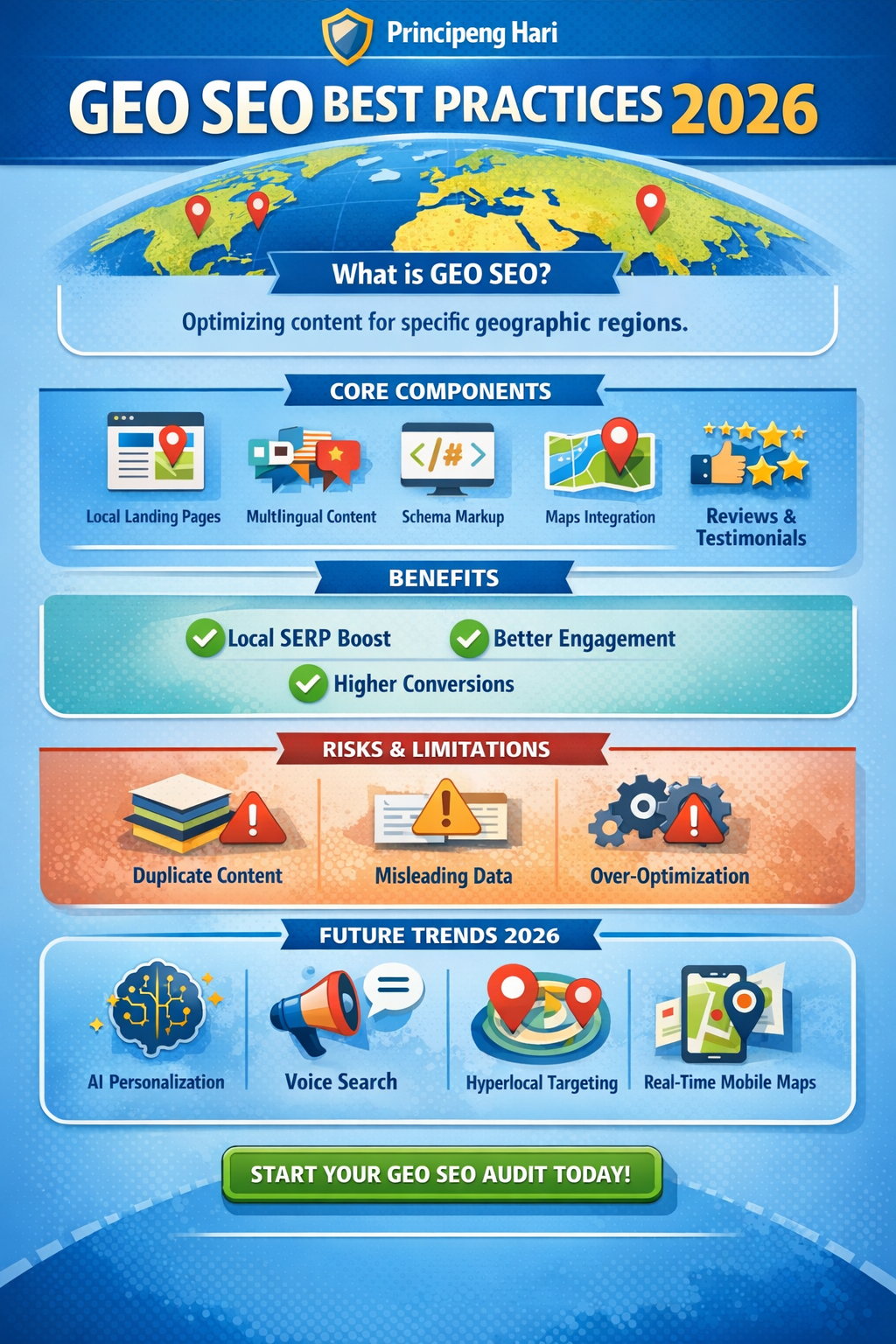
GEO SEO, or geographic search engine optimization, is the process of optimizing content and web assets to perform well for users in specific locations. It ensures that businesses appear in relevant searches for their target regions.
Key components include:
-
Localized content and landing pages
-
Structured data like LocalBusiness schema
-
Google Business Profile optimization
-
Consistent NAP (Name, Address, Phone) across directories
Learn How GEO SEO Works
Next Funnel Link: Awareness → Consideration
Who This Information Applies To
This guide is essential for:
-
Businesses targeting regional markets
-
Digital marketers managing multi-location campaigns
-
E-commerce stores with location-specific shipping
-
SEO professionals aiming to enhance local SERP performance
Even global brands can benefit by segmenting content for high-value regions.
\Evaluate Your Market Locations
Next Funnel Link: Awareness
How GEO Best Practices Work
Effective GEO SEO combines multiple signals to communicate location relevance to search engines:
- On-Page Signals: Location-specific keywords, title tags, headers
- Off-Page Signals: Local backlinks, citations, reviews
- Technical Signals: hreflang tags for multilingual content, geo-targeted sitemaps
- Behavioral Signals: CTR, dwell time, user interactions from specific regions
These strategies ensure your content aligns with both local search intent and global optimization standards.
Audit Your GEO Signals
Next Funnel Link: Consideration → Conversion
Core Components / Types
-
Local Landing Pages: Unique pages per city, region, or country
-
Multilingual Content: Translated and culturally adapted content
-
Schema Markup: LocalBusiness, Organization, and GeoCoordinates structured data
-
Maps Integration: Embedding Google Maps and location widgets
-
Reviews & Testimonials: Region-specific social proof
Download GEO Optimization Checklist
Next Funnel Link: Consideration → Conversion
Benefits, Limitations & Risks
Benefits:
-
Higher local SERP rankings
-
Better user engagement and conversions
-
Improved mobile visibility
Limitations:
Risks:
Assess Your GEO Risks
Next Funnel Link: Consideration
Safety, Compliance & Regulations
Ensure your geo-targeted content complies with local regulations:
-
Privacy laws (e.g., GDPR, CCPA) for collecting location data
-
Accurate representation of addresses and services
-
No misleading claims or false localization
Following guidelines protects your brand and avoids search penalties.
Review Regional Compliance Checklist
Next Funnel Link: Consideration
Common Misunderstandings
-
Misconception: One landing page can serve all locations
Reality: Search engines favor unique pages per region
-
Misconception: GEO SEO is only for local small businesses
Reality: Global enterprises benefit from regional targeting
-
Misconception: Backlinks are optional
Reality: Local citations and reviews impact ranking significantly
Debunk GEO SEO Myths
Next Funnel Link: Awareness → Consideration
Evidence, Standards & Sources
-
Google Search Central: Local SEO guide 2026
-
MOZ: Geo-Targeting Best Practices
-
Ahrefs: Local SERP Analysis Report
-
Search Engine Journal: Multilingual & Multi-Region SEO
Explore Full GEO Resources
Next Funnel Link: Awareness
Future Developments
In 2026 and beyond, GEO SEO is expected to evolve with:
-
AI-driven local search personalization
-
Enhanced map integration in search results
-
Voice search with geo-contextual results
-
Real-time hyperlocal targeting for mobile users
Stay Ahead with GEO Trends
Next Funnel Link: Awareness → Consideration
Frequently Asked Questions
Q1: Do I need separate pages for every city?
A: Yes, for highly competitive regions, unique pages improve ranking.
Q2: Can GEO SEO work for e-commerce?
A: Absolutely, with localized landing pages and shipping info.
Q3: How do I track GEO performance?
A: Use Google Analytics, Search Console location reports, and local SERP tracking tools.
See Full FAQ on GEO SEO
Next Funnel Link: Consideration
Final Considerations & Next Steps
Effective GEO SEO requires strategic planning, consistent updates, and compliance with both local regulations and global SEO standards. Implementing these best practices in 2026 ensures businesses can capture highly relevant traffic and maximize local engagement.
Start Your GEO SEO Audit Today
Next Funnel Link: Conversion